A 200-stall structured-parking expansion at a US suburban office now pencils at roughly $10.4 million in construction alone, before land, soft costs, or a single dollar of operating expense. UCLA’s Institute of Transportation Studies put aboveground structured parking at a median of $52,000 per space across 17 American cities in its February 2026 update, with construction costs rising 50% faster than general inflation since 2012. The same report priced underground parking at $73,000 per space. Meanwhile, Kastle Systems logs office peak-day occupancy at 63% of pre-pandemic norms, with Friday lots running at 30–40%. The CFO objection that parking is amortized capital and shuttles are forever-opex misses the whole right-hand side of the ledger. Below is where the breakeven actually sits, why it has moved, and what a 1,200-employee site should do with the spreadsheet.
Why parking stopped being a one-time cost
Treating a parking structure as a depreciable asset that “gets paid down” was a defensible accounting convention in 1995. It is not a defensible operating assumption in 2026.
Three numbers break the abstraction. First, the construction-cost number itself has moved: WGI’s annual industry survey pegged the national median at $29,900 per space (construction-only) in 2024, up 3.1% over 2023, while UCLA ITS, using a more comprehensive cost basis, reported $52,000 per space aboveground in 2026. The gap between the two is a discount-rate question more than a disagreement; either way, the trajectory is clear. Donald Shoup’s 2012 baseline figures are no longer in the right zip code.
Second, structured parking carries permanent maintenance load. The Victoria Transport Policy Institute calculated annual operating costs at $200 per space for a basic surface lot up to more than $1,000 per space for high-amenity structured facilities, with structured maintenance specifically clustering at $400–$660 per space per year (Litman, VTPI). Across a 1,000-stall garage, that is $400,000–$660,000 a year for cleaning, lighting, repairs, security, snow removal, access control, enforcement, insurance, and labor, every year, forever, regardless of how many employees show up on a Friday.
Third, surface lots are not durable infrastructure. Industry pavement-lifecycle analyses put asphalt life at 25–35 years, with full replacement at $4–10 per square foot. A 200-stall surface lot sized at roughly 350 square feet per stall (with drives) hits a mid-six-figure rebuild within a single 30-year TCO window. The “we already have the lot” defense is a deferred capital cost, not a free input.
Run the 30-year math on a single new 200-stall structured deck (at $52,000/space construction, $500/space/year O&M, and modest land carry) and total cost of ownership clears $13–15 million in real terms before the first ribbon-cutting. That is the comparison number, not the line item on the capital request.
The Tuesday-only campus
Hybrid work did not just shrink demand. It made demand bimodal in a way parking infrastructure cannot match.
Kastle’s 10-city Back to Work Barometer logged a post-pandemic peak-day high of 63.1% in February 2024, with weekly average occupancy at 53%. That headline number hides the operationally important pattern. In Class A+ towers (the high-end buildings Kastle tracks separately), Tuesday and Wednesday now run at roughly 90% utilization. Friday clears 30–40%. Industry parking-management surveys (Wayleadr 2024, drawing on Kastle access data) put roughly 30% of staff parking empty on average across the working week.
A facilities team being asked in 2026 to spec parking expansion against the Tuesday peak is being asked to spec a 30-year asset against a use-pattern that emerges roughly 100 days per year. The other 160-odd workdays, that capacity is depreciating concrete with a security guard.
NAIOP’s 2024 industrial parking study, conducted with Bunt & Associates across 62 sites in Metro Vancouver and the Fraser Valley, found peak utilization between 41% and 53% on lots that were oversupplied by an average of 50%. (Canadian sample; flag for context.) The researchers estimated that halving paved area would have allowed for a 15% increase in building footprint on the same parcels. Industrial sites tend to run multi-shift operations and were supposed to be the case where parking demand stayed firm. It did not.
If your parking expansion plan was drafted against 2016/2017 ratios (the NAIOP developer survey conducted October 2016 and published spring 2017 logged 4 spaces per 1,000 square feet as typical, with one-third of developers projecting a 5/1,000 future), it is being aimed at a target that no longer exists. Insurance-sector benchmarks of 6/1,000 are now actively misleading.
Where the 800-employee breakpoint comes from
A shuttle program has roughly fixed cost per route and per vehicle. A parking expansion has roughly fixed cost per space. The breakeven between them is a function of headcount, route consolidation, and land cost, not a fashion statement.
Take a 1,200-employee suburban site with a 68.7% drive-alone mode share (the 2022 ACS national figure, the most recent commuting brief published by the Census Bureau) and assume the company is being asked to add 200 stalls to handle growth. Construction at $52,000 per space lands at $10.4 million; add $500 per space per year in maintenance and a 30-year midpoint repave/refresh, and 30-year TCO sits in the $13–15 million range, conservatively. Annualize that and the parking option costs roughly $450,000–$500,000 per year in real-dollar terms.
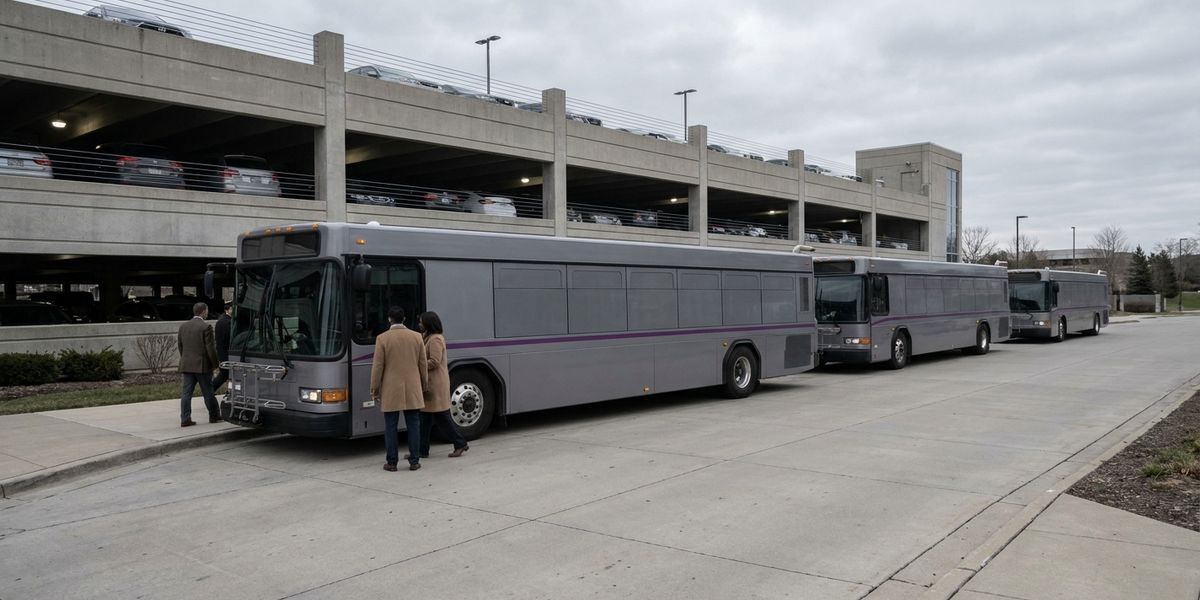
Now price the shuttle alternative. Public-transit operating cost per vehicle revenue hour spans $90 in San Diego to $245 in New York in 2022 NTD data (Allegheny Institute analysis of FTA National Transit Database). That is the upper bound, fully loaded with unionized labor and ADA service. Commercial charter coach rates run $135–$285 per vehicle hour depending on size (Metropolitan Shuttle, GOGO Charters, Thumbtack 2024 averages); managed-service contracts with named US contract operators land between the two. A six-route program with two 50-passenger motorcoaches per route, running a 90-minute AM and 90-minute PM cycle five days a week, costs roughly $400,000–$700,000 a year in vehicle hours, depending on the local labor market. That is comparable to the parking O&M alone, before the capex.
The math turns at headcount. Below ~400 employees, you cannot generate the 30–50 daily riders per vehicle a route needs to amortize the driver, fuel, depot, and dispatch overhead. A single bus with 12 riders is a charter, not a commute program. Above ~800, multiple consolidated routes can run at 65–75% load, the per-rider economics collapse, and Section 132(f) lets the employer pass through up to $340 per month per employee in qualified transportation benefits as pre-tax in 2026 (up from $325 in 2025, per IRS Rev. Proc. 2025-32). The same provision treats vanpool and shuttle the same as transit pass. Genentech’s gRide is the canonical case: a 55-coach motorcoach fleet that, before the pandemic, moved ~2,500 employees a day and racked up over a million annual employee trips. The program crossed 100 million displaced driving miles by 2012, and a multiple of that since. Trellis documented the program’s origin story: Genentech built it specifically instead of adding parking-structure capacity at the South San Francisco campus.
The breakpoint also shifts with land. Alts.co’s synthesis of structured-parking economics estimated structured construction only pencils when underlying land clears roughly $1–3 million per acre (about $25–$70 per square foot). Below that threshold (most US suburban industrial parks), surface lot is the cheaper-per-stall answer if you stay with parking at all, and the shuttle case is correspondingly stronger because the parking saving is harder-won. Above that threshold (urban-edge office, dense suburbs adjacent to transit), structured math kicks in and shuttle math gets even more favorable, because every avoided stall is now a $50K+ avoided capital line item.
Ryde’s published case-study benchmarks land in similar territory: shuttle programs at named enterprise sites typically cut commute-related transportation cost by ~25% versus the parking-expansion baseline they replace (a 1,200-employee hi-tech site, for example, moved from NIS 8M to NIS 6M in annual shuttle spend), with the larger savings concentrated at the >1,000-employee end of the range. The pattern is not unique to any one operator. It is the inverse fixed-cost curves doing the work.
The hybrid-RTO trap, and the named cases that already ran the experiment
Texas Department of Transportation halted plans for a larger parking structure at its new Austin campus when the building opened in 2022; NAIOP cited it directly in its 2024 “Parking and the Return to Office” coverage as a reference case for what we’d call do-not-build-for-2018-demand reasoning. Microsoft’s Connector program runs ~3,000 daily trips across 22 routes and 80 buses, with the Seattle Times reporting that 61% of riders previously drove alone, roughly 800 vehicle trips per day removed from Redmond-area roads, and 800 stalls of parking demand the company never had to build. Apple’s TDM filings with the City of Cupertino disclosed an annual TDM budget of $35 million in the 2013–2014 entitlement record, with a fleet of 30 motorcoaches and 20 shuttles serving 55 Bay Area pickup points and a non-SOV target around 28%. (Older filing; current numbers not public.) For a campus that now houses roughly 12,000 employees, that is a structural choice about land use, not a perk.
The flip side argument has weight. A skeptic looking at this evidence would say: parking is a depreciable asset on the balance sheet, shuttles are forever-opex, and committee math at most companies prefers a one-time capital ask to a permanent operating line. Shuttles also carry ridership risk. A program built for 600 daily riders that lands at 200 looks like waste. And not every site has the geographic shape that makes routes work. Multi-tenant business parks where employer-of-record fragmentation kills consolidation, rural manufacturing sites with 24/7 multi-shift schedules, sites with genuinely cheap and abundant land: the math really does come out the other way at all three.
Concede the ridership risk. Concede the fragmentation problem. Concede that a 300-employee single-shift site should not run a shuttle. The CFO objection that shuttles are forever-opex is exactly correct. What is wrong is pretending parking is anything else. A structured deck is forever-opex with a giant capex spike on the front end and a near-rebuild waiting in year 28. The only honest comparison is opex-to-opex, and at 800-plus employees on a parking-dominant site, the shuttle line is shorter.
There is one more wrinkle worth pricing in. Electric shuttles now hit roughly 1.2–1.5x the capex of a comparable diesel motorcoach but cut maintenance by 30–40%, and PG&E’s published Class 3 shuttle-van TCO reports up to 41% lifetime cost savings. The curve continues to bend in the shuttle’s favor over a 10-year fleet horizon. Concrete’s curve does not bend. Reinforced steel and post-tension cable price what they price.
What 2027 looks like for the facilities team that bets wrong
Any operations or facilities VP currently being asked to approve a structured-parking expansion above $30 million should run a parallel TCO with a 3–5 year shuttle pilot before the contract for concrete is signed. The probability that a 2026 demand forecast (built on Tuesday-Wednesday peaks that are already sliding back toward a Wednesday-only pattern at some employers) accurately predicts 2046 use is low enough that locking in 30 years of fixed asset against it is a higher-risk bet than the operating-expense line item makes it look.
But Friday tells a different story than the spreadsheet anticipates. The cleaner test is to spend a year flexing capacity through a contracted shuttle program and watching what happens to peak-day stall pressure. Most sites at >800 employees will discover the comparison was never close, and a meaningful share of them will end up with a parking lot to repurpose rather than a structure to repay. The smaller sites will learn something useful too: if the shuttle ridership is not there at 12 months, the contract unwinds in 90 days and concrete was never poured. That asymmetry, reversible operating commitment versus irreversible capital commitment, is why the 800-employee math points where it does.
For employers at that scale weighing the next round of campus capex, Smart Employee Commuting walks through the route-consolidation and ridership-modeling math that the parallel TCO needs as inputs.
Sources
- “No Such Thing as Free Parking” — UCLA Institute of Transportation Studies, accessed 2026-04-29.
- “Parking Structure Cost Outlook for 2024” — WGI (Wantman Group, Inc.), accessed 2026-04-29.
- “Transportation Cost and Benefit Analysis II – Parking Costs” — Victoria Transport Policy Institute (Litman), accessed 2026-04-29.
- “Peak Day Data Adds New Dimension to Back to Work Barometer” — Kastle Systems, accessed 2026-04-29.
- “Lots of Opportunity: Optimizing Industrial Parking” — NAIOP with Bunt & Associates, accessed 2026-04-29.
- “How Genentech Used a Parking Lot to Fund Its Employee Commuter Shuttle” — Trellis, accessed 2026-04-29.
- “Commuting in the United States: 2022” — US Census Bureau, accessed 2026-04-29.
- “Commuter Benefit Monthly Limit Increase, 2024 to 2025” — Commuter Services / IRS Section 132(f), accessed 2026-04-29.
- “Microsoft Connector: 19 Routes, 53 Buses Later” — Seattle Times, accessed 2026-04-29.
- “Apple Campus 2 Transportation Demand Management Plan” — City of Cupertino, accessed 2026-04-29.
- “PRT Cost and Activity Compared to Other Transit Agencies” — Allegheny Institute (NTD-derived), accessed 2026-04-29.
- “Parking Lot Economics: The Costs of Convenience” — Alts.co, accessed 2026-04-29.