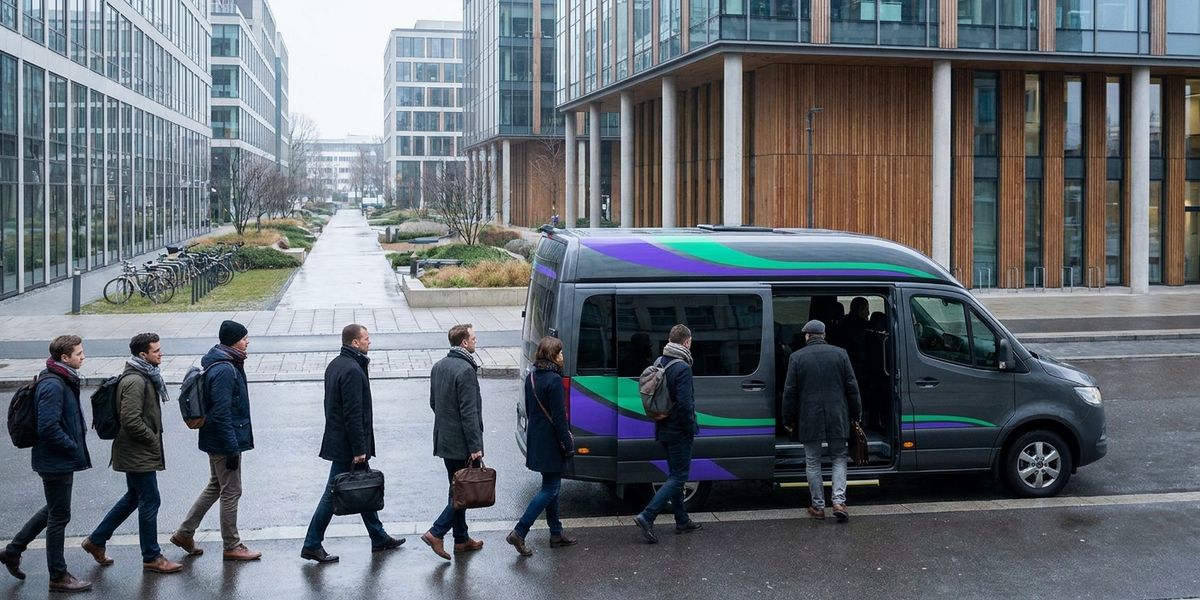
Belgium plans to make the company car optional — and the alternative to it compulsory. Under a reform announced by the federal Council of Ministers on 9 January 2026, any employer that offers company cars would have to offer a “mobility budget” instead: from 1 January 2027 for companies with 50 or more staff, and from 1 January 2028 for those with 15 to 49. The dates matter to anyone who owns a company-car policy, because the budget is not a cash-out scheme. Its rules name “organised collective transport” as a funded, tax-free commute option, which is the line where an employer shuttle stops being a cost center and becomes a benefit the payroll system already pays for. The reform is the clearest signal yet that the company car is being unbundled into a budget, and that the budget is starting to carry shuttles inside it.
One caveat belongs up front, because it changes how you read everything below. As of mid-2026 the 2027 mandate was an announced reform, not a finished law. Partena Professional, reporting on the Council of Ministers decision, warned that “the legislative process still has a long way to go” and that the dates were subject to change; Securex noted the text still had to pass the Council of State before parliamentary debate. The obligation had earlier been floated for 1 January 2026 and was pushed back. So treat the 2027 phase-in as planned and probable, not settled. Watch the Belgian statute book, not the press release, for the final word.
What a mobility budget actually pays for
The mobility budget, on the books in Belgium since the law of 17 March 2019, lets an employee trade a company car for an annual allowance equal to that car’s full running cost. The amount is the vehicle’s total cost of ownership: lease or financing, fuel or charging, insurance, maintenance, taxes, non-deductible VAT. Because the budget equals what the car would have cost, the employer pays nothing extra to offer it. For 2026 the legal allowance runs from €3,233 to €17,244 a year and may not exceed one-fifth of the employee’s gross salary (BDO Belgium). Those bounds are indexed, so they drift upward each year.
What the money buys is split across three pillars, and the split is the whole design.
Pillar 1 is a greener company car — from 1 January 2026, only a zero-emission vehicle qualifies. An employee who still wants a car can take one, but it has to be electric. Pillar 2 is the sustainable-transport bucket: public-transport season tickets, (e-)bikes and scooters, shared mobility, rent or mortgage interest near the workplace, and the part that matters here, organised collective transport. Spending inside pillar 2 is exempt from income tax and social-security contributions, which makes it the cheapest euro in the whole structure. Pillar 3 is whatever is left over, paid out in cash once a year and taxed through a special employee social-security contribution of 38.07%.
Read those three together and the incentive is plain. Cash is the most expensive way to use the budget; a funded commute mode is the cheapest. BDO’s FAQ lists “organised shared transport” explicitly inside pillar 2, and other Belgian advisers use the phrase “collective transport.” Either way, an employer-arranged shuttle or shared-ride service is a budget-eligible expense an employee can draw on tax-free — provided, from 2026, the vehicles used for shared and pooled trips are themselves zero-emission.
Why Belgium is forcing the switch first
No other country leans on the company car the way Belgium does. Around 60% of new passenger cars sold there are company cars, and the Tax Expenditures Lab put the public cost of the company-car regime at just over €5.2 billion a year by 2028. The fleet is so large it moves the national EV numbers: 28% of new passenger cars registered in 2024 were fully electric, a share the analysis attributed almost entirely to company cars. A subsidy that big, pointed that squarely at private car use, is precisely the thing a government trying to cut congestion and emissions wants to redirect.
The mandate is the redirection. Until now, an employer could simply decline to offer the budget; the 2019 scheme was opt-in on the employer side. The reform removes that choice for company-car employers above the headcount thresholds, while leaving the employee free to keep the car. Eligibility still hinges on a 36-month rule. An employer generally must have offered company cars for at least three years before the budget applies, and the employee must have had, or qualified for, a car for 12 of the prior 36 months. This is a company-car-employer obligation, then, not a universal commute benefit. The 2026 reform reworks how that window is counted and lets employers defer until existing lease contracts run out, which is one reason the timeline kept moving.
The low-uptake objection, and why it cuts the other way
Here is the strongest case against reading anything into this. After six years on the books, almost nobody uses the mobility budget. The ONSS monitoring report published in March 2026 counted 18,386 workers on the budget in 2024 across 1,488 employers — about 3.2% of the 572,897 Belgian workers who held a company car. A skeptic in a global HR seat can fairly ask why a 3% take-rate inside one country’s idiosyncratic car-tax system should shape a commute strategy in Frankfurt or Manchester.
Two things blunt that objection.
First, the reason uptake stayed low is the exact thing the mandate removes. When offering the budget was the employer’s choice, most employers simply kept writing car leases; the scheme never reached the worker. Flip it to an obligation and every company-car employer with 50-plus staff has to put the option on the table. The growth curve already pointed up before any mandate: 5,186 workers used the budget in 2022, 10,250 in 2023, and 18,386 in 2024, close to a doubling each year. Euros allocated followed the same slope, from €31.1 million in 2022 to €143.3 million in 2024 (ONSS, March 2026). A 3.2% base growing at that rate, then pushed from voluntary to compulsory, is not a dead scheme. It is an early one.
Second, the workers who do take the budget overwhelmingly use it to leave the car behind. ONSS found 92.6% of budget-holders did not take a pillar-1 company car at all; they spent on transit, bikes, shared mode, and the rest. The average budget per worker reached €7,792 in 2024. That is real money flowing into commute alternatives, not a payroll rounding error, and it is the pool a pillar-2 commute service draws from.
The limit on the argument deserves stating plainly. The company-car distortion that makes the budget necessary is distinctly Belgian, and a 3% take-rate is a small base by any measure. The claim here is not that the world will copy Belgium’s tax code. It is that the mechanism Belgium is now making mandatory, swapping the car for a budget and spending that budget tax-free on a real commute alternative, is being built voluntarily across Europe at the same time.
Where the employer shuttle fits inside pillar 2
Most discussion of the mobility budget treats it as a personal-mobility wallet: the employee buys a transit pass, rents a bike, expenses a shared car. Pillar 2’s inclusion of organised collective transport opens a second route the cash-out framing misses. An employer that runs a shuttle, or contracts shared-ride commuting for a site, gives every eligible employee a tax-free way to spend the budget on getting to work — without each person having to assemble a commute out of apps. For a 1,200-person site on a transit-poor edge of a city, that collective option is often the only credible alternative to the car the budget is supposed to replace.
This is where the model rewards capability over accounting. An employer that can only offer cash-out, or a list of third-party passes, hands the budget back to the employee and hopes they find something better than driving. An employer that can offer organised collective transport gives them one. The difference is whether the company can actually stand up a shared commute service that people will use: the right routes, reliable timing, and the visibility to run it across shifts and sites. That is the layer Ryde works on: the platform an employer uses to organise and run collective commuting, not a vehicle on the road. For employers weighing how to make a car alternative real rather than nominal, our smart employee commuting approach is built for exactly this pillar-2 use.
One guardrail on the enthusiasm: from 2026, vehicles used for shared and pooled trips inside the budget must be zero-emission to keep the tax treatment, so the commute service an employer organises has to be electric to qualify. That raises the bar on fleet sourcing. It also lines the shuttle up with the same decarbonisation logic that made pillar 1 EV-only — which is the point.
The trend the mandate is the leading edge of
Belgium is first to compel the swap, not first to invent it. France runs the forfait mobilités durables, a tax-advantaged allowance for sustainable home-work travel; the French government sets a flat €300/year for public-sector agents, with private-sector exemption caps in the €700–€900 range depending on what it is combined with (€700 stand-alone, €900 when combined with the employer’s mandatory public-transport contribution). The FMD Barometer (France Mobilités / Via ID) found fewer than 30% of private firms had implemented it by the end of 2023, so reach still lags the policy. Germany has a proposed Mobilitätsbudget, taxed at a 25% flat rate up to €2,400/year, still a proposal rather than law as of 2026. Austria and Finland run tax-free job-ticket and bike-allowance schemes on the same principle (Navit’s survey of European mobility-benefit regimes). The figures differ; the direction does not.
Large employers are moving without waiting for a mandate. SAP — which Navit reports operates Germany’s largest company-car fleet at roughly 17,000 vehicles — introduced a mobility budget for eligible employees from 1 April 2023, usable across trains, bikes, rental cars, taxis, and scooters through an internal app. A company that size choosing to unbundle even part of its fleet into a budget is the strongest market signal in the space, and it predates Belgium’s compulsion.
There is a second engine under all of this, and it is not fiscal. The EU’s Corporate Sustainability Reporting Directive pulls Scope 3 emissions into mandatory disclosure for in-scope companies, and the GHG Protocol puts employee commuting in Scope 3 Category 7. Once a company has to report the commute as a number — and have it assured — the company-car fleet stops being only a cost line and becomes a reported emissions line too. (The CSRD scope thresholds were in flux through the 2025–26 Omnibus revisions, so who exactly must report is itself a moving figure worth checking against EUR-Lex.) A budget that shifts spend from a combustion car to a zero-emission shared commute moves both numbers at once.
For HR, benefits, and ESG leaders running EU operations, the practical read is to treat the mobility budget as the template rather than the Belgian exception — and to ask one question before 2027 arrives: if your company-car policy were converted into a budget tomorrow, could you offer employees a collective commute they would actually choose over the car, or only a cash-out and a wish? If you can build the former, you can talk to us about what running it across your sites looks like.
Sources
- ONSS / RSZ — Monitoring van de vergroening van de salariswagens (annual overview; 2024 mobility-budget figures, report published March 2026). https://www.rsz.be/stats/monitoring-salariswagens — accessed 2026-06-13
- Next Mobility — Mobility Budget in Belgium: The Real ONSS Figures 2024 (English analysis of the ONSS report). https://www.nextmobility.be/en/post/mobility-budget-belgium-onss-figures-2024/ — accessed 2026-06-13
- Securex (Lex4You) — Mandatory mobility budget: not before 2027. https://www.securex.be/en/lex4you/employer/news/mandatory-mobility-budget-not-before-2027 — accessed 2026-06-13
- Partena Professional — Mandatory mobility budget postponed to 2027. https://www.partena-professional.be/en/our-insights/infoflashes/mandatory-mobility-budget-postponed-2027 — accessed 2026-06-13
- BDO Belgium — Understanding the mobility budget — FAQ. https://www.bdo.be/en-gb/insights/articles/2025/understanding-the-mobility-budget-faq — accessed 2026-06-13
- Tax Expenditures Lab — Tax Expenditures Linked to Company Cars: The Case of Belgium, September 2025. https://www.taxexpenditures.org/2025/09/29/tax-expenditures-linked-to-company-cars-the-case-of-belgium/ — accessed 2026-06-13
- Gouvernement (France) — Forfait mobilités durables. https://www.transformation.gouv.fr/ministre/actualite/forfait-mobilites-durables-300-euros-par-pour-les-deplacements-domicile-travail — accessed 2026-06-13
- France Mobilités / Via ID — Résultats du Baromètre Forfait Mobilités Durables (FMD), édition 2024. https://www.francemobilites.fr/outils/ressources/resultats-du-barometre-forfait-mobilites-durables-fmd-edition-2024 — accessed 2026-06-13
- GHG Protocol — Corporate Value Chain (Scope 3) Standard, Category 7 (Employee Commuting). https://ghgprotocol.org/corporate-value-chain-scope-3-standard — accessed 2026-06-13