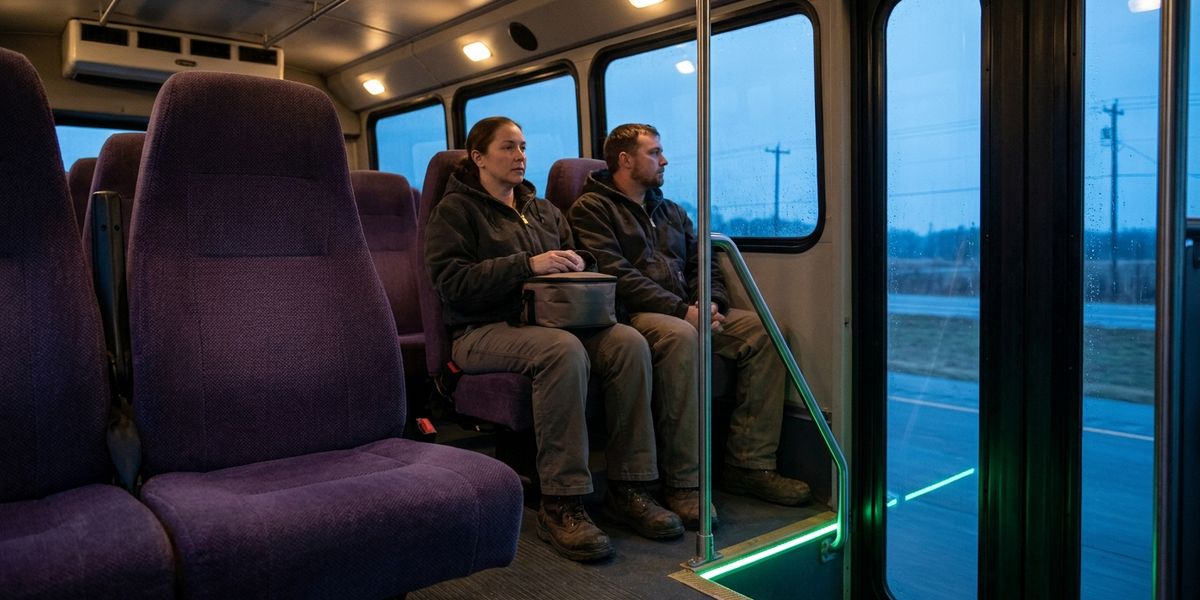
You book the shuttle under facilities and the raise under compensation. When the raise budget is tight and somebody proposes a commute program instead, the reflex in the room is that people would rather have the cash.
At a car-dependent shift site that transit doesn't reach, that reflex has the arithmetic backwards. A shuttle seat is pay. In the US it is pay the IRS leaves untaxed up to $340 a month. For a worker who would otherwise spend that much getting to work, matching it with $4,080 a year of take-home cash takes $5,078 of gross pay in the 12% federal bracket. At a $40,000 salary, that is a 12.7% raise.
WorldatWork's survey puts the projected 2027 average US salary-increase budget at 3.6%, or $1,440 on the same salary. One seat outweighs three average raises, and the standard total-comp benchmark has no line to record it on. The case survives the two objections your CFO will raise, the lost tax deduction and the employees who never ride, though the first one takes a real bite out of it.
The commute line missing from your total-comp benchmark
Start with the benchmark you calibrate against. Private-industry compensation averaged $46.89 an hour worked in June 2026, with benefits making up 30.0% of it, according to the BLS Employer Costs for Employee Compensation release. ECEC sorts those benefits into five categories: paid leave, supplemental pay, insurance, retirement and savings, and legally required benefits. Commuting isn't one of them.
So the line never reaches the statement. A comp team that benchmarks its offer against ECEC has no column for a shuttle. It books the shuttle as facilities spend and then reports a total-rewards figure that leaves out a benefit worth thousands of dollars a year to the people who use it.
Access data sharpens the problem. In the March 2025 National Compensation Survey, 10% of private-industry workers had access to subsidized commuting. The share ran from 3% in the lowest wage quartile to 20% in the highest, and from 6% in production and service occupations to 20% in management, business and financial roles. Two caveats belong next to those figures. BLS assigns wage categories by an occupation's average wage, not by each worker's own pay. And its definition of subsidized commuting covers transit, vanpools, discount fares and tokens without naming employer-run shuttles (BLS, The Economics Daily, July 2025). Neither caveat changes the direction: the workers with the least cash to spare for getting to work are the least likely to get help with it.
Site size moves the number too. Access reached 22% at establishments with 500 or more workers, against 6% at those under 100. Counted by employer rather than by worker, 12% of organizations offer a transit subsidy and 10% a parking subsidy (SHRM Employee Benefits Survey, 2025). Large multi-shift sites are where a shuttle is most likely to exist already, which makes them the first place to check whether your statement shows it.
Genentech is a useful marker of scale. Its buses carry 60% of the South San Francisco commuters who don't drive alone, according to its annual update on 2025 to the city's planning commission (San Mateo Daily Journal, March 2026). We found no public source in which Genentech, or any other large employer, states what a seat is worth in gross pay.
What a shuttle seat is worth in gross pay
Price the seat as a raise, and for most of an hourly workforce the comparison stops being close.
The ceiling comes from IRS Publication 15-B. For 2026 an employer can exclude up to $340 a month of combined commuter-highway-vehicle transportation and transit passes from an employee's wages, and anything above the cap is wages. A shuttle counts as a commuter highway vehicle when it seats at least six adults besides the driver, at least 80% of its mileage is expected to be home-to-work trips, and employees fill at least half the seats. A pass for a vehicle with six or more adult seats, run by an operator in the business of carrying passengers for hire, also qualifies. The half-full test is the one an under-filled pilot route can fail.
Each row prices a seat at the cap, $4,080 a year, against the gross raise that leaves the worker with the same take-home amount. Employee and employer FICA run 7.65% each below the $184,500 wage base (IRS Publication 15, 2026), and the corporate rate is 21% (26 U.S.C. §11). The 5% state rate is an illustration, not an average. The employer columns assume the seat costs what it is worth, and the multipliers compare each figure with that $4,080, which a US employer cannot deduct.
| Worker's tax wedge | Gross raise worth a $4,080 seat | Employer cost of that raise | After 21% corporate deduction | Raise as % of $40,000 |
|---|---|---|---|---|
| 12% federal + 7.65% FICA (19.65%) | $5,078 | $5,466 (1.34×) | $4,318 (1.06×) | 12.7% |
| Same, plus 5% state (24.65%) | $5,415 | $5,829 (1.43×) | $4,605 (1.13×) | 13.5% |
| 22% federal + FICA + 5% state (34.65%) | $6,243 | $6,721 (1.65×) | $5,310 (1.30×) | n/a: the 22% bracket starts near $66,500 gross |
| EITC phase-out, head of household with two children, ~$34,000–$58,600: 21.06% + FICA + 10–12% federal (38.7–40.7%) | $6,657–$6,881 | $7,166–$7,408 (1.76–1.82×) | $5,661–$5,852 (1.39–1.43×) | 16.6% (10% bracket at $40,000) |
Two assumptions carry most of that table. The seat is worth $340 a month to a worker only if they would otherwise spend that much getting to work, so a short drive in a paid-off car makes it worth less. And the exclusion stops at the cap, so a long route whose seat is worth more than $340 a month pushes the excess back into taxable wages.
What drivers spend sets the outer bound. AAA's Your Driving Costs study put owning and running a new vehicle at $12,863 a year in 2026, or $1,071.92 a month. That covers all driving, not commuting alone, so it isn't the value of a seat. For anyone who can skip or delay buying a car because a seat exists, though, $340 a month understates what they get.
Drop one more assumption while the table is open: that tax-free benefits do the most for the lowest-paid. On federal income tax alone, they don't. The gross-up grows with the marginal rate, which is why the 22% row beats the 12% row. A single filer stays in the 12% bracket up to $66,500 of gross pay, which is the $50,400 taxable threshold plus the $16,100 standard deduction (IRS, 2026 inflation adjustments). The private-industry median wage of $24.50 an hour (BLS National Compensation Survey, March 2025) sits well inside it.
The low-wage case rests instead on access (the 3%-against-20% gradient above) and on the earned income tax credit. For a head-of-household parent of two earning between $23,890 and $58,629 in 2026, each extra dollar of wages removes 21.06 cents of credit (26 U.S.C. §32; Rev. Proc. 2025-32). The credit phases out on earned income or AGI, whichever is higher, and the statute counts only compensation includible in gross income. An excluded commute benefit counts toward neither, so the seat leaves the credit alone and the raise doesn't. Above about $34,000 that band carries the widest wedge in the table, modelled with federal tax at 10–12%. Below about $34,000 the child tax credit absorbs federal income tax, so the wedge there is closer to 29%, which is still above the 12%-bracket row.
Office workers have already put a number on escaping the commute. In the Survey of Working Arrangements and Attitudes, US respondents priced a hybrid schedule, with two or three days a week at home, at 8% of pay on average, as Barrero, Bloom and Davis reported in the Journal of Economic Perspectives (2023). That figure bundles flexibility with the saved trips, so it is no valuation of a shuttle. It does show that people price the commute in the same units as salary. Ramp agents and line operators never get that option, which leaves cheaper commuting as the only version on offer.
The CFO's objection: the shuttle isn't deductible
IRC §274(a)(4) and §274(l) are the first thing your finance partner will raise, and the point stands. Under them, a US employer gets no deduction for qualified transportation benefits, or for any cost of carrying employees between home and work, apart from a narrow safety exception. A raise is deductible. For a C-corporation at 21%, that pulls the employer's advantage in the lowest-wedge row from 34% down to 6%.
Six percent is thin. If the case for the seat rested on employer savings alone, it would not survive a budget committee.
It doesn't rest there. The deduction sits on the employer's tax return, and the worker never sees it. To the rider the seat still lands as $5,078 of gross-equivalent pay, whatever the employer's tax position. And 6% is the floor of the employer gap, not its typical size: with a 5% state income tax it reads 13% after the deduction, and in the upper EITC phase-out band 39–43%. Tax-exempt employers, a group that includes many hospital systems and universities, have no income-tax deduction to lose, so for them the pre-deduction column is the whole comparison.
A second objection is that a raise reaches everyone and a seat reaches only riders. The statute has answered it already. Section 132(f)(4) says an employee's freedom to choose between a qualified transportation fringe and taxable cash doesn't, by itself, make the fringe taxable. Offer both. Riders take the seat at its untaxed value, and everyone else takes the cash.
A third objection sounds like economics: if long commutes mattered, the labor market would already price them. It does, slowly. When Danish firms relocated and lengthened their workers' commutes, wages were about 0.15% higher for each extra kilometre three years after the move, on register data covering the whole workforce (Mulalic, van Ommeren and Pilegaard, Economic Journal, 2014). Read that from the employer's side of the table. You end up paying for a long commute with or without a shuttle. Without one, you pay through wages taxed at the full wedge, three years late.
Outside the US, the swap mostly stops working
What happens to the swap when your program runs in more than one country? In the UK, and for German transit subsidies, the trade that §132(f)(4) permits stops working.
The UK is more generous on the seat and stricter on the swap. Under the works bus exemption, an employer pays no tax or National Insurance on a bus that carries employees between home and work, provided the service is open to every employee whether or not they use it and the vehicle seats 12 or more passengers, or 9 for a minibus. No monthly cap applies.
At 20% income tax and 8% employee National Insurance, a basic-rate employee in England, Wales or Northern Ireland keeps 72p of each extra pound in cash (HMRC rates and thresholds, 2026 to 2027). Delivering £1 of take-home pay therefore costs £1.389 gross, and £1.597 with the 15% employer contribution. A qualifying seat costs £1.00. Then comes the condition that changes the design. Provide the bus through salary sacrifice and the exemption is gone; the employer reports the higher of the salary given up or the cost of the service on form P11D.
Germany splits the two. Section 3 No. 15 of the Income Tax Act exempts transit subsidies only when paid on top of wages already owed. Section 3 No. 32 makes employer-provided group transport between home and the first place of work tax-free where the business needs it to deploy the employee, a narrower test than the US one.
For a multi-country total-rewards team the rule is short. In the US the seat can replace part of a raise, offered as a choice. In the UK it goes on top of the raise, as a German transit subsidy does, and a German shuttle must first pass the business-need test. It still belongs on the statement at its gross-pay value, because that is what it is worth to the worker even when it can't fund the raise budget.
Put the seat on the total-rewards statement at gross value
Valuing the seat changes nothing until it appears where workers and the comp committee look. Four changes get it there.
- Show the seat at its gross-pay equivalent for the bracket most riders sit in, not at its cost. A $4,080 seat listed as $4,080 understates it by the tax wedge.
- Pull per-seat cost and occupancy for each route from operations data before you set a cash alternative, since a route under half full can fail the commuter-highway-vehicle test.
- Where US rules allow it, offer seat or cash, and set the cash figure from the cost you just pulled.
- Check local mandates before redesigning anything. Washington DC, San Francisco and the Bay Area region already accept employer-provided transportation as a compliant option, and the 2026 commuter-benefit mandate map lists the rest.
If the alternative on the table is a parking subsidy rather than a raise, that is a different calculation with different inputs, and the shuttle-versus-parking cost comparison walks through it.
Salary-increase budgets for 2027 are being set this quarter, and WorldatWork's survey projects the same 3.6% employers paid in 2026. Before you sign off the pool for a car-dependent shift site, put two columns side by side: the raise at 3.6%, and the seat at its gross-pay equivalent for the bracket most of that site's workforce sits in. If the seat wins by margins like the ones above, offer it next to cash where US law lets you, and put it on the statement at gross value everywhere else. If it loses because the route is short or half-empty, the comparison has told you something about the route, not about the benefit. The second column needs a real cost per seat by site, and Ryde's analytics and reporting tracks transportation cost per employee, per site and per supplier.
Sources
- Internal Revenue Service, "Publication 15-B (2026), Employer's Tax Guide to Fringe Benefits" — https://www.irs.gov/pub/irs-pdf/p15b.pdf (accessed 7 October 2026)
- Internal Revenue Service, "Publication 15 (2026), (Circular E), Employer's Tax Guide" — https://www.irs.gov/pub/irs-pdf/p15.pdf (accessed 7 October 2026)
- Internal Revenue Service, "IRS releases tax inflation adjustments for tax year 2026, including amendments from the One, Big, Beautiful Bill" — https://www.irs.gov/newsroom/irs-releases-tax-inflation-adjustments-for-tax-year-2026-including-amendments-from-the-one-big-beautiful-bill (accessed 7 October 2026)
- Internal Revenue Service, "Revenue Procedure 2025-32" — https://www.irs.gov/pub/irs-drop/rp-25-32.pdf (accessed 7 October 2026)
- Legal Information Institute, 26 U.S. Code §132 — https://www.law.cornell.edu/uscode/text/26/132 (accessed 7 October 2026)
- Legal Information Institute, 26 U.S. Code §274 — https://www.law.cornell.edu/uscode/text/26/274 (accessed 7 October 2026)
- Legal Information Institute, 26 U.S. Code §32 — https://www.law.cornell.edu/uscode/text/26/32 (accessed 7 October 2026)
- Legal Information Institute, 26 U.S. Code §11 — https://www.law.cornell.edu/uscode/text/26/11 (accessed 7 October 2026)
- U.S. Bureau of Labor Statistics, National Compensation Survey, "Employee Benefits in the United States, March 2025" — https://www.bls.gov/ebs/publications/employee-benefits-in-the-united-states-march-2025.htm (accessed 7 October 2026)
- U.S. Bureau of Labor Statistics, "Employee Benefits in the United States, March 2025," news release USDL-25-1464, 25 September 2025 — https://www.bls.gov/news.release/archives/ebs2_09252025.pdf (accessed 7 October 2026)
- U.S. Bureau of Labor Statistics, The Economics Daily, "All aboard! Subsidized commuting was available to 1 in 10 private industry workers in 2024," 3 July 2025 — https://www.bls.gov/opub/ted/2025/all-aboard-subsidized-commuting-was-available-to-1-in-10-private-industry-workers-in-2024.htm (accessed 7 October 2026)
- U.S. Bureau of Labor Statistics, "Employer Costs for Employee Compensation, June 2026" — https://www.bls.gov/news.release/archives/ecec_09092026.htm (accessed 7 October 2026)
- U.S. Bureau of Labor Statistics, Handbook of Methods, "Employer Costs for Employee Compensation: Concepts" — https://www.bls.gov/opub/hom/ecec/concepts.htm (accessed 7 October 2026)
- SHRM, Kathryn Mayer, "IRS Boosts Commuter Benefit Limits for 2026," 17 October 2025 — https://www.shrm.org/topics-tools/news/benefits-compensation/irs-boosts-commuter-benefit-limits-2026 (accessed 7 October 2026)
- WorldatWork, Workspan Daily, Paul Arnold, "WorldatWork: Employers' 2027 Pay Budget Projections Point to Stability," 16 July 2026 — https://worldatwork.org/publications/workspan-daily/worldatwork-employers-2027-pay-budget-projections-point-to-stability (accessed 7 October 2026)
- Barrero, J.M., Bloom, N. & Davis, S.J., "The Evolution of Work from Home," Journal of Economic Perspectives 37(4), 2023 — https://www.aeaweb.org/articles?id=10.1257/jep.37.4.23 (accessed 7 October 2026)
- Mulalic, I., van Ommeren, J.N. & Pilegaard, N., "Wages and Commuting: Quasi-natural Experiments' Evidence from Firms that Relocate," The Economic Journal 124(579), 2014 — https://doi.org/10.1111/ecoj.12074 (accessed 7 October 2026)
- AAA, "Your Driving Costs 2026," 15 September 2026 — https://newsroom.aaa.com/2026/09/aaa-new-vehicle-ownership-costs-hit-12863-annually/ (accessed 7 October 2026)
- GOV.UK, "Expenses and benefits: works bus services" — https://www.gov.uk/expenses-and-benefits-works-bus-services (accessed 7 October 2026)
- HM Revenue & Customs, Employment Income Manual, EIM21850 — https://www.gov.uk/hmrc-internal-manuals/employment-income-manual/eim21850 (accessed 7 October 2026)
- GOV.UK, "Rates and thresholds for employers 2026 to 2027" — https://www.gov.uk/guidance/rates-and-thresholds-for-employers-2026-to-2027 (accessed 7 October 2026)
- Bundesministerium der Justiz, Einkommensteuergesetz §3 — https://www.gesetze-im-internet.de/estg/__3.html (accessed 7 October 2026)
- San Mateo Daily Journal, Alyse DiNapoli, "South City's Genentech saw limited development in 2025 as part of annual update," 27 March 2026 (subscriber-only; no open-access version)