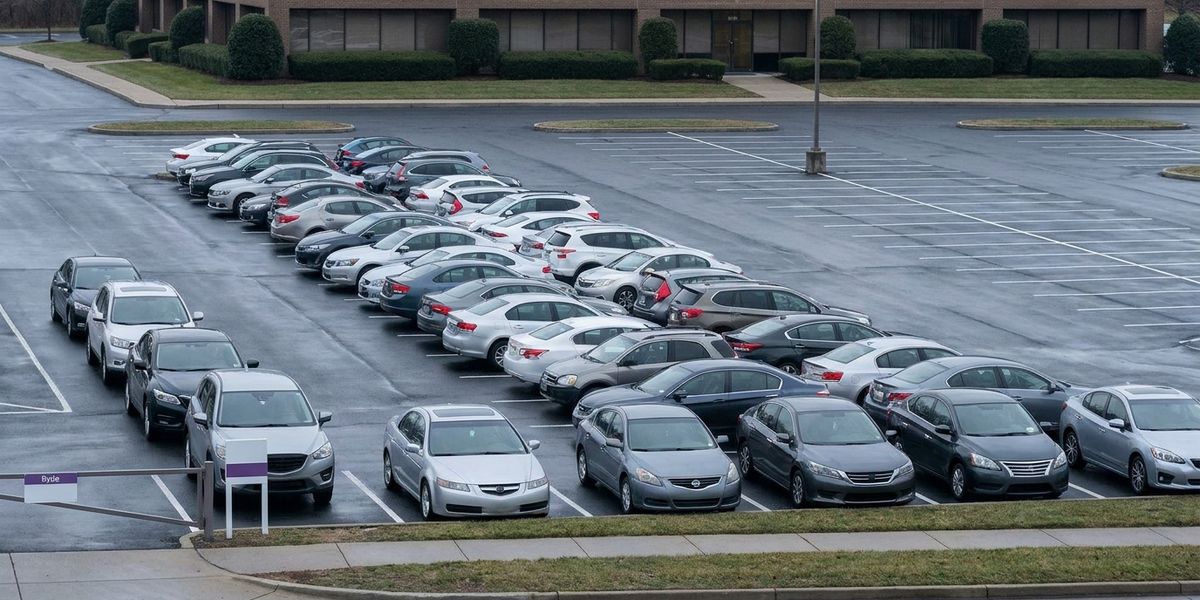
A 1,200-employee suburban site running a “three days in office” hybrid policy does not see 60% attendance evenly distributed across the week. Tuesday clears 70% while Friday limps in below 25%; Wednesday and Thursday sit between, at 66% and 60%. Monday lands around 35%. Run the parking math against the 60% weekly-average and the lot is short on Tuesday by a hundred stalls. Run the shuttle-utilization math the same way and the Tuesday route stands at the curb because its 50-passenger seat count was sized to a 36-passenger average. JLL’s 2025 occupancy benchmark put global peak utilization at 80% against an average of 54% — a 1.48× ratio that is roughly the under-pricing built into every facility plan that uses weekly averages as its planning unit. Getting that wrong does not show up in the parking budget. It shows up downstream, in three places most facilities teams never line-itemize.
Why weekly-average math is the wrong unit
Office demand under hybrid is bimodal in a way that pre-pandemic planning never had to contend with.
Kastle’s access-control data puts the weekly peak on Tuesday or Wednesday, and those midweek peaks have grown noticeably faster since 2022 while the Monday and Friday average has held flat (Kastle). In the week of December 8, 2025, all office buildings in its barometer hit a post-pandemic record of 66.0% on Tuesday against a 56.3% ten-city weekly average, a gap of about 1.2×. That figure averages five-day-mandate organizations into the denominator. Narrow to A+ class assets that skew toward hybrid populations and the same December 2025 reading recorded a 95.5% Tuesday peak against a 78.8% weekly average.
CBRE’s 2025 Americas Occupier Sentiment Survey sharpens the same point. CBRE found 73% of organizations at peak-day capacity (61–100% utilized), against only 34% on the average day, with 66% of respondents describing average utilization as below 60%. Hybrid’s dominant operational signature is not “53% utilization.” It is “53% on average and 90% on the day that matters.”
The problem this creates for transportation and parking planning is mechanical. None of the components flex: parking lots fill in stall-count units, shuttle seats are sold by the contracted bus, and drop-off curb space is a fixed length of asphalt with a queue behind it. A site that sized any of those for a 60% Tuesday-to-Friday flat line built its capacity for a week that does not exist and undersized for the only three days when capacity is actually being tested.
Where the manager concentration shows up
Peak demand is not just demand. It is manager-weighted demand, and that changes the cost of a missed slot.
Gallup’s May 2025 panel of 17,660 US workers found that only 34% of hybrid employees set their own office days. For 35% the manager or team decides, and for another 31% the employer does (Gallup). Behaviour cascades: managers come midweek because their bosses come midweek, and direct reports come midweek because their managers do. Bloom’s Stanford WFH Research team has been pointing at this same self-reinforcing loop in the SIEPR working-from-home brief for two years now.
That coordination produces a Tuesday-loaded population that disproportionately includes senior individual contributors and people-managers — the employees whose hour of late-arrival or rideshare-reimbursement-cycle delay costs the most. A 9:15 manager arrival pushes a 9:30 standup to 9:45 for six attendees. Accounting for that hour does not appear in the parking budget. It appears in a slipped sprint, a delayed hiring decision, or a missed handoff that the ops team only reads a week later.
Work Design Magazine's reading of the Q2 2025 Flex Report puts it plainly: the "three-day norm, particularly Tuesday through Thursday, creates usage peaks that exacerbate bottlenecks" in parking, elevators and meeting space. The peak is not a regional anomaly. It is what structured hybrid looks like in steady state across the Flex Index sample.
A worked breakeven for the 1,200-person suburban site
Take a 1,200-person suburban office at a 3-day-required hybrid policy. Stanford WFH data and the Q2 2025 Flex Report both put a typical hybrid site close to 2.8 days in-office on average. Apply Kastle’s day-of-week distribution to a 1,200-person site at that policy and the headcount on each weekday lands at roughly 420 Monday, 720 Tuesday, 690 Wednesday, 590 Thursday, and 290 Friday. The weekly average is 540. The peak is 720. The ratio: 1.33×, in line with the JLL national figure once you account for some site-to-site variance.
Now spec the parking.
A facilities team using the 540 weekly-average and a 65% drive-alone share would build for ~350 stalls. That number is wrong by about 120 stalls on a Tuesday morning. Cost of being short shows up in three places. First, rideshare reimbursement: at $14 average Lyft/Uber one-way and 50 employees absorbing the spillover three days a week, an annualized rideshare bill clears $200,000 before tax. Second, late-arrival cost: 50 employees at an average billable rate of $80/hour losing an average 20 minutes hunting for a parking space adds another $100,000-plus a year in pure productivity drag. Third, parking-bypass-to-retail: the strip mall across the highway gets used as overflow until the property owner sends the employer a letter, the legal team negotiates a parking-license fee, or both.
Total annual cost of the under-sizing decision: $300,000–$500,000, none of which the original 540-baseline budget captured.
Compare that to the cost of building three days right with a peak-day shuttle program. A standard 50-passenger motorcoach charters at $150–$300 per vehicle hour in regional 2025 averages, with mid-size coach options at $100–$175 for short routes. A four-route program covering the 120-stall gap on T/W/Th, running a 90-minute morning and 90-minute evening cycle, costs roughly $260,000–$560,000 a year for those three days alone. Run the same program five days a week and the cost is $440,000–$940,000. The peak-day-only contract is the right unit, and most charter operators will price it at 90–95% of the equivalent five-day rate (driver shifts and minimum-day economics flatten the discount). Add Section 132(f), which lets employers pass through up to $325/month per employee in qualified transportation benefits as pre-tax and treats commuter shuttle the same as transit pass, and the after-tax delta narrows further.
Math turns at the boundary between average-day and peak-day planning, not at the boundary between parking and shuttle. Parking expansion sized to peak demand is also a defensible choice — that calculation is documented in Where the 800-employee shuttle-vs-parking breakeven sits, which walks through the 30-year structured-parking math. The point here is narrower: spec to peak, not to average. A unit error of this kind costs $300K–$500K a year invisibly until somebody traces the rideshare and overtime lines back to a Tuesday morning.
Genentech ran the named version of this experiment 15 years ago. Its gRide program, documented by Trellis, grew to a 55-coach motorcoach fleet specifically to absorb a peak-day demand the South San Francisco campus could not park. Microsoft’s Connector program is the second canonical reference point: 22 routes and roughly 80 buses by 2016, with the Seattle Times reporting that 60% of riders previously drove alone. Both programs were sized to peak — the average-day picture would have produced fleets too small to do the work.
What a peak-aware program looks like
A peak-aware program differs from one that pretends Friday is Tuesday in three concrete ways: how the contract is shaped, how seats are allocated, and whether the demand side gets touched at all.
The contracting layer is the most boring fix and also the highest-impact one. Most managed-services agreements with US contract operators or regional charters will price a three-day-only contract. The savings versus a five-day equivalent are smaller than facility leaders expect (driver pay structures don’t proportionally collapse), but the savings are real and the operational fit is much closer. Three-day pricing typically lands at 60–70% of five-day cost for the same route count. Friday capacity that nobody used is no longer in the budget.
Dynamic seat allocation does similar work on the parking and shuttle side. Vendor data from workplace-parking platforms like Wayleadr suggests 30–40% of stalls under fixed allocation sit empty on a typical day because reserved holders are away, sick, or skipping. A dynamic-allocation system (book by day, expire unused holds at 9:30am, release to a waitlist) recovers that capacity at the parking layer. Apply the same booking pattern to shuttle seats and a four-route program runs at 65–75% load on Tuesday without overflow on Wednesday. The goal is not to add capacity; it is to stop letting Tuesday’s no-shows hide under reserved-spot accounting that nobody reads.
Manager-day staggering is the only intervention that addresses the demand side rather than the supply side. Gallup’s finding that a manager or team sets the office days for 35% of hybrid workers says manager schedules pull the peak. A small policy nudge from director-level (spread teams across at least two anchor days, not three) can flatten the curve by five to 10 percentage points without touching individual flexibility. Most large hybrid employers haven’t run that play because the framing fights about "more days" or "fewer days," when the operationally interesting axis is which days. JPMorgan and Salesforce defeated the peak by mandating five; that is one answer, but it gives back hybrid entirely. A cheaper answer is to keep three days and stagger them.
Ryde’s customer programs follow that pattern: peak-day shuttle scheduling, a Policy Engine that anchors booking windows by team and day, a WhatsApp channel that absorbs the cancellation discipline dynamic allocation requires. None of those tools is a workaround for getting the planning unit right; they are the mechanics that follow once it is.
The case against doing anything
A skeptical CFO reading this argument will land on the same response in every committee: spillover is fine to absorb. Victoria Transport Policy Institute’s parking-management overview, in Litman’s standard reference text, takes exactly that position: “parking is acceptable, provided that additional parking is available nearby, and any spillover problems are addressed.” Building shuttle capacity for a Tuesday peak means a fleet that runs partially empty on Friday. Charter coach hourly billing makes Friday underutilization expensive. Better to swallow the friction, the argument goes, than over-build for ~100 days a year.
Granted on the math premise. Friday’s capacity question is real, and a five-day shuttle for a three-day demand pattern is the wrong shape. What the spillover-is-fine argument misses is the asymmetry of who absorbs the friction. When a manager or team sets the office days for 35% of hybrid workers (Gallup), peak-day overflow lands on a manager-heavy population, on the very days chosen for time with the manager. Those rideshare bills and late-arrival costs are not distributed across the workforce; they fall on the people whose lost time is most expensive. A site that absorbs $300–$500K a year in spillover cost without measuring the productivity drag against the senior IC and manager population is mispricing the line item by an order of magnitude.
A second skeptical move worth granting: dynamic-allocation parking software does close some of the gap without spending capex or signing a charter contract. Vendor recovery numbers around 30–40% are real, particularly at sites with rigid reserved-stall systems. A mistake is to read that recovery as a substitute for peak-day planning. It expands the effective capacity of the lot, but it does not change the underlying T/W/Th demand cliff. A rideshare reimbursement bill arrives whether the parking management software is good or bad, because the demand cliff is not what dynamic allocation solves.
What the 2027 facilities plan should not look like
Any operations VP or facilities director writing a 2027 capital plan against weekly-average attendance data is sizing the program against a number that has not described real demand for three years. Planning-unit error is small per row in the budget (a few stalls, two seats per route, half a driver shift) and large in aggregate when it accumulates across three midweek days, 50 weeks a year, and a manager-loaded peak that the rideshare line item silently absorbs.
A cleaner frame is to spec everything (parking, shuttle, drop-off curb, transit pickup capacity, rideshare reimbursement budget, even meeting-room booking caps) to the Tuesday peak and then track how often the program runs at less than 70% of that capacity on Friday. Some employers will discover they need three-day-only contracts. Some will discover the underlying peak is sliding back toward Wednesday-only as RTO pressure tightens, which would compress the planning unit further. Both are useful answers. Neither is available to a team still using a 5-day weekly average as its baseline.
For employers writing that plan now, Smart Employee Commuting covers the route-consolidation and demand-modeling math the peak-day spec needs as inputs, and the contact form is the right place to start when the parallel TCO needs to be run before the next round of campus capex is signed.
Sources
- “Peak Day Data Adds New Dimension to Back to Work Barometer” — Kastle Systems, accessed 2026-05-10.
- “Kastle Back to Work Barometer Hits All-Time Post-Pandemic Highs” — Kastle Systems, accessed 2026-05-10.
- “Global Occupancy Planning Benchmark Report 2025” — JLL, accessed 2026-05-10.
- “JLL Workforce Preference Barometer 2025” — JLL, accessed 2026-05-10.
- “2025 Americas Office Occupier Sentiment Survey” — CBRE, accessed 2026-05-10.
- “Working from Home in 2025: Five Key Facts” — Stanford Institute for Economic Policy Research (SIEPR), accessed 2026-05-10.
- "Hybrid Work in Retreat? Barely." — Gallup, September 2, 2025, accessed 2026-10-17.
- “Structured Hybrid’s Rise and the Future of Office Space” — Work Design Magazine (citing Q2 2025 Flex Report), accessed 2026-05-10.
- “How Genentech Used a Parking Lot to Fund Its Employee Commuter Shuttle” — Trellis, accessed 2026-05-10.
- “Microsoft Connector: 19 Routes, 53 Buses Later” — Seattle Times, accessed 2026-05-10.
- “Charter Bus Rental Rates” — Great Lakes Motor Coach (regional 2025 averages), accessed 2026-05-10.
- “Parking Management: Strategies, Evaluation and Planning” — Victoria Transport Policy Institute (Litman), accessed 2026-05-10.