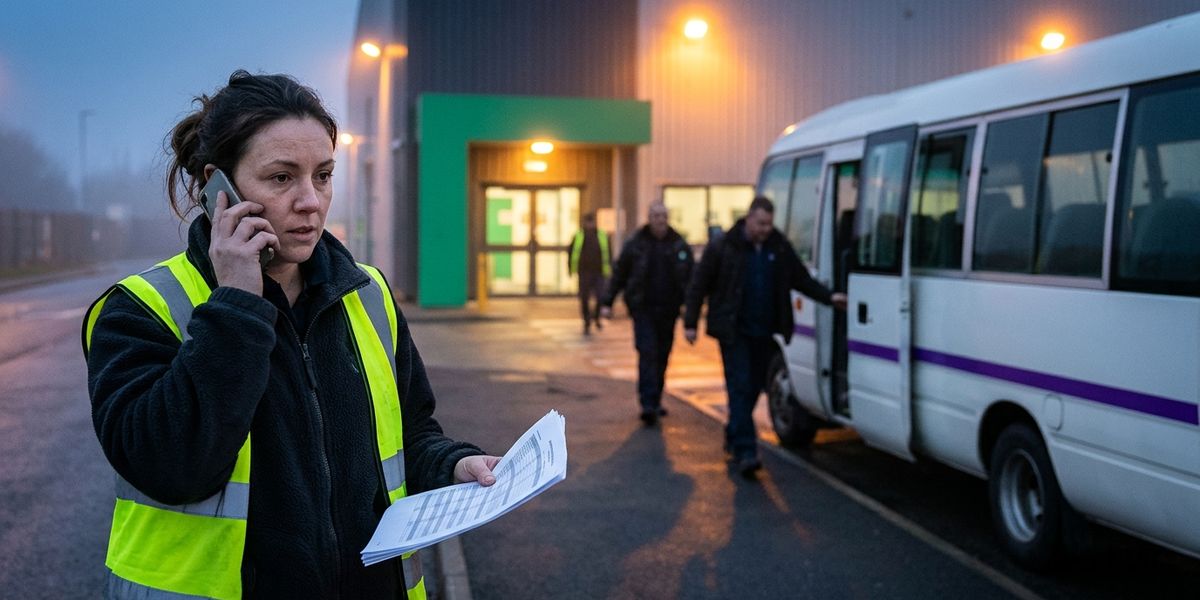
Who rebuilds the shuttle routes when the 6:00 a.m. shift moves to 5:30 with three days' notice? A software selection can close without anyone answering that. The evaluation scores route optimization, the rider app and the reports, the contract gets signed, and the daily operation lands on whoever owns facilities that quarter. In its September 24, 2026 release, the Bureau of Labor Statistics found that 9% of US wage and salary workers learned their work schedule one day or less in advance, and only 59% knew it four weeks or more ahead. Each late change means a route edit, a rider message and a call to a transport vendor. Two models answer the question: the employer's own team runs the platform, or the software provider runs the program as a managed service. Neither the license fee nor one coordinator's salary decides between them. Staffing depth does. Can the employer cover the change load and the out-of-hours rider support with more than one trained person?
What the operating work looks like once the shuttle software is live
Three workloads start on go-live day and never finish. Routes need re-planning as shifts, headcount and attendance move. Transport vendors need rides assigned, driver and vehicle changes chased and service complaints closed. And riders need answers, including at hours when the facilities office is dark.
Re-planning is the heaviest of the three, and software does less of it unattended than many buyers expect. On Ryde's platform, for example, a shift-time change updates the employee's booking, but the rides already built for that day are changed by a dispatcher, who re-times the pickups, checks them against the site's gates and break rules, and sends the change to riders and the vendor. Office campuses add a weekly rhythm: Kastle Systems' keycard data for the week of October 26, 2026 put average occupancy across 10 US metros at 56.5% of the February 2020 baseline, against a Tuesday peak of 66.7%. If ridership follows occupancy, a route sized for Tuesday carries 15% fewer riders on the week's average day. Someone has to decide whether to trim it.
Vendor coordination is quieter, and it never stops. Rides go out, the transport vendor assigns drivers and vehicles, and every late arrival or no-show needs a follow-up that ends in a record. A supplier portal for transport vendors keeps that exchange in one place. Somebody still has to read it every morning.
Rider support sets the staffing floor. Nationally, 15% of wage and salary workers usually worked a non-daytime schedule in 2024–25, including 5% on evenings and 3% on nights (BLS, same release); the rest of that group rotates, splits shifts or keeps irregular hours. A three-shift plant sits far above the national figure by definition. Coverage arithmetic is blunt. A week has 168 hours and a full-time job has 40, so keeping one support seat staffed around the clock takes 4.2 full-time people before anyone takes vacation, calls in sick or goes to training. A narrower window, 5 a.m. to 11 p.m. six days a week, is 108 hours and still 2.7 people. One coordinator covers neither.
None of this is a comparison of owned fleets, charter contracts and software. That analysis lives in the build, buy or outsource cost comparison. The question here starts after the software is bought: who carries these three workloads every day, for the life of the contract?
When your own team should run the shuttle platform
Self-managing works, and for some employers it is the better model. A team that sits next to the shift supervisors hears about Thursday's overtime call before it reaches any ticket queue. It knows which gate the night shift uses. It pays no service margin.
Four conditions make it hold up. At least two people are trained to change a route and publish it. Shift patterns move by the week rather than by the day. The program runs at a handful of sites with a small number of transport vendors. And someone in-house already understands the local rules on paid travel time and overtime that shape where a route can start.
The first condition carries the most weight, because a program's knowledge collects in whoever runs it. Median tenure with the current employer was 4.1 years in January 2026 (BLS, 2026), falling to 3.0 years for workers aged 25 to 34 and rising to 4.9 for management and professional occupations. A median predicts nothing about any one coordinator. Over a multi-year software contract, though, a program run by one person should plan for at least one handover, and whatever lives only in that person's head leaves with them: the dispatcher who picks up at 4 a.m., the reason one route skips the north lot.
Public transit has written this trade down. Describing a rural agency that runs its operation itself, National RTAP's Transit Manager's Toolkit says: "Managing operations internally does place a greater administrative burden on the transportation provider." That agency also employs its own drivers, which a shuttle program on software does not, so the administrative load in a shuttle program is lighter. The direction is the same. Direct control buys training and responsiveness, and the employer carries all of the administration.
Growth weakens the model. A second site, a third transport vendor or a move from fixed routes to shift-linked ones each adds change load without adding a person. If you approve the shuttle budget, ask how many people can publish a route change today, then ask the same question for a year from now.
What a managed shuttle service runs, and what the employer keeps
In a managed model, the software provider's administrators run the platform day to day. They build routes from employee addresses and shift schedules, and rebuild them when shifts, headcount or sites change. They send rides to the transport vendors and follow up on driver and vehicle changes and service issues. They answer riders about bookings, late shuttles and complaints. Some providers go further and contract the transport vendors themselves, bill the employer on a single invoice and assign a dedicated account manager. The employer decides who is eligible, the maximum ride time, the pickup radius and the budget, and follows results in the same dashboard the provider's team works from.
Vehicles and drivers do not move in either model; they stay with the transport vendors. That separates a managed shuttle service from handing the whole program to a charter operator. The employer changes who plans and coordinates, while the people driving stay where they were. The fit is clearest for employers with no dedicated transport team, and for a new site or a fast-growing program where routes change every week and the work outgrows a coordinator's spare hours.
The closest public precedent comes from the East Bay. The Emeryville Transportation Management Association's May 2025 request for proposals describes the West Berkeley Shuttle, a last-mile service from Ashby BART for employees and tenants of participating businesses, as one that "is funded and administered by select property owners throughout West Berkeley, collectively known as the West Berkeley Shuttle LLC." ETMA has run the shuttle's operations since 2011, and the RFP spells out who does what. ETMA keeps route and service-level design, ridership reporting and the liaison with the contractor's project manager, while the contractor supplies "all personnel, specified equipment and maintenance." ETMA's role is transit management with no software platform in it, and the RFP sets out roles without reporting results. But the layers match: the funders set the terms, a specialist runs the program, and an operator runs the buses.
Accountability for the program does not transfer with the work, and two US commute rules make that explicit. Washington's commute trip reduction statute requires a major employer's program to include "designation of a transportation coordinator," with that person's name, location and phone number displayed at each affected worksite (RCW 70A.15.4040). Since January 1, 2025, South Coast AQMD Rule 2202 has required worksites submitting an average vehicle ridership survey to designate an Employee Transportation Coordinator who has passed the district's certification course. Neither text says the coordinator must be on the employer's payroll. Both assume a named person answers for the program. Both rules target drive-alone commuting, yet they show where regulators expect accountability to sit. A provider's account manager is that named person's counterpart.
The control objection to outsourced shuttle program management
The strongest case against a managed model is control. Hand the daily work to a provider, the argument goes, and the knowledge leaves with it, the margin becomes permanent overhead, and taking the work back is expensive. The outsourcing record supports the worry. Deloitte's 2024 survey of more than 500 business and technology leaders found that 70% of organizations had selectively insourced previously outsourced work in the past five years. The top reason, given by 68%, was "better control over service quality and performance," ahead of building capabilities in-house (64%) and spend optimization (56%).
From 2009, Transdev provided transportation management services to New Orleans' Regional Transit Authority, and in May 2020 the RTA announced it would end the contract. At 3 a.m. on December 20, 2020, its bus, streetcar and paratransit operators and maintenance staff became RTA employees, and the agency's headcount went from 64 to 791. The RTA expected "significant cost savings in overhead and operational redundancies," its press release said, without giving a figure.
That case marks where the analogy stops. The jump in headcount came from bringing operators and maintenance staff in-house, the layer that stays with transport vendors in either shuttle model. An employer that takes a managed shuttle program back hires planners and support staff, not drivers. Much of what Deloitte's respondents call control is also something the employer keeps under a managed contract: the policy, the budget, the dashboard and the ride data. Where the provider also contracts the transport vendors, the exit terms have to say what happens to those contracts on day one of a handover.
But the same survey argues the other side. Despite widespread insourcing, 40% of respondents expected their outsourcing investment to rise and only 20% planned a cut. Cost savings as the main reason to outsource fell from 70% of organizations four years earlier to 34% in 2024, and access to talent became the number-one driver. Buyers are paying for people who already know the work, which is the managed-shuttle argument in Deloitte's own numbers.
One point goes to the skeptic. The vendor management office "still lacks maturity for nearly 70% of surveyed organizations" (Deloitte, 2024). A managed program that nobody on the employer side reviews is a worse version of self-managing. National RTAP's guidance says the same for transit, where "the grantee is responsible for oversight of the contractor throughout the life of the contract." Of contracted operation, the toolkit adds: "This poses challenges, delays, and additional layers of communication when trying to resolve issues." That extra layer is what a managed service actually costs in operating terms. The defense is a contract with data ownership, exit terms and measured service levels in it before go-live, which the employee shuttle SLA guide works through clause by clause.
Where employee shuttle program management is heading
Corporate travel is the nearest adjacent case: a program the employer owns, where the company writes the policy and can buy booking and servicing from a travel management company. Its staffing data is a preview. The Global Business Travel Association surveyed 270 travel managers in North America and Europe between September 22 and October 1, 2026, and 62% called their programs understaffed, rising to 68% among programs spending $30M or more a year. Median team size was three full-time people; programs spending under $10M averaged 2.8. Scope keeps widening, with 88% of teams highly involved in travel risk management and 63% in expense.
We found no comparable survey of shuttle programs, so this is analogy, not shuttle data. Our read is that shuttle program ownership is moving the same way. The in-house owner's job narrows to policy, vendor governance and the data, and the daily operation goes to whoever can staff it in depth, whether that is a second trained employee or a provider's team. Deloitte points to the contract form that follows: 67% of its respondents are adopting outcome-based outsourcing relationships. For a managed shuttle service, that means terms written against on-time arrival and complaint resolution, figures a shuttle platform's ride records can already supply.
Make the operating-model decision inside the software procurement, not in month six, when changing who runs the program means moving its knowledge a second time. Count the people who could change a route and tell the riders at 5 a.m. on a Sunday. If the answer is two or more and your shifts move by the week, run the platform yourself and budget for the second person's training from the start. If the answer is one, buy the operating work as a managed service and keep three things in-house regardless: the transport policy, the data, and a named owner who reviews the provider and the transport vendors every quarter. Either way, write data ownership and exit terms into the contract before the first rider boards. Expect the self-managed model to get harder to staff each time a program adds a site.
Ryde runs both models on one platform: managed employee transportation, where Ryde's administrators plan the routes, contract and coordinate the transport vendors and support riders under a dedicated account manager, or Ryde's employee commuting software for teams that run the program themselves.
Sources
- US Bureau of Labor Statistics — Job Flexibilities and Work Schedules — 2024-25, September 24, 2026. https://www.bls.gov/news.release/archives/flex2_09242026.htm — accessed 2026-11-11
- US Bureau of Labor Statistics — Employee Tenure in 2026, September 24, 2026. https://www.bls.gov/news.release/archives/tenure_09242026.htm — accessed 2026-11-11
- Kastle Systems — Back to Work Barometer, week of October 26, 2026. https://www.kastle.com/safety-wellness/getting-america-back-to-work — accessed 2026-11-11
- National Rural Transit Assistance Program — Operations Management Models, Transit Manager's Toolkit, updated August 21, 2026. https://www.nationalrtap.org/Toolkits/Transit-Managers-Toolkit/Administration/Operations-Management-Model — accessed 2026-11-11
- Emeryville Transportation Management Association — Request for Proposals for Shuttle Operations and Maintenance Services, May 5, 2025. https://emerygoround.com/files/ETMA-Shuttle-Operations-and-Maintenance-RFP.pdf — accessed 2026-11-11
- Washington State Legislature — RCW 70A.15.4040. https://app.leg.wa.gov/RCW/default.aspx?cite=70A.15.4040 — accessed 2026-11-11
- South Coast Air Quality Management District — Rule 2202, On-Road Motor Vehicle Mitigation Options, amended August 4, 2023. https://www.aqmd.gov/docs/default-source/rule-book/reg-xxii/rule-2202.pdf — accessed 2026-11-11
- Deloitte — Global Outsourcing Survey 2024: Multidimensional sourcing. https://www.deloitte.com/content/dam/assets-shared/docs/services/consulting/2025/global-outsourcing-survey-2024.pdf — accessed 2026-11-11
- New Orleans Regional Transit Authority — RTA successfully brings operations and maintenance in-house, December 19, 2020. https://www.norta.com/news-list/rta-successfully-brings-operations-and-maintenance-in-house — accessed 2026-11-11
- Global Business Travel Association — Business Travel Programs Take on Broader Responsibilities Even as 62% of Travel Managers Say Their Teams Are Understaffed, New GBTA Research Finds, November 3, 2026. https://gbta.org/business-travel-programs-take-on-broader-responsibilities-even-as-62-of-travel-managers-say-their-teams-are-understaffed-new-gbta-research-finds/ — accessed 2026-11-11