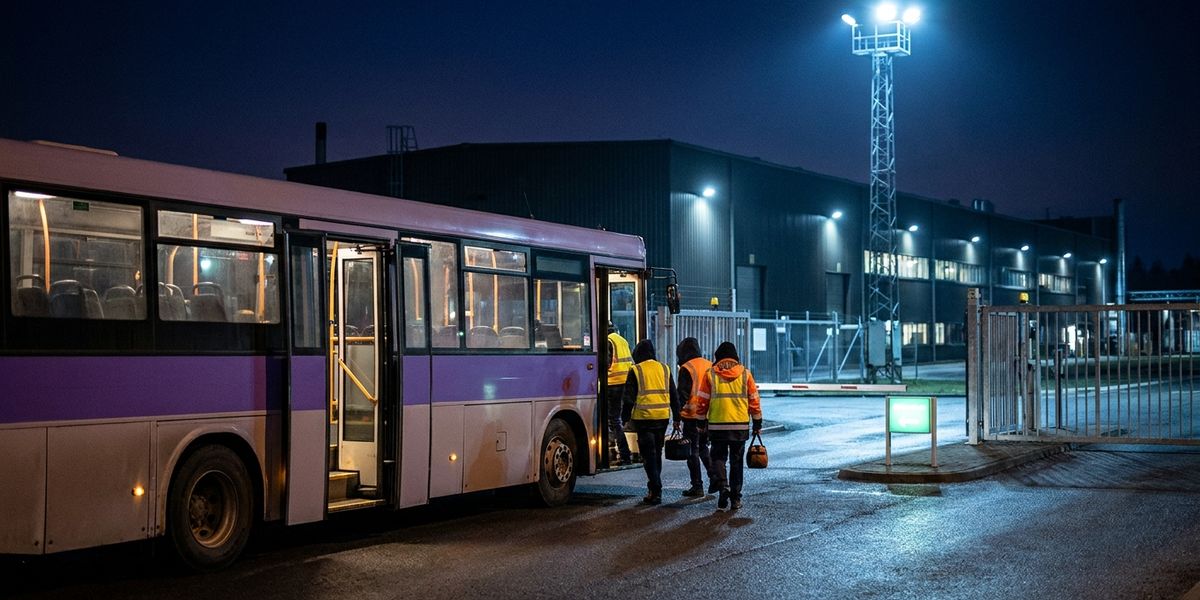
A production line scheduled to start at 06:00 cannot wait for a shuttle that pulls up at 06:12. That twelve-minute gap is the whole problem in one sentence. Office commuting forgives a late arrival; a continuous manufacturing line does not, because the off-going shift clocks out on the handover and the station sits empty until the relief operator reaches it. Multiply that across three handovers a day, seven days a week, and employee transportation stops being a perk line and becomes a piece of the production schedule.
This guide is for the operations and plant leaders who own line uptime, headcount-at-station, and per-unit cost at sites of 200 to 20,000-plus employees, especially two-shift, three-shift, and 24/7 continuous operations. Costing the transportation line item honestly, planning routes around shift boundaries instead of an office commute curve, choosing between owning a fleet, chartering, and optimizing with software, and instrumenting the program once it runs are the decisions it works through. HR leaders defending a retention case and facilities leaders managing parking load will find the cost and routing sections directly useful too.
What it does not cover: a charter-vendor buying checklist for a single route, last-mile microtransit on an office campus, or country-by-country labor regulation. The data is US-anchored with European context, and the framework holds for any plant where the workforce lives farther from the gate than transit will carry them.
Why factory shuttle logistics break the rules office commuting plays by
An office runs on one arrival peak and one departure peak, with an hour of slack on each side. A 24/7 plant runs on hard deadlines. A three-shift operation typically hands over at 06:00, 14:00, and 22:00, and each of those times is an arrival cutoff, not a target. Miss it and you are either holding the off-going shift on unplanned overtime or running the line a body short.
The stakes behind getting this right are climbing, not flattening. Deloitte and The Manufacturing Institute projected that US manufacturing could need as many as 3.8 million additional workers between 2024 and 2033 as investment drives growth. The figure that gets quoted most is the second one: more than 5 in 10 of those skilled openings, about 1.9 million jobs, could go unfilled if the skills and applicant gaps are not addressed. That 1.9 million is a conditional projection, not a forecast of doom, and it is worth keeping the “if” attached. The demand is already visible in current data. BLS counted hundreds of thousands of open manufacturing positions through 2025 in its JOLTS series, against a manufacturing employment base of roughly 12.7 to 12.8 million (BLS Current Employment Statistics, 2025).
Workforce is what manufacturers themselves name as the binding constraint. In the National Association of Manufacturers’ Q1 2024 outlook survey, 65% of respondents ranked attracting and retaining talent at the top of their business challenges, ahead of supply chain, ahead of energy cost. NAM has run that survey quarterly for years, and talent has held the top or near-top spot in most of them outside the pandemic shock.
Here is where transportation enters the picture. When you cannot fill seats from the immediate area, you widen the recruiting radius, and a wider radius means a longer commute for the people you hire. The longer the commute, the more fragile attendance becomes against exactly the deadlines a line cannot flex around. A site that solves recruiting by reaching 50 kilometers out has not solved staffing; it has converted a hiring problem into an attendance problem, and the attendance problem lands on the shift handover.
The 22:00-to-06:00 problem: where transit stops and the night shift starts
Public transit is built for the daytime commuter, and it abandons the night-shift worker precisely when that worker needs a ride. The American Public Transportation Association, in its report on late-shift workers, documented that in many areas local buses simply do not run between roughly 1:00 a.m. and 5:00 a.m. APTA estimated that late-shift commuters who depend on transit earn around $28 billion in wages and generate $84 billion in sales a year, yet workers on those schedules in metro areas were about 40% less likely to commute by public transit than daytime workers, largely because the service is not there to use.
Manufacturing carries more of these schedules than most sectors. The most recent dedicated federal read on shift prevalence, the BLS Job Flexibilities and Work Schedules survey for 2017–18, found that 16% of US workers usually worked a non-daytime schedule: 6% on evenings and 4% on nights, with the remainder on rotating or other arrangements. Production occupations sat among the highest for night work. BLS has not refreshed that dedicated survey since, so cite it with the year showing; it remains the best available baseline rather than a current snapshot.
Put the two facts together and the night band stands out as the structural weak point. The 22:00 handover sends one crew home into the hours when transit has shut down and pulls another in from those same hours. For a worker without a car, or with a car they would rather not drive home exhausted at 06:30, the realistic options narrow to a colleague’s carpool that may or may not survive the next schedule change, or an employer-run ride. The night shift is also where absenteeism and turnover concentrate, which means the band with the thinnest transport alternatives is the band where staffing fails most expensively.
A plant that builds its transportation program around the day shifts and treats nights as an afterthought has protected the easy band and left the hard one exposed. Routes that run when nothing else does are the ones that matter most.
Why the plant sits far from the workforce, and why that gap is widening
Reshoring and greenfield siting are pushing new plants away from dense labor pools, not toward them. Large fabrication and assembly facilities get sited for land, power, water, and incentives, and those criteria rarely coincide with where the skilled workforce already lives. CSIS, analyzing the semiconductor build-out, estimated that planned US fabs would need somewhere between 70,000 and 90,000 fab workers, with full domestic self-sufficiency requiring on the order of 300,000, and flagged that recruiting and retaining that workforce is a major challenge precisely because the sites often land far from existing talent. Construction alone pulled thousands per site, with reporting on individual reshored fabs citing six to seven thousand construction workers each.
The commute distances that result are not theoretical. Tesla reportedly runs a free employee shuttle from Killeen, Texas, to its Austin gigafactory, a site about 75 miles away, using a fleet of roughly 50-passenger charter buses making the round trip multiple times a day with pickups across several towns (Killeen Daily Herald). Local reporting documented the route in operational detail, down to the operator and the vehicle count, which is why it works here as an illustration. The point it makes concretely: when the labor pool is 75 miles out, the employer either builds the bridge across that distance or competes for the small slice of workers willing to drive it twice a day.
European plants face a milder version of the same arithmetic. Eurostat reported the average one-way commuting time across the EU at 25 minutes in 2019, with national figures ranging from about 19 minutes up to 33 in Latvia. Those averages flatter the industrial case, though, because they blend dense-city office workers with everyone else. An industrial park on the edge of a metro region or out in a peripheral zone sits in the long tail of that distribution, not at the mean. Catchment areas of 40 to 70 kilometers are common for plants sited away from population centers, which is a long way past where a 25-minute average implies.
The strategic read for an operations leader is straightforward. If your site selection or expansion plan puts the next plant in a peripheral zone, the transportation question is not a post-occupancy facilities detail. It is a staffing precondition, and it belongs in the workforce model alongside wage assumptions and the recruiting radius.
What unreliable commutes actually cost a plant, in absences and defects
The vendor pitch for shuttles usually leads with a tidy “cuts absenteeism by X%” figure. Those numbers almost never trace to a verifiable source, so this guide builds the cost case from peer-reviewed evidence instead and keeps the causal chain explicit.
Start with the commute-to-absence link. Goerke and Lorenz, using German panel data in an IZA study designed to isolate causation by tracking workers who changed commuting distance while staying with the same employer and residence, found that long-distance commuters were absent about 20% more than employees with no commute. Earlier work cited in the same paper put the elasticity of illness-related absence with respect to commuting distance at roughly 0.07 to 0.09. The German magnitudes will not transfer point-for-point to a US or Israeli plant, and the core paper dates to 2017, so treat it as evidence of the mechanism rather than a transplantable percentage. The mechanism is the useful part: a longer, more grinding commute produces measurably more absence, and a reliable employer-run ride is one of the few levers that shortens the effective burden of that commute without moving the worker’s house.
The absence shows up at the worst place for a line: the handover deadline. An operator who misses the 06:00 cutoff is not 12 minutes late to a meeting that starts whenever everyone arrives. The station is unstaffed, the off-going operator either stays on overtime or the line slows, and a thin night roster has no float to absorb it.
Then there is what turnover does to product quality, which is the figure that should get a CFO’s attention. A 2022 Management Science study by Moon and colleagues tracked nearly 50 million mobile devices through four years of customer use and matched field failures back to the staffing of the assembly lines that built them. Each one-percentage-point rise in a line’s weekly worker-turnover rate raised field failures by 0.74% to 0.79%. Devices built in the high-turnover weeks right after payday were 10.2% more likely to fail in the field than those from the lowest-turnover weeks. Turnover does not just cost the recruiting line; it shows up later as warranty claims and returns on product the customer already paid for.
A word on what that study does and does not say, because conflating two causal chains is easy here. The Management Science work links turnover to defects. The IZA work links commuting burden to absence, and a broad body of HR research links commuting burden to turnover. Transportation acts on the absence and turnover end of the chain; the defect cost is what makes the turnover end expensive. Reliable transport reduces the commuting burden, which trims absence and turnover, which in turn protects quality and recruiting spend. Each link is sourced; the program does not need a vendor’s invented “30% reduction” to stand up.
On the recruiting side, SHRM’s benchmarking has long pegged the average hard cost per hire in the low thousands of dollars, on the order of $4,100 to $4,700 depending on the edition. That is the recruiting cost alone, not full replacement cost with lost productivity and training, so resist the urge to inflate it with the “50% to 200% of salary” figures that circulate in vendor blogs without a primary source behind them.
Building the transportation line item: a true-cost methodology
Most finance teams track one leg of commute spend and miss the rest. Parking is visible because it sits in the capital budget. The costs that hide are absence traceable to commute friction, turnover-driven recruiting and quality spend, and the shift premiums a plant pays when it cannot staff nights at base rate. A defensible transportation business case totals all four and compares the all-in figure against the program cost, not the shuttle cost against zero.
Parking is the easiest avoided cost to quantify because there is a published benchmark. WGI’s Parking Structure Cost Outlook put the US median construction cost for structured parking at about $29,900 per space in 2024, up a few points year over year. A surface lot costs far less per space, mostly land and paving, while underground structures run much higher. The avoided-capex argument only holds where the plant would otherwise have to build structured parking; for a rural site with cheap land and a surface lot, the avoided cost is real but small, and overstating it discredits the rest of the case.
Walk a worked example for a 1,200-person plant on a three-shift rotation in a peripheral industrial zone, with a 50-kilometer catchment and persistent night-shift staffing trouble.
The site is weighing 350 net new parking spaces to handle peak overlap at the 14:00 handover. At the structured-parking median, that is roughly $10.5M in capital before maintenance and lighting. Absence traceable to long commutes is the second leg: applying the direction of the IZA finding to a workforce where a large share commute well over 30 kilometers, the plant models a meaningful share of its unplanned-absence hours as commute-linked, each one carrying either overtime backfill or lost line output. The third leg is turnover, where every departure runs through a recruiting cost in the low thousands plus the quality drag the Management Science study quantified. The fourth is shift-premium leakage: when the plant cannot fill nights from its local pool, it pays a higher differential or leans on agency labor to cover the band. Total those four and the “true” commute-related spend is several times the parking line alone, which is the only line most reviews look at.
That all-in figure is the denominator the program competes against. A transportation program that costs a fraction of it, and moves even part of the absence and turnover, pencils out long before anyone counts the avoided parking capital. The discipline is to put every leg on the same page rather than defending a shuttle against a blank cell.
Build a fleet, charter the routes, or optimize with software: a decision framework
Three models cover almost every manufacturing transportation program, and none of them wins everywhere. The right answer is usually a blend, and the deciding variables are site size, how spread out the catchment is, and how thin the night demand runs.
| Model | Best fit | Cost shape | Night-band fit | Multi-shift flexibility |
|---|---|---|---|---|
| Own fleet | Single large site, stable routes, high daily volume | High capex plus drivers, maintenance, depreciation | Strong if you accept low night utilization | Low — vehicles and drivers are fixed assets |
| Charter contract | Fixed high-volume corridors (the Tesla Killeen pattern) | Per-vehicle, per-route; little capex | Costly on thin night runs unless renegotiated | Medium — limited by the contract terms |
| Software-optimized managed model | Multi-shift, dispersed catchment, demand that varies by shift | Per-seat / per-trip; right-sized to the roster | Strong — thin night lines get sized to actual demand | High — separate route profiles per shift |
Owning a fleet makes sense when one large site runs predictable, high-volume routes and the plant wants direct control of vehicles and drivers. The trade is capital and rigidity: buses and drivers are fixed costs that sit idle on the thin 22:00 run and cannot be reshaped when a shift pattern changes. Chartering removes the capex and suits fixed high-volume corridors, which is the shape of the long-haul commuter route from a distant town. Its weakness is the same thin night band, where a per-vehicle charter rate prices a near-empty bus the same as a full one. The software-optimized managed model, where a platform reads the shift roster and right-sizes routing rather than running a fixed timetable, fits the multi-shift, dispersed case best, because it can run a full vehicle on the dense 06:00 inbound and a smaller one on the thin 22:00 line.
The common objection deserves a direct answer: below some headcount, doesn’t a structured program just fail to pencil? Sometimes. A 150-person single-shift plant near a town with decent transit probably does not need more than a subsidy. But the threshold is lower than most operations leaders assume once the catchment is wide and the schedule is multi-shift, because the cost the program offsets is not the shuttle alone; it is the absence, turnover, and shift-premium stack from the section above. The question is not “are we big enough for buses,” it is “what is unreliable commuting already costing us at this site.” Ryde’s smart shuttles sit in the software-optimized column, where routing follows the roster instead of a static schedule. For the broader cost comparison logic, the breakdown in reducing corporate transportation costs runs the math across program types.
Designing routes around three shift boundaries
Once the model is chosen, the planning work is route design against the handover clock, and it is genuinely different from designing an office shuttle. Three principles carry most of it.
Build an arrival buffer before every handover, not a target time. If the line starts at 06:00, the route should deliver workers to the gate with enough margin to badge in, change, and reach the station before the off-going crew leaves. A 06:00 arrival is a 05:58 failure waiting to happen. Designing to a 05:45 delivery for a 06:00 start trades a few minutes of paid waiting against the far larger cost of an unstaffed station, and on a continuous line that trade is not close.
Run separate route profiles per shift rather than one timetable stretched across all three. The 06:00 inbound and the 22:00 inbound serve different volumes, different pickup densities, and a different transit baseline, because the night route runs when public options have shut down. A single profile forced across both over-serves the day and strands the night, which is the most common design failure and the one that gets a program cancelled for “low utilization” when the real fault was uniform routing.
Right-size the vehicle to the demand on each line, and re-size as the roster moves. A thin 22:00 line carrying 14 people does not need the 50-seat coach that the 06:00 line fills. Matching vehicle size to seated demand per shift is where the software-optimized model earns its cost difference; a fixed fleet or a flat charter cannot do it. Map the catchment by pickup town and let the densest corridors justify the larger vehicles while the thin tail gets a right-sized one.
The catchment map underneath all three is the foundation. Plot where workers actually live against the shift they work, and the route structure mostly designs itself: a few dense corridors that justify high-frequency runs, a longer thin tail that needs smaller or pooled vehicles, and a night band that needs deliberate coverage rather than the leftovers of the day plan.
Metrics that tell you the program is working
A transportation program is easy to fund and easy to kill, because the people who set its budget rarely ride it. Instrument it so the decision gets made on data rather than on the loudest complaint.
On-time arrival at handover is the headline metric, and it is specific to manufacturing in a way office-shuttle metrics are not. Track the share of riders delivered before each shift’s badge-in cutoff, by shift. A program that hits 99% at 06:00 and 88% at 22:00 has a night-route problem the system-wide average would hide. No-show rate by shift is the second: if the night band shows higher no-shows than days, the routing or the coverage is failing exactly where staffing is hardest. Cost per seated trip, tracked per shift and per route, is the efficiency line that catches the near-empty night coach before it becomes the reason finance kills the program. Utilization by line and shift tells you where to re-size vehicles. And recruiting radius is the strategic metric: if a working program lets the plant hire reliably from towns it previously could not serve, that widened radius is a recruiting asset worth naming in the next workforce plan.
Resist the single system-wide average on every one of these. Averaging a full 06:00 run against a deliberately light 22:00 run produces a middling number that describes neither and hides both. The whole point of shift-boundary design is that the shifts are not alike, so the measurement cannot pretend they are.
Five mistakes that sink a manufacturing shuttle program
The failures repeat across sites, and most are visible in the data the plant already holds.
Running one route profile across unlike shifts is the most common. A timetable built for the dense day inbound, then copied onto the night band, over-serves one and abandons the other, and the program gets judged on a blended utilization figure that misrepresents both. Match the profile to each shift’s real volume and transit baseline.
Putting fixed vehicles on thin night demand is the second. A 50-seat coach assigned to a 14-person 22:00 line burns cost per seat and hands a budget reviewer an easy line to cut. Size the vehicle to the seated demand, and let the night line run smaller.
Carrying no per-shift cost visibility is the third. A program tracked only as a single monthly total cannot show finance which shift is efficient and which is not, so the whole thing gets defended or attacked as one undifferentiated number. Instrument cost per seated trip by shift from day one.
Skipping the pilot and launching site-wide is the fourth. Nothing discredits a program faster than turning it on across every shift and route at once, getting the windows wrong on most of them, and watching utilization crater. The detailed version of why these rollouts collapse is in why shuttle pilots fail in week 6. Pilot the hardest shift at one site, instrument it, then scale on the numbers.
Treating the night band as an afterthought is the fifth and most expensive. The 22:00-to-06:00 shift has the thinnest transit alternative, the highest staffing difficulty, and the most fragile attendance, and a program that covers days well but goes dark on nights protects the band that was never the problem. The night routes are the ones that justify the program.
Frequently asked questions
How does an employee shuttle work for a factory on shifts?
A manufacturing employee shuttle runs timed routes from where workers live to the plant gate, scheduled to deliver each shift before its handover cutoff rather than on a fixed all-day headway. The defining difference from an office shuttle is that arrival is a deadline, not a target: a route serving a 06:00 line start delivers riders with a buffer to badge in and reach the station before the off-going crew leaves. Well-run programs use separate route profiles for the 06:00, 14:00, and 22:00 handovers because each serves different volumes and a different transit baseline.
Do employee shuttles reduce absenteeism in manufacturing?
The honest evidence is indirect but real: there is no credible vendor statistic, but peer-reviewed research links longer commutes to higher absence. An IZA study found long-distance commuters were absent about 20% more than employees with no commute, isolating the effect by tracking workers whose commuting distance changed while their job and home stayed fixed. A reliable employer-run ride reduces the effective commuting burden, which is the variable that research connects to absence; it does not eliminate absence, and any vendor quoting a precise reduction percentage should be asked for the primary source.
How much does an employee transportation program for manufacturers cost?
Cost depends on the model, the catchment, and how thin the night demand runs, so the useful answer is a methodology rather than a number. Owning a fleet front-loads capital plus drivers and maintenance; a charter contract is per-vehicle and per-route with little capital; a software-optimized managed model prices per seat or per trip and right-sizes to the roster. The figure that matters is not the program cost in isolation but the program cost against the all-in commute spend it offsets, which includes avoided parking capital (a US median around $29,900 per structured space in 2024, per WGI), absence, turnover, and shift-premium leakage.
What is the best transportation option for night shift workers?
For the 22:00-to-06:00 band, a demand-sized employer-run route almost always beats both a fixed full-size shuttle and a commuter subsidy. Public transit frequently does not run between roughly 1:00 and 5:00 a.m. (APTA), so a subsidy leaves the night worker driving themselves home tired, and a fixed 50-seat vehicle burns cost per seat on a thin line. A right-sized route that runs only the seats the night roster actually needs covers the band where staffing is hardest without the empty-coach cost.
How do you plan shuttle routes for a 3-shift plant?
Start from a catchment map of where workers live plotted against the shift they work, then design three separate route profiles to the 06:00, 14:00, and 22:00 handovers. Each profile gets an arrival buffer before its cutoff, a vehicle sized to that shift’s seated demand, and coverage matched to the transit options available at that hour, which means the night profile needs deliberate design rather than the day plan’s leftovers. The smart employee commuting overview covers how roster-driven routing handles the per-shift differences, and the manufacturing industry page describes the shift-handover problem in more operational detail.
Two numbers to pull before your next workforce review
Two artifacts turn this from a concept into a decision a finance team can evaluate. First, build the all-in commute-cost figure for one site: avoided parking capital, commute-linked absence hours, turnover cost with the quality drag attached, and shift-premium leakage on nights. That number, not the shuttle quote, is what the program competes against, and it is almost always several times larger than the parking line most reviews stop at. Second, map your catchment by pickup town against shift, and you will see immediately whether the night band has any realistic transit alternative or whether it is the exposed seam in your staffing.
The plants that will staff their night shifts reliably over the next decade are the ones that treat transportation as part of the production schedule rather than a facilities afterthought, because the labor math is moving against the sites that wait. If you want to pressure-test a roster-driven, shift-matched model against your own catchment and handover clock, look at how Ryde structures manufacturing transportation programs and the outcomes documented in the case studies, then bring your hardest shift to the conversation.
Sources
- The Manufacturing Institute & Deloitte. “Manufacturers Need as Many as 3.8 Million New Employees by 2033” / “Taking charge: Manufacturers support growth with active workforce strategies.” https://themanufacturinginstitute.org/manufacturers-need-as-many-as-3-8-million-new-employees-by-2033/
- Deloitte Insights. “Supporting US manufacturing growth amid workforce challenges.” https://www.deloitte.com/us/en/insights/industry/manufacturing-industrial-products/supporting-us-manufacturing-growth-amid-workforce-challenges.html
- National Association of Manufacturers. “2024 First Quarter Manufacturers’ Outlook Survey.” https://nam.org/2024-first-quarter-manufacturers-outlook-survey/
- U.S. Bureau of Labor Statistics. “Job Openings and Labor Turnover Survey (JOLTS).” https://www.bls.gov/jlt/
- U.S. Bureau of Labor Statistics. “Manufacturing employment, Current Employment Statistics.” https://www.bls.gov/iag/tgs/iag31-33.htm
- Goerke L, Lorenz O. “Commuting and Sickness Absence.” IZA Discussion Paper No. 11183. https://docs.iza.org/dp11183.pdf
- Moon K, Loyalka P, Bergemann P, Cohen J. “The Hidden Cost of Worker Turnover: Attributing Product Reliability to the Turnover of Factory Workers.” Management Science, 2022. https://pubsonline.informs.org/doi/10.1287/mnsc.2022.4311
- Society for Human Resource Management. “Average cost per hire” benchmarking. https://www.shrm.org/topics-tools/news/shrm-benchmarking-report-4129-average-cost-per-hire
- American Public Transportation Association. “Supporting Late-Shift Workers: Their Transportation Needs and the Economy.” https://www.apta.com/wp-content/uploads/APTA_Late-Shift_Report.pdf
- U.S. Bureau of Labor Statistics. “Job Flexibilities and Work Schedules in 2017–18.” https://www.bls.gov/spotlight/2020/job-flexibilities-and-work-schedules/home.htm
- Eurostat. “Main place of work and commuting time – statistics.” https://ec.europa.eu/eurostat/statistics-explained/index.php?title=Main_place_of_work_and_commuting_time_-_statistics
- WGI (Walker Consultants). “Parking Structure Cost Outlook for 2024.” https://publications.wginc.com/parking-structure-cost-outlook-for-2024
- Center for Strategic and International Studies. “Reshoring Semiconductor Manufacturing: Addressing the Workforce Challenge.” https://www.csis.org/analysis/reshoring-semiconductor-manufacturing-addressing-workforce-challenge
- Killeen Daily Herald. “All Aboard: Tesla busing Killeen-area workers to Austin factory daily.” https://kdhnews.com/business/all-aboard-tesla-busing-killeen-area-workers-to-austin-factory-daily/article_7591d184-7732-11ed-9603-c75c954fd5a3.html