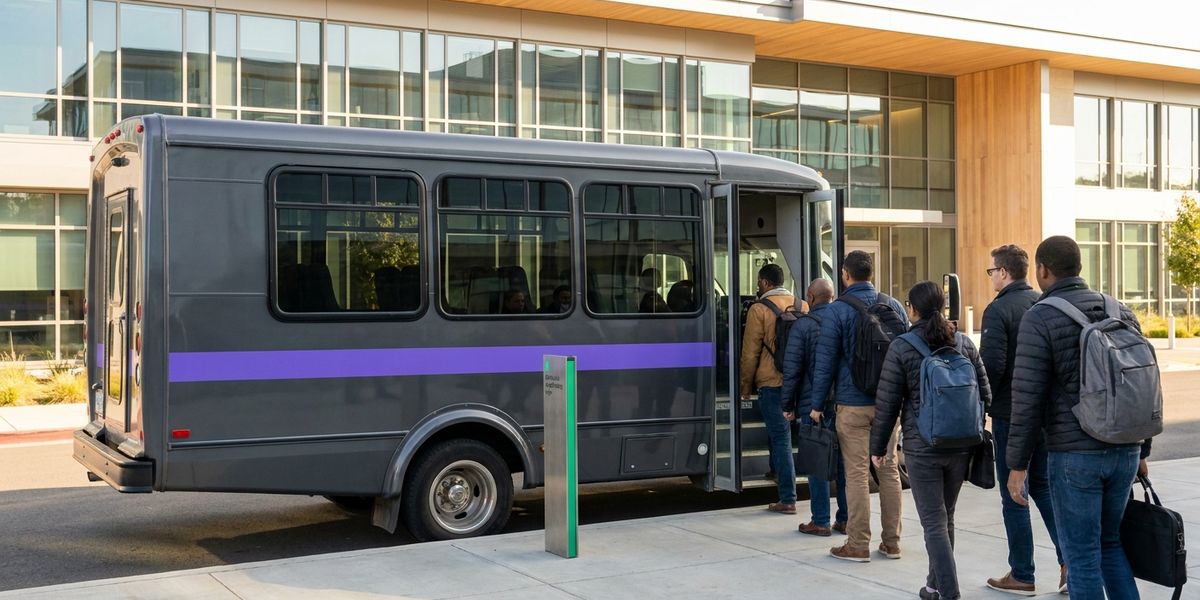
On January 7, 2026, Wix told staff in Tel Aviv, Beersheba, Kraków, and Vilnius that the office week was returning to five days, effective February 1. President Nir Zohar framed the reason as collaboration: the office, he told staff, delivers “the quick chats, the unplanned ideas” that make “a real difference in how fast things move,” especially as the industry is reshaped by AI. That is a defensible call, and Wix is one of many high-tech employers making it this year. Should people be in the building? That policy question is increasingly settled. What leadership has not always staffed is the question that decides whether the mandate actually produces the attendance and retention it was meant to: can every employee reliably get to the desk five mornings a week? That second question is a commute question, and the commute is the part of an RTO plan most employers leave to chance.
The mandate is the policy. The commute is the delivery.
A mandate sets the expectation. It does not move anyone across town.
The expectation is now mainstream. Flex Index put 32% of US firms at full-time in-office as of Q4 2025, with the average required in-office week climbing to 2.78 days from 2.49 two quarters earlier. CBRE’s 2025 Americas occupier survey, covering 184 large companies, found 72% hitting their stated attendance goals, up from 61% the year before, and 77% now asking for three or more days. So the skeptic’s first instinct is correct: mandates are landing. Plenty of employers are getting the badge swipes they asked for.
Look one layer down, though, and the same CBRE data shows where the friction sits. Two-thirds of organizations report their offices run under 60% utilized on an average day, while attendance concentrates on a few peak days — a gap we’ve traced before in the Tuesday-through-Thursday peak. Kastle Systems, which reads keycard swipes across roughly 2,600 US buildings, recorded its highest weekly average since early 2020 in December 2025: 56.3%, with a 66.0% Tuesday peak that set a post-pandemic single-day record. Even at the high-water mark, the average instrumented building sat close to half empty. A mandate’s whole job is to move that swipe number, and a swipe only happens after someone has completed a physical trip to the building.
That trip is getting harder, not easier. The Census Bureau’s American Community Survey put the mean one-way US commute at 27.2 minutes in 2024, up from 26.8 the prior year. The share of workers facing a 60-plus-minute one-way commute reached 9.3%, the highest the survey has ever recorded. Employers are asking for more in-office days at precisely the moment the trip in is lengthening — the mandate-meets-commute squeeze one 2026 analysis traces across the firms going five-day. A mandate is a line in a policy doc. Its delivery happens at the loading dock of the commute, where that policy either arrives or doesn’t.
Where RTO mandates actually lose people
When a mandate underdelivers, it rarely fails at the policy line. It fails at the parking-lot line, and the people it sheds are disproportionately the ones an employer least wants to lose.
The cleanest academic read on this comes from a working paper by Ding, Jin, Ma, Xing, and Yang, which tracked 54 S&P 500 tech and finance firms that announced RTO mandates against the LinkedIn employment histories of more than three million workers. Using a difference-in-differences design that adjusts for the national turnover trend, the authors calculated that the average turnover rate at RTO firms rose 14% after the mandates took effect. Their finding on who left is the part that should worry a People-Ops leader: the increase concentrated among senior, skilled, and women employees, and the firms then took significantly longer to refill those roles. (The paper is a 2024 working draft and not yet peer-reviewed, so treat the 14% as directional rather than settled.)
Gartner’s HR research lines up with that pattern from the survey side. Under rigid on-site requirements, Gartner found high performers reporting 16% lower intent to stay, double the 8% drop among average performers; women came in at 11% lower and millennials at 10%. That same research recorded no measurable effect of the mandate on actual performance. Talent most exposed to a hard mandate is the talent with the most outside options.
Does any of this prove the commute is the mechanism? On its own, no. Turnover has many inputs. But the most rigorous causal evidence available points straight at commute friction. Bloom, Han, and Liang ran a six-month randomized controlled trial of 1,612 Trip.com employees, published in Nature in 2024, splitting them between five days in-office and a three-day-office hybrid. Resignations in the hybrid group fell 33% with no hit to performance grades or promotion rates, and the effect was strongest among non-managers, women, and — the load-bearing detail here — employees with long commutes. Each quit, the researchers estimated, cost the firm about $20,000 in recruiting and training.
Read those three findings together. Workers who leave after a mandate skew senior and skilled (Ding and colleagues); flight risk concentrates in high performers and women (Gartner); and what most reduces quitting is relief for the people with the worst trip in (Bloom and colleagues). A mandate isn’t the wound. Commute friction is where it bleeds.
What a campus that engineered the commute looks like
Some employers stopped treating the trip as the worker’s private logistics problem and built it into the workplace. Their numbers are the proof of concept.
Microsoft’s Connector is the canonical case. A rider survey found 61% of Connector passengers had previously driven to Redmond alone, and the program removed on the order of 800 vehicle trips and 32,200 vehicle-miles of travel from the road each day across its 20-plus routes. Genentech ran a similar play in South San Francisco. Its gRide program set a 30% modal-shift target for its first three years and beat it; today more than 40% of employees use gRide on a given day, and the program has eliminated over 4.5 million single-occupancy trips since 2006. Neither company waited for local transit to solve the problem for them. They put the commute inside the offer.
Geography is what makes the difference dramatic for multi-site employers. Wix’s mandate covers Israeli sites, and Israel is a useful stress test: reporting by Globes, citing the OECD, has described Israeli road congestion as the worst in the developed world, with the large majority of trips made by private car. Drop a five-day requirement onto a market like that with no transport plan, and you have asked every employee to personally solve the densest traffic in the OECD, five mornings a week, on their own. The same logic scales down to a congested US suburban campus or a Polish tech hub. The harder the local trip, the more the managed-transportation layer is doing — and the more an absent one quietly costs.
This is the variable an employer can actually control. You cannot widen the highway or accelerate the regional rail timetable. You can put a vanpool or a smart employee commuting program between the neighborhood and the door, which is exactly the move the aviation hubs in our analysis of 4 a.m. ramp shifts reach for when transit can’t deliver workers on time.
The CFO’s objection, and why the math still favors the program
A sharp finance leader will push back, and the objection deserves a real answer rather than a strawman. Commuting, the argument goes, has always been the employee’s responsibility; the 2025–26 tech labor market hands employers the upper hand to ask for attendance without subsidizing the trip; and a transportation program is a cost center with no obvious line to the attendance metric. The 32% of firms now mandating full-time office (Flex Index) is offered as proof that mandates stick without anyone buying a bus.
Take the premise at face value. An employer genuinely cannot own every worker’s driveway-to-desk trip, and a soft labor market does shift bargaining power. Where the objection breaks is the claim that the transportation spend has no line to retention. Evidence above draws that line directly. A program is not the only thing that moves turnover — wage floors do, as the UC Berkeley Labor Center documented at San Francisco International, where a quality-standards wage floor cut screener turnover from 94.7% to 18.7% in fifteen months against a roughly 110% industry norm. But once pay is competitive, the commute is the next variable down, and it is far cheaper to engineer than a wage reset.
Run the comparison the way a finance team would. What costs real money is not the bus; it is the senior engineer who leaves because the five-day trip became untenable.
- Trip.com’s RCT priced each avoided resignation at about $20,000, and hybrid cut resignations 33% — with long-commute workers among those most retained.
- AAA puts the all-in cost of running a new car at $11,577 a year (2025, all driving, not commute-only). That is the personal burden a managed program offsets, and the burden a worker weighs against a competing job with a shorter trip.
- A commuter shuttle or vanpool is a qualified transportation fringe benefit. For 2026 the IRS lets employers deliver up to $340 per month per employee pre-tax, so a chunk of the program runs on tax-favored dollars rather than new gross spend.
The program does not have to retain many senior people to clear its own cost. Lose three or four hard-to-refill engineers in a year because the trip got worse, and the replacement bill — recruiting, ramp time, the roles that sat open while the team carried the gap — dwarfs a regional vanpool contract. The commute is the one RTO failure mode an employer can engineer away, and it is priced below almost every alternative on the table.
The 2026 question isn’t whether to mandate
Through 2026, more high-tech employers will land where Wix did, and for sound collaboration reasons. The open question is no longer whether to bring people in. It is whether the attendance and retention numbers survive contact with the parking lot — whether the senior people leadership most wants in the room can actually get there five mornings a week without the trip becoming the reason they take the next call from a recruiter. Employers that write the commute into the RTO plan from day one will convert the mandate into attendance. Those that bolt it on after the badge data disappoints will be reverse-engineering a retention problem they could have priced in advance.
If you own an RTO policy and the attendance number that comes with it, the cheapest place to start is the trip itself. Mapping where your people live against how they actually get in is a short exercise; let’s run it together before the next quarter’s attendance report makes the case for you.
Sources
- “Wix says US employees will remain hybrid as the company announces 5-day office return” — Calcalist (CTech), January 7, 2026. Accessed 2026-05-28.
- “Kastle Back to Work Barometer Hits All-Time Post-Pandemic Highs” — Kastle Systems, December 2025. Accessed 2026-05-28.
- “Commuting Characteristics by Sex (ACS 1-Year Estimates)” — US Census Bureau, American Community Survey, 2024. Accessed 2026-05-28.
- “Return-to-Office Mandates and Brain Drain” — Ding, Jin, Ma, Xing, Yang, SSRN working paper, 2024. Accessed 2026-05-28.
- “Hybrid working from home improves retention without damaging performance” — Bloom, Han, Liang, Nature, June 2024. Accessed 2026-05-28.
- “Gartner HR Research Finds High Performers, Women, Millennials Are Greatest Flight Risks” — Gartner, January 2024 (surveys May–June 2023). Accessed 2026-05-28.
- “The Flex Report Q4 2025” — Flex Index (Scoop), Q4 2025. Accessed 2026-05-28.
- “2025 Americas Office Occupier Sentiment Survey” — CBRE, 2025. Accessed 2026-05-28.
- “AAA: New Vehicle Costs Drop to $11,577” — AAA, September 2025. Accessed 2026-05-28.
- “Microsoft Connector: 19 Routes, 53 Buses Later” — Seattle Times. Accessed 2026-05-28.
- “The Evolution of Genentech’s gRide Program” — Sengerio. Accessed 2026-05-28.
- “IRS Boosts Commuter Benefit Limits for 2026” — SHRM (citing IRS Rev. Proc.), 2025. Accessed 2026-05-28.
- “Living Wages and Economic Performance: The San Francisco Airport Model” — UC Berkeley Labor Center (Reich, Hall, Jacobs), 2003. Accessed 2026-05-28.
- “OECD, IMF: Israel has West’s worst traffic jams” — Globes (citing OECD/IMF), 2018. Accessed 2026-05-28.