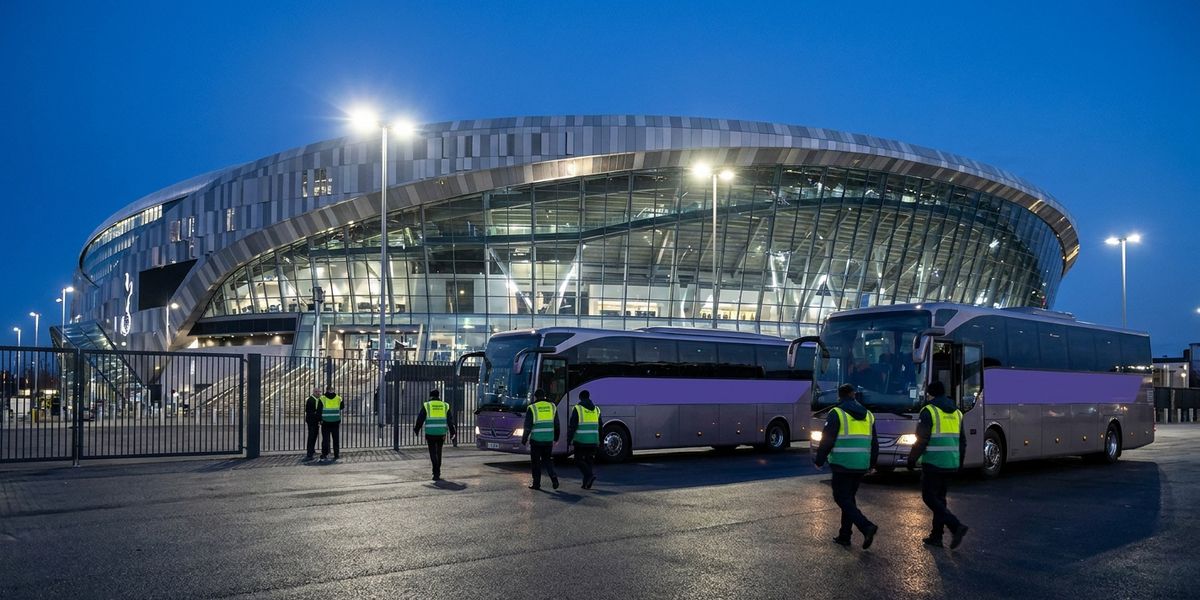
At Allegiant Stadium in Las Vegas, an outside operator has moved the venue’s own gameday workforce for five years running. Transportation Management Services reports that since 2021 it has shuttled stadium employees from an offsite parking lot to the venue, with headcount swinging from 500 to 3,000 per event across more than 40 events a year. Read that swing again. A single building has to absorb a sixfold change in how many workers it puts on site and pulls back off, and it built a managed program to do it. Most venues haven’t. They plan fan ingress and egress to the minute, then treat the transport of their event-day workforce as something the staffing contractor or the workers themselves will sort out. That gap, not the size of the employee lot, is what shows up later as gameday no-shows and replacement overtime. The evidence below says event-day staff transport is a distinct operational input, and a transit-timing problem before it is a parking one.
Why a sold-out night triples your headcount
A non-event day at an arena needs a skeleton crew. A sold-out one needs a small workforce that materializes for four to six hours and then disappears. The gameday workforce transportation problem starts there, with a headcount that bears no relation to the building’s baseline staffing.
The concessions count alone is large. ESPN, reporting in 2020 on stadium workers idled by the shutdown, logged 625 Levy concession workers at Barclays Center, 792 at the United Center, around 1,060 across Wrigley Field and Guaranteed Rate Field, and roughly 2,500 Aramark workers staffing the three south Philadelphia stadiums. Wells Fargo Center put its gameday roster near 1,000; the 76ers counted about 350. Those are food-and-beverage figures only. They leave out security, ushers, parking crews, and the cleaning teams who haven’t even clocked in when the gates open. The full event-day roster sits above every one of those numbers.
So the building doesn’t just need more people on an event night. It needs them in two tight windows, inbound before doors and outbound across a long, staggered tail, and it needs them from a labor pool that mostly works these hours by exception, not by routine. That is a logistics problem with a specific shape, and it is the one the Allegiant program was built to handle.
Fan transport and staff transport are not the same problem
Venues quietly conflate two things at this point. When a city stands up special event transit, that service exists to clear the crowd. It is timed to fans.
Look at the published plans. For Super Bowl LX, VTA scheduled its event service to run for a window after the game and then wind down; NJ Transit’s Meadowlands rail and bus service follows the same logic, with trains and buses sized to fan egress and the last departures landing within an hour or two of the final whistle. Generous, by transit standards. Useless for the people who can’t leave yet.
Because the staff who most need a late ride are the ones still working when that window closes. Post-event breakdown does not begin until the last guest is out, and a venue’s turnaround can run eight to 10 hours past that point, according to commercial-cleaning operators who staff it. The math is unkind. Fan transit stops one to two hours after the game; the cleaning and load-out crews are on the clock until two, three, or four in the morning. The single most transit-dependent slice of the workforce is the slice the transit window is designed to miss. Late-night staff transport, in other words, is a different service with a different clock, and bolting it onto a fan plan does not produce it.
The no-show math nobody puts on the staffing budget
Strand a worker at the end of a shift once and you have taught them what overbooking the next shift will cost you. This is the part that never makes it onto the staffing line, even though it sets the size of that line.
Start with who these workers are. Food and beverage serving roles carried a median wage of $14.92 an hour in May 2024, per the Bureau of Labor Statistics, and ushers and ticket-takers sit in the same band. For a worker earning near $30,000 a year, the car the venue assumes they own is not a rounding error. APTA’s study of late-shift workers put the annual cost of car ownership at about $8,849, close to 31% of a late-shift worker’s income, against roughly $77 a month for transit where transit runs. When it doesn’t run, that math is theoretical. The worker still has to get home.
And transit largely doesn’t run for this shift. APTA found late-shift workers 40% less likely to use mass transit than 9-to-5 workers, with only 3.8% of those on the job between 4 p.m. and 6 a.m. taking public transit versus 6.5% of daytime workers. That is a supply effect, not a preference. The buses aren’t there. A peer-reviewed study of night-shift commuting in Seoul, published in Transportation Research Part A in 2024, reached the matching conclusion from the other direction: extending transit service hours measurably helped three-shift and 24-hour-duty workers, the same population profile as a stadium’s gameday crew.
Stack those facts and the no-show mechanism is plain. Stadium worker transportation that ends before the shift does converts, predictably, into people who don’t show for the next one. Venues and contractors absorb that by overbooking rosters and paying replacement overtime when the overbook isn’t enough. The precise no-show rate floats around event-staffing vendor blogs at figures I won’t repeat, because none of them carry an auditable method. The direction is not in doubt. A reliable ride home is the cheapest insurance against a stand that opens late because gameday crew transportation failed.
“But our staff have cars and we give them parking”
The standard objection is reasonable on its face. Most gameday workers drive, the venue already hands them a lot, and anything past that belongs to the staffing contractor. Grant all three points. They still solve the wrong half of the problem.
Parking is an ingress fix. It gets a worker from a car to a turnstile at 3 p.m. It does nothing for the worker walking back to a remote offsite lot at 3 a.m., and the income data above explains why so many of these workers don’t have the car the objection assumes in the first place. Stadium employee shuttle service and a staff parking lot are not interchangeable; one addresses the moment the building empties of fans, the other the moment the building empties of staff. The Allegiant model is instructive precisely because it pairs them: offsite parking plus a managed shuttle, so the lot handles storage and the shuttle handles the timing the lot can’t. An event staff shuttle timed to breakdown is the part the parking spreadsheet leaves out.
There is a fair version of the contractor argument too. Concessions and security labor is contracted to firms like Aramark, Levy, Sodexo Live!, Legends, and CSC, and those firms carry the no-show and overtime cost on their own P&L. True. But the venue owns the egress window, the lot, and the guest-experience risk when a stand opens late. Pushing the transport problem entirely to the contractor doesn’t move the constraint; it just moves the invoice.
What treating staff transport as an input looks like
The fix is not exotic. It is the same offsite-parking-plus-shuttle pattern Allegiant has run since 2021, with one design rule that fan-oriented plans skip: the last staff departure is set by the end of breakdown, not by fan egress. Venue staff transportation works when the timetable is built backward from the moment the cleaning supervisor signs off, then forward from when the inbound surge begins.
Managed event-day staff transport adds two things a parking lot can’t. It compresses the inbound surge into scheduled loads instead of a self-parking crush, and it guarantees the outbound ride for the 2 a.m. crews who otherwise weigh a long walk to a dark lot against simply not coming next time. A venue that meters the surge with a shuttle, the way Ryde’s Ryde for Sports program is built to, is also generating the trip data to right-size the next event instead of guessing. The same offsite-parking-versus-shuttle trade-off plays out at non-stadium employers, which is the ground the employee shuttle versus parking cost breakdown covers in detail; the stadium case is the extreme version of it, with a sixfold surge and a 3 a.m. tail.
The aviation parallel is worth a glance, because ground handlers face the same 4 a.m. transit desert that breakdown crews do, and the airport ramp-shift commute analysis traces how that gap turns into a recruiting cost. Stadiums get the surge in one direction what airports get every night.
As host cities scale up fan transit for the 2026 World Cup and the Super Bowls and Olympics behind it, the venues that extend the same timing discipline to their own workforce will read the result first in their overtime line, not their guest surveys. The ones that don’t will keep paying for the missing ride twice: once in the overbooked roster, and again in the stand that opens late. If you run venue operations or the staffing contract under it, the question to put to your fleet or transit partner this month is narrow and answerable: what time does the last staff ride leave, and is that clock set by the fans or by the crew still on the floor? To pressure-test how a managed Smart Shuttles program would meter your own event-day surge, talk to the Ryde team.
Sources
- Transportation Management Services (TMS) — “Allegiant Stadium Gameday Transportation.” https://www.tms.com/recent-projects/allegiant-stadium-gameday-transportation/ (accessed 2026-05-31)
- American Public Transportation Association (APTA) — “Supporting Late-Shift Workers: Their Transportation Needs and the Economy.” https://www.apta.com/wp-content/uploads/APTA_Late-Shift_Report.pdf (accessed 2026-05-31)
- Streetsblog USA — “Late-Night Workers Could Save Big With 24-Hour Transit.” https://usa.streetsblog.org/2019/09/10/late-night-workers-could-save-big-with-24-hour-transit (accessed 2026-05-31)
- U.S. Bureau of Labor Statistics — “Food and Beverage Serving and Related Workers,” Occupational Outlook Handbook. https://www.bls.gov/ooh/food-preparation-and-serving/food-and-beverage-serving-and-related-workers.htm (accessed 2026-05-31)
- Santa Clara Valley Transportation Authority (VTA) — “Super Bowl LX VTA Service.” https://www.vta.org/go/event-service/super-bowl-lx-vta-service (accessed 2026-05-31)
- NJ Transit — “Meadowlands Rail and Bus Service.” https://www.njtransit.com/meadowlands (accessed 2026-05-31)
- ESPN — “Thousands of stadium workers sidelined by the coronavirus pandemic.” https://www.espn.com/espn/story/_/id/29073065/thousands-stadium-workers-sidelined-coronavirus-pandemic (accessed 2026-05-31)
- Lim, Ahn, Shin, Lee, Kim — “Investigating night shift workers’ commuting patterns using passive mobility data,” Transportation Research Part A: Policy and Practice, Vol. 181, 2024. https://www.sciencedirect.com/science/article/pii/S0965856424000508 (accessed 2026-05-31)