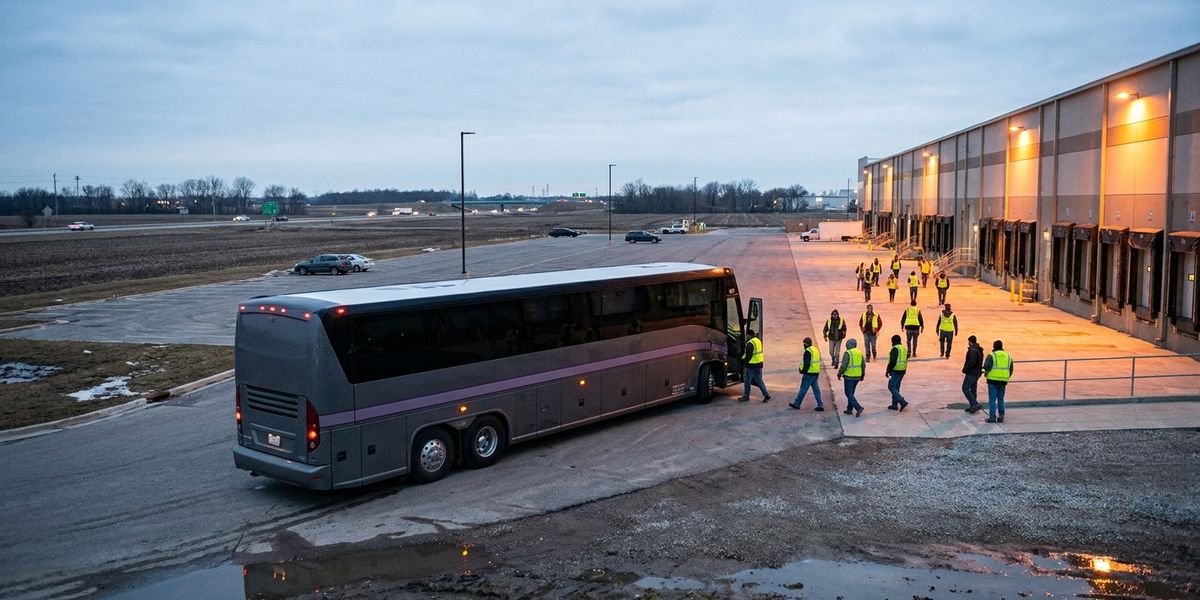
US labor law decides whether a relocated distribution center worker has lost a job by asking whether the new site sits within a "reasonable commuting distance" of home. It then declines to say what that is. No mileage appears in 20 CFR 639.3, no minute threshold, no formula. Warehousing and storage employed 1,837,400 people in August 2026 and counted 23,848 private establishments as of the first quarter (BLS, Industries at a Glance, NAICS 493), and the networks those buildings form keep consolidating. A distribution center relocation gets priced as real estate: square footage, racking, conveyor commissioning, lease term. It gets settled on the warehouse worker commute, on whether enough of the existing roster can still reach the building at 5 a.m. on a Tuesday. The Department of Labor does name four factors that fill the statutory void, and warehouse employee transportation is the only one an employer can change by decision rather than by construction.
"Reasonable commuting distance" is a legal test with no number in it
A transfer offer is the dividing line the regulation draws. Under 20 CFR 639.3(f)(3), an employee has not suffered an "employment loss" where the employer "offers to transfer the employee to a different site of employment within a reasonable commuting distance with no more than a 6-month break in employment," or to any other site regardless of distance where the employee accepts within 30 days. Everything else in the definition counts: a termination other than discharge for cause, a layoff exceeding six months, a cut of more than 50% in hours during each month of any six-month period. So the commuting question decides whether a 300-person consolidation is a WARN-countable event or a non-event, and the rule leaves the question open.
The Department of Labor's WARN Advisor calls it "a flexible term that will vary with local conditions," then lists what the flexing turns on, measured from the worker's home:
- accessibility of the place of employment
- quality of the roads
- customarily available transportation
- usual or customary travel times
Three of those four are fixed by geography and public budgets on any timeline a relocation runs to. Road quality is a state DOT program. Accessibility follows the interchange that made the parcel affordable in the first place. Customary travel times are whatever the local labor market already does. Customarily available transportation is the single line an employer can move inside one planning cycle, by putting a vehicle on the road between where the workforce lives and where the building now sits.
That is a named factor, not a safe harbor, and the distinction is worth holding. No published decision has surfaced confirming that operating a shuttle settles the statutory test. The 1989 final-rule preamble also notes that where a collective bargaining agreement defines reasonable commuting distance, "that definition should control" — so an employer at a represented site may already be working to a number written by someone else.
Some statutes do carry a figure. Under Cal. Labor Code § 1400.5, a covered "relocation" is the removal of all or substantially all of the industrial or commercial operations in a covered establishment to a different location 100 miles or more away. Federal WARN contains nothing equivalent, which leaves the federal question to be argued site by site, after the transfer offers have already gone out.
The labor shed a distribution center inherits is 11 miles wide, not 26
Iowa Workforce Development runs a survey program that asks workers the question directly and publishes both halves of the answer. In the 2024 Cedar Rapids laborshed analysis, produced with the Cedar Rapids Metro Economic Alliance, employed respondents reported currently commuting an average of 11 miles and 17 minutes one way. Employed respondents open to changing jobs gave a different figure for what they would be willing to travel: 26 miles and 35 minutes. Unemployed respondents likely to accept work put their own willingness at 22 miles and 30 minutes.
Stated willingness among the job-changers runs 2.4 times the distance the employed population actually travels. That gap is what a relocation plan runs on. Transfer-acceptance forecasts get built from what people say in a town hall or a retention survey, which is the 26-mile number; attendance in month three is settled by the 11-mile number, which is what the same workforce was already doing before anyone asked.
Laborshed framing carries further than the specific miles do. Iowa Workforce Development's Laborshed Studies page calls a laborshed "the area or region from which an employment center draws its commuting workers" — a catchment measured outward from the building rather than a radius drawn on a map. The Cedar Rapids study covers 587,894 employed people, 86.3% of the survey population. Inside that, 72,226 are flagged as likely to change employment: their current median wage is $19.00 an hour, and production, construction and material-moving occupations make up 21.3% of them.
National figures set the outer bound. Mean one-way travel time for US workers was 27.2 minutes in 2024, 69.2% drove alone, 3.7% used public transportation and 9.3% commuted 60 minutes or more each way (Census Bureau, American Community Survey 1-year estimates, table S0801). A site that adds 20 minutes to a 17-minute commute pushes a large share of its roster into the far tail of that distribution.
One caveat belongs up front. Cedar Rapids is one metro in one state. And no US statistical series reports commute distance or transit access for warehousing on its own: the Census Bureau publishes commuting by industry at a 13-category level that folds NAICS 493 into "transportation and warehousing, and utilities". An operations team cannot look the answer up for its own site, which is precisely the argument for measuring it. The same blind spot sits underneath data center site selection, where the workforce peak arrives years before the building opens.
The closest per-five-minute turnover curve was measured on teachers
Francisco Santelli and Jason Grissom of Vanderbilt tracked every teacher and school leader in Metropolitan Nashville Public Schools across twelve school years, 2008-09 through 2019-20, estimating each commute with traffic mapping software and controlling for school fixed effects. Their finding, published in AERA Open on 15 October 2024: "each 5-minute increase in one-way commute time predicts an increase in transfer probability of 0.8 to 1.0 percentage points over most of the commute time distribution."
What happens at the tail is the part that carries. "Teachers who commute 45 minutes or more to work are 10 percentage points more likely to transfer than another teacher in the same school commuting only 5 minutes," the authors write, against an overall transfer rate of 12% in the sample. Exit from the district altogether runs 3 points higher for that group, which is also absent 1.8 days more per year. For principals and assistant principals the paper finds no consistent evidence.
Teachers are not order fillers. The preprint is explicit about its population, and no equivalent fixed-effects study on hourly warehouse labor has surfaced. What survives the transfer is the shape of the relationship rather than the coefficient: commute-driven attrition rises monotonically, moves in five-minute steps, and shows no cliff edge where tolerance suddenly snaps. Printing 0.8 points per five minutes as a warehouse figure would be inventing data.
That shape is also what separates a relocation from ordinary churn. Normal attrition arrives one resignation at a time, spread across a year, at commute times that differ person by person. A consolidation applies the same step change to every commute in the building on the same Monday. Quits in transportation, warehousing and utilities ran 2.2% in July 2026 against 2.1% for total private (BLS, Job Openings and Labor Turnover Survey, Table 4), and that sector aggregate mixes utilities and long-haul trucking in with warehouse floors, so treat it as a floor for the warehouse rate. June came in at 2.3% and May spiked to 2.8%.
Do it Best is shifting 300 jobs across a state line
About 300 people work at Do it Best Group's Montgomery, New York distribution center, and on 1 September 2026 the company put a date on their building: operations cease in the second quarter of 2027, about nine months out, and the volume goes to a 1.4 million square foot site in Wilkes-Barre, Pennsylvania. That Pennsylvania site is where a new operation, Hanover, was announced in February, when the company set out its distribution center optimization plan. Staff who qualify and are willing to move house will be offered relocation support. The consolidation follows Do it Best's acquisition of True Value and the merging of two distribution networks. Ty Sordelet, VP of logistics, told Hardware Retailing that bringing the two businesses together "has required us to look carefully at how we operate and how we can build a more effective distribution network."
Relocation packages and notice periods are the standard pair in a consolidation, and both rest on the same assumption: that the people who matter to the transition are the people who will move house. A relocation package, by design, reaches whoever transfers. It has nothing to say to the associate who stays put, for whom the new building is a different commute rather than a different life. A notice period does not reach that worker either. A transportation plan is the instrument that does.
The geometry keeps making that group bigger. Warehouses moved away from metropolitan population centers faster than other industries did. In Chicago, the average distance of warehousing establishments from their own barycenter rose from 71.0 to 79.8 km between 1998 and 2013, an 11.5% increase against 7.3% for all establishments, with the warehousing barycenter itself shifting 13 km southwest (Dubie, Kuo, Giron-Valderrama and Goodchild, Journal of Transport Geography, 2020). The sector also grew far faster than the economy around it over that window: US warehousing employment climbed from 119,493 in 1998 to 809,359 by 2015, and establishment count rose 114% against 10.4% across all industries. Those series stop collecting in 2015, so they describe a structural drift that no one has re-measured. Nothing since has reversed the direction.
A documented counter-move exists, and it does not require the employer to own vehicles. The Capital District Transportation Authority extended its Universal Access program to Amazon's Schodack, New York distribution facility in June 2022, giving Amazon employees unlimited rides on fixed-route service and FLEX On Demand through a Navigator card, and enhanced Route 233 from Broadway Station with extended service to the facility and a nearby park-and-ride. Nearly 30 regional employers and universities were already enrolled when Amazon joined. A transit authority will restructure a route around a large employer's shift clock when someone asks early and pays a share; that conversation takes months, which is the same lead-time arithmetic that makes seasonal workforce transport a second-quarter decision.
The objection: nobody retains a distribution center workforce, they re-hire one
The strongest argument against all of this arrives with BLS numbers attached. Hand laborers and material movers held 6,917,800 jobs in 2025, with projected openings averaging 904,200 a year across the following decade and median pay of $38,220, or $18.38 an hour. No credential is required to do the work. Projected openings alone equal about 13% of the occupation every year. And the new site was chosen partly because it sits on a labor pool of its own. Read that way, a consolidation re-hires a workforce instead of retaining one, and a transportation budget buys something the labor market supplies free.
Occupational projections run the wrong way for that argument. BLS puts growth for the same occupation group at 4% between 2025 and 2035, about as fast as the average across all occupations. No shrinking denominator is coming to make the existing roster cheap to lose.
904,200 openings a year cut both ways. It is the skeptic's evidence that warehouse labor is abundant, and it is the reason the replacement market around the new building is crowded: every competing distribution center inside that labor shed draws from the same pool in the same quarter, while sector quits sit at or above the total-private rate.
Timing refuses to cooperate as well. A transfer date is set by a lease expiry and a conveyor commissioning schedule, both of them fixed months out and often printed in a press release. Recruiting, screening, onboarding and training several hundred order fillers at a site that is not yet running has no such fixed date, and it competes with go-live for the attention of the same operations managers.
Then the legal asymmetry, which is the sharp end. Under 639.3(f)(3), a transfer offered within a reasonable commuting distance produces no employment loss at all, so no WARN count and no notice obligation attaches to it. Site the building outside that band and identical headcount becomes a countable employment loss carrying 60-day notice, with severance exposure in states that add it. Re-hiring does not route around the transportation question; it re-classifies the event.
Measurement belongs in the site-selection pack, before the lease is signed, and it is cheap to run. Geocode the current roster to home postal code. Compute drive times from each of those points to every candidate site at the real shift-change hour rather than at 8 a.m. Then read off the share of the roster that crosses from a 17-minute band into a 35-minute one. That share is the transfer-conversion forecast, and it is knowable a year before anyone has to act on it.
Price the two paths with the discipline the racking budget already gets. A contracted route between the old labor shed and the new building has a per-seat cost that an operator will quote. The alternative carries recruiting spend, training spend, a productivity ramp and, if the site lands outside the commuting band, a 60-day notice obligation, none of which appears anywhere in the real-estate model. Expect "customarily available transportation" to draw more attention as networks keep consolidating, because it is the one factor of the four an employer controls and the only one that leaves a paper trail showing the commute was kept inside the band. Ryde plans and manages employee shuttle routes for warehousing and distribution sites whose labor shed no longer matches the building.
Sources
- Legal Information Institute, Cornell Law School, "20 CFR § 639.3 — Definitions" (Worker Adjustment and Retraining Notification regulations) — https://www.law.cornell.edu/cfr/text/20/639.3 (accessed 18 September 2026)
- U.S. Department of Labor, elaws WARN Advisor, glossary entry "Reasonable Commuting Distance" — https://webapps.dol.gov/elaws/eta/warn/glossary.asp?p=Reasonable+Commuting+Distance (accessed 18 September 2026)
- U.S. Department of Labor, WARN Act regulations preamble (final rule, 1989) — https://www.dol.gov/general/topic/training/warn-reg-preamble (accessed 18 September 2026)
- California Legislative Information, California Labor Code § 1400.5 (Cal-WARN definitions) — https://leginfo.legislature.ca.gov/faces/codes_displaySection.xhtml?lawCode=LAB§ionNum=1400.5 (accessed 18 September 2026)
- Iowa Workforce Development with the Cedar Rapids Metro Economic Alliance, "Cedar Rapids Laborshed Analysis," 2024 — https://workforce.iowa.gov/media/1081/download (accessed 18 September 2026)
- Iowa Workforce Development, "Laborshed Studies" — https://workforce.iowa.gov/laborshed-studies (accessed 18 September 2026)
- U.S. Census Bureau, American Community Survey 1-year estimates, table S0801 (Commuting Characteristics by Sex), 2024 — https://www.census.gov/topics/employment/commuting/guidance/acs-1yr.html (accessed 18 September 2026)
- Francisco Arturo Santelli & Jason A. Grissom, "A Bad Commute: Travel Time to Work Predicts Teacher Turnover and Other Workplace Outcomes," AERA Open, first published 15 October 2024 — https://journals.sagepub.com/doi/10.1177/23328584241287792 (accessed 18 September 2026)
- Santelli & Grissom, "A Bad Commute," EdWorkingPaper 22-691, Annenberg Institute at Brown University, December 2022 (preprint) — https://edworkingpapers.com/sites/default/files/ai22-691.pdf (accessed 18 September 2026)
- U.S. Bureau of Labor Statistics, "Industries at a Glance — Warehousing and Storage: NAICS 493" — https://www.bls.gov/iag/tgs/iag493.htm (accessed 18 September 2026)
- U.S. Bureau of Labor Statistics, Job Openings and Labor Turnover Survey, Table 4, quits levels and rates by industry and region, seasonally adjusted — https://www.bls.gov/news.release/jolts.t04.htm (accessed 18 September 2026)
- U.S. Bureau of Labor Statistics, Occupational Outlook Handbook, "Hand Laborers and Material Movers" — https://www.bls.gov/ooh/transportation-and-material-moving/hand-laborers-and-material-movers.htm (accessed 18 September 2026)
- Melaku Dubie, Kai C. Kuo, Gabriela Giron-Valderrama & Anne Goodchild, "An evaluation of logistics sprawl in Chicago and Phoenix," Journal of Transport Geography 88 (2020) 102298 — https://urbanfreightlab.com/wp-content/uploads/2023/04/Logistics-Sprawl-Chicago.pdf (accessed 18 September 2026)
- Doug Donaldson, "Do it Best Group to Close Montgomery Distribution Center, Shift Volume to Wilkes-Barre," Hardware Retailing, 1 September 2026 — https://hardwareretailing.com/do-it-best-group-to-close-montgomery-distribution-center-shift-volume-to-wilkes-barre/ (accessed 18 September 2026)
- Do it Best Group, "Do it Best Group implements distribution center optimization plan," 13 February 2026 — https://www.doitbestonline.com/2026/do-it-best-group-implements-distribution-center-optimization-plan/ (accessed 18 September 2026)
- Capital District Transportation Authority, "Amazon joins CDTA's Universal Access program," 29 June 2022 — https://www.cdta.org/news/amazon-joins-ua-program (accessed 18 September 2026)