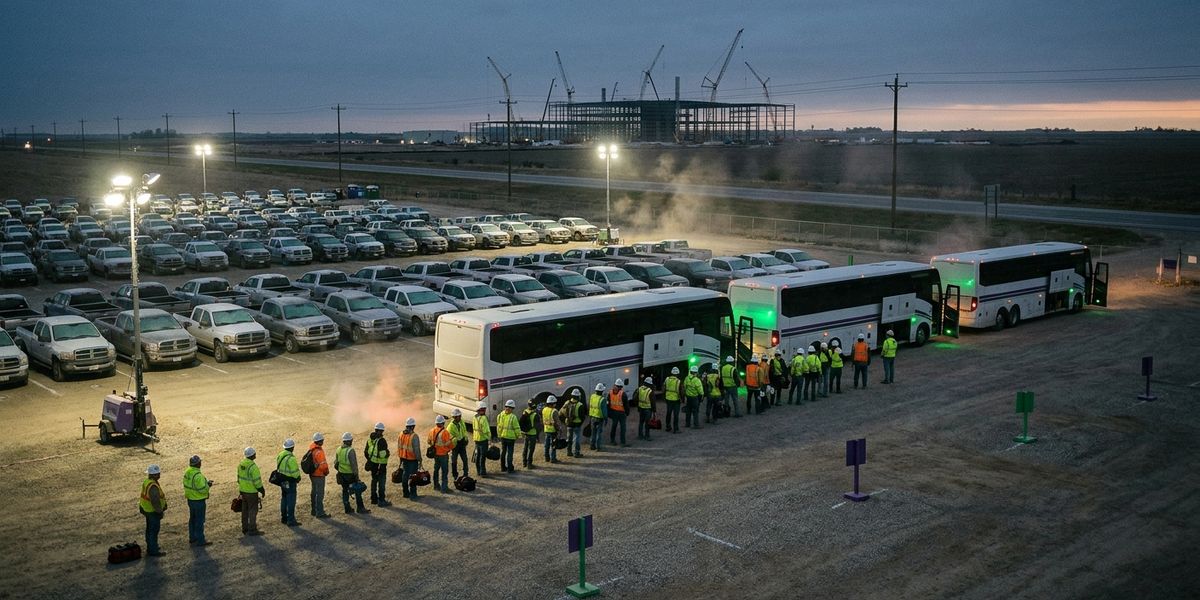
In February 2022, on a school day, Louisiana's transportation department counted 1,817 vehicles at one point on LA-183, one of the two-lane state highways meeting at Holly Ridge Elementary in Richland Parish. The department did not count that spot again until July 2025 — high summer, no school traffic in it at all. That count logged 5,224. Meta was building Hyperion behind it. Police records obtained by the Gulf States Newsroom show nine crashes on the surrounding roads across all of 2024 and 64 between January and mid-September 2025, a rise the newsroom put at more than 600%.
Meta's own page for that campus lists 7,500+ skilled trade workers on site at peak and 1,000 operational jobs once it runs. Data center workforce transportation, where anyone plans it at all, gets planned for the 1,000. The 7,500 arrive years earlier, on rural roads and through a security gate that no operations-phase traffic study ever modelled. One megaproject has a decade of published numbers showing what happens when an owner is legally required to plan for them. It sits in Somerset, England, and it is not a data center.
The 7.5-to-1 ratio that trip-generation models never see
Kittelson & Associates, a transportation-engineering firm with nothing to sell here, stated the mechanism plainly in April 2026: "The greatest influx of people and vehicles on the data center property is probably impacting the streets during construction." Their explanation for the gap is the useful part. The data-center trip data in the Institute of Transportation Engineers' Trip Generation Manual, the document a county planning commission reviews, "is for commuter peak hours during typical daily operations, not construction trips." Trade shifts are also timed around the rush, not into it, so even the hours a study does model are the wrong hours. Kittelson's authors put it without hedging: "Ironically, you could say we're faced with a lack of data."
Headcounts, by contrast, are public, and they all point the same direction. Microsoft disclosed more than 3,000 construction workers during daily peak activity at Mount Pleasant, Wisconsin, against roughly 500 full-time employees at the first datacenter and about 800 across both (Brad Smith, September 2025). DataBank's VP of construction, Tony Qorri, wrote in January 2026 that "where peak crew sizes once reached 750 workers," the company's eight-building Red Oak campus in Texas "will hit 4,000 to 5,000 workers by early 2026." Meta's Richland Parish numbers moved inside seven months: 5,000 at peak with 500+ permanent roles in December 2025, then 7,500+ at peak with 1,000 permanent by July 2026 after the 5GW expansion.
So the build runs six to eight times the operation it leaves behind at Meta and Microsoft, and the peak headcount climbs with each new project. A construction surge behaves like a seasonal peak that never repeats — it ramps over months, holds for one or two quarters, and disappears. What separates it from a Q4 retail peak is that data center construction traffic lands on a road network with no spare capacity and no second option.
Two-thirds of the new build is going where no fixed-route bus runs
Siting has flipped. Pew Research Center joined the Data Center Map database to Census urban–rural geography in April 2026 and found 67% of planned data centers in rural areas, against 87% of existing facilities in urban ones. Land and power moved the sector out of the metros in one cycle.
Rural transit looks adequate on paper and disappears in a parking lot at 05:30. North Dakota State University's Upper Great Plains Transportation Institute reported that 84% of US counties had some level of rural transit service in 2023. Of the 1,226 rural general-public agencies filing that year, 1,091 ran demand-response service and only 427 ran any fixed route at all (Rural Transit Fact Book 2025, drawing on the National Transit Database). Dial-a-ride gets one person to a dialysis appointment. It cannot put 5,000 trade workers through a badge-screened turnstile inside a 40-minute window.
Commuting data says the same thing from the household side. Just 0.4% of rural residents travel to work by public transportation against 4.3% of urban residents, 76.7% of rural workers drive alone, and mean rural travel time to work runs 28.2 minutes (ACS 2023, via UGPTI). A hyperscale site worker commute in a county like that is a solo pickup truck by default, because nothing else has ever existed there to be chosen.
Consequences arrive quickly, and they arrive as somebody's line item. Vantage is paying for sworn Ozaukee County Sheriff's Office and Wisconsin State Patrol officers to hand-direct traffic at three Wisconsin locations during 5:30–7:30 a.m. and 3:30–5:30 p.m. windows, Monday to Friday, expected to run through at least October 2026 (Ozaukee Press, 6 May 2026). Sheriff Christy Knowles told the paper she spent six minutes covering six-tenths of a mile. The Lighthouse campus had about 500 workers on site when she said it, and the paper's peak figure is 5,000.
Abilene, Texas absorbed roughly 6,000 workers for the Stargate build into a city of just over 100,000, per Texas Standard. TIME has average monthly rent at $2,395, up close to $1,000 year on year against a pre-existing shortfall of some 5,600 units. Two more RV parks were approved. Virtually every motel filled. Over in Richland Parish, Meta's local commitment for roads, water and wastewater went from more than $300M in December 2025 to more than $1B by July 2026 — a figure that accompanies a 5GW expansion rather than a traffic bill.
None of that money buys anyone a seat on a bus. It buys officers at intersections, asphalt, and RV pads: the retail price of a commute that nobody procured.
Somerset already ran this experiment at 10,000 workers
Hinkley Point C, EDF's nuclear station on the Somerset coast, has spent a decade running the program the data-center sector keeps describing in the abstract. It did not volunteer. The Development Consent Order permitting the project requires NNB Generation Company (HPC) Ltd, the owner rather than any contractor, to implement a Construction Workforce Travel Plan and a Construction Traffic Management Plan "until the end of the Construction Period." Compliance goes quarterly to a Transport Review Group where Somerset Council, National Highways and EDF are all represented.
Take 14 June 2023, the busiest day of that month. 10,036 workers were on site; 9,076 answered the travel survey. 86.6% of them — 7,863 people — had arrived on the HPC bus service, against a travel-plan target of 87%. Cars carried 2.5%, or 224 people, of whom 192 were drivers. Public bus and rail each carried zero. On-site parking provides 200 of a permitted 300 spaces, with 293 permits in issue for a workforce of ten thousand.
Structure produced that split, and the structure copies. Seven park-and-ride sites feed the campus, with an eighth in planning, from a 920-space lot at junction 23 of the M5 down to 133 spaces at Cannington. Those seven held 8,106 permits at quarter end. Two residential campuses supply a further 20.2% of arrivals, inside that 86.6%. The site logged 1,079 bus movements on the survey day against a Transport Assessment forecast of 1,232 a day at peak, and the three motorway-junction park-and-ride services ran 48 to 73 passengers a bus in the 05:00 hour. Car-sharing among the minority who do drive as far as a park-and-ride hit 36% at junction 23, above the 27% target for the quarter. EDF projected the workforce to peak above 12,000 in late 2025.
Three design choices carry that result, and each transfers to a hyperscale campus. Parking at the gate is capped by permit rather than by acreage. Parking is relocated to lots that already sit on the strategic road network, where the traffic belongs. And the mode split is a number the owner publishes on a fixed schedule to a body that can escalate.
That third choice is the one the data-center sector has not copied, and it is the cheapest of the three. Meta, Microsoft, Vantage and DataBank all publish peak headcounts; not one of them publishes how those people reach the gate. Kittelson's engineers say the construction-phase data does not exist, and the reason it does not exist is that no US permitting authority has yet required an owner to produce it quarterly. An industry that reports power usage effectiveness to two decimal places cannot state its own construction mode split to the nearest 10%.
The objection: it's temporary, and it's the contractor's problem
The skeptical case is genuine, and a reporter stated it more cleanly than any operator has. Andrew Chow, who covered Abilene for TIME, told Texas Standard in February 2026 that "all of the jobs and the investment is front-loaded in the construction. Once these data centers go up, there's actually very few jobs inside the working data center." Across more than 1,200 US data centers, even the largest employ fewer than 150 permanent workers, sometimes as few as 25 (Good Jobs First, cited by WRI). Brookings economists Dany Bahar and Greg Wright, running a synthetic-control study across 93 counties that received their first large facility, measured total private employment up 4% to 5% over five to six years with construction employment jumping 11% — confirmation that the build, and not the finished hall, is the employment event. Cushman & Wakefield sized the average 2024 data-center parcel at 224 acres, up 144% since 2022 (via WRI). If parking is tight, pave more of it.
Acreage is the wrong variable, though. The approach road is the constraint, and so is the gate. Kittelson's engineers note that security-driven gated entry "could cause spillback to public streets," which is precisely the failure mode of a 224-acre site with one screened entrance: the queue forms outside the fence, on a state highway, and every unused acre inside is irrelevant. Rural surfaces impose their own ceiling — unpaved roads "might not be prepared to support sustained heavy vehicle movements," in the same firm's words. Paving is a familiar move, and the shuttle-versus-parking arithmetic at steady-state campuses is well documented, but neither addresses a two-lane state highway carrying somebody else's schedule.
Ownership of the duty is the second flaw in the objection. Trade workers are employed by subcontractors, while the traffic counts, the crash statistics and the rezoning hearing all attach to the name on the application. Somerset's arrangement makes that explicit by statute; the same allocation appears without one. Vantage is the entity writing checks for deputies in Ozaukee County. Meta is the entity signing a $1B infrastructure package in Richland Parish. Nobody negotiates data center construction workforce logistics with an electrical subcontractor.
Then there is schedule risk, which is where construction worker transportation stops being a community-relations question. STL Partners prices delay on a typical 60MW US data center at up to $14.2M a month (March 2025), the figure Berkeley Research Group's construction team relays in its own hyperscale work. The scarcity underneath is far better documented. Associated Builders and Contractors' model calls for 349,000 new construction workers in 2026 and 456,000 in 2027, with the association attributing part of the gap to megaprojects including AI data centers. BRG's own observation that a single hyperscale project "may require hundreds of electricians, while local availability offers only a fraction of that number" describes a crew that is being drawn from outside the county by definition. Trade crew transportation is therefore a schedule input: every crew-hour burned in a queue at the gate is drawn from the scarcest resource on the job.
What the 24/7 phase inherits from the build
Handover is where the two-phase argument pays. Even the largest of those 1,200 facilities employs fewer than 150 permanent people to cover a 24/7 rotation, in a county whose transit agency operates dial-a-ride on weekdays, if it operates anything. Remote data center staff transport at that headcount will never justify its own procurement in 2029. Which is the argument for writing it into the construction contract in 2026, while buying power is maximal and the routes already run.
Uptime Institute, citing the Finnish Institute of Occupational Health, reported that fatigue-related workplace injury risk runs 15% higher on 10-hour shifts than on 8-hour shifts and 38% higher at 12 hours, and Uptime's own guidance is to avoid shifts beyond 12 hours. Neither figure counts the drive. A 12-hour critical-environment shift bracketed by the 28.2-minute mean rural commute at each end is closer to a 13-hour day — and that connection is inference, not an Uptime finding. Nobody has measured it, because nobody is measuring site worker transport at these facilities at all.
A four-person night rotation absorbs a no-show by calling someone in from 30 miles away, or by running short on a facility where running short is a reportable event. Access control adds the second constraint: critical-infrastructure sites require pre-cleared personnel and pre-cleared vehicles at the gate, so an ops-phase transport provider has to be badged, manifested and route-tested before it moves a single technician. Standing that up in the month after commissioning is the expensive route. Inheriting it from a construction program that has cleared the same gate for three years costs almost nothing extra.
Watch the permitting hearings between now and late 2027. A workforce travel plan is a condition of consent at Hinkley Point C; in the US it remains something an owner volunteers, or something a county board improvises after the crash numbers reach the local paper. Richland Parish, Ozaukee County and Abilene each produced the same public sequence — headcount announced, road counts multiply, sheriff intervenes, infrastructure commitment gets rewritten upward. County attorneys read each other's conditions of approval. The first US jurisdiction that writes a construction workforce travel plan with a published mode-split target into a special-use permit will be copied within a year, and the owners who already have one drafted will clear that hearing while their competitors renegotiate a schedule under a moratorium.
If you are scoping a campus that peaks above 1,000 trade workers, Smart Shuttles is where Ryde's off-site parking runs, hub-and-spoke routing and boarding-status tracking fit — and the first number worth pricing is the one nobody in this sector currently publishes.
Sources
- Meta Data Centers — Richland Parish Data Center (7,500+ peak trade workers; 1,000 operational jobs). https://datacenters.atmeta.com/richland-parish-data-center/ — accessed 2026-08-06
- Meta Data Centers — Deepening Our Investment in Richland Parish, Louisiana, 13 July 2026 ($1B+ local infrastructure; 5GW expansion). https://datacenters.atmeta.com/2026/07/deepening-our-investment-in-richland-parish-louisiana/ — accessed 2026-08-06
- Meta Newsroom — Meta's Richland Parish Data Center Supports Louisiana Economy, 19 December 2025 ($300M+ infrastructure; 5,000 peak; 500+ permanent). https://about.fb.com/news/2025/12/metas-richland-parish-data-center-supports-louisiana-economy-875-million-in-contracts/ — accessed 2026-08-06
- Microsoft On the Issues (Brad Smith) — Made in Wisconsin: the world's most powerful AI datacenter, 18 September 2025. https://blogs.microsoft.com/on-the-issues/2025/09/18/made-in-wisconsin-the-worlds-most-powerful-ai-datacenter/ — accessed 2026-08-06
- DataBank (Tony Qorri, VP of Construction) — Data Center Construction Predictions for 2026, 23 January 2026. https://www.databank.com/resources/blogs/data-center-construction-predictions-for-2026/ — accessed 2026-08-06
- Gulf States Newsroom / WWNO (Drew Hawkins) — Construction on Meta's largest data center brings 600% crash spike, chaos to rural Louisiana, 19 November 2025 (Richland Parish police records; Louisiana DOTD counts). https://www.wwno.org/local-regional-news/2025-11-19/construction-on-metas-largest-data-center-brings-600-crash-spike-chaos-to-rural-louisiana — accessed 2026-08-06
- Kittelson & Associates (Chris Brehmer, Diego Arguea, Chris Tiesler, Amy Donald) — Why data centers don't fit standard traffic assumptions, 8 April 2026. https://www.kittelson.com/ideas/why-data-centers-dont-fit-standard-traffic-assumptions-and-how-to-plan-for-their-transportation-impacts/ — accessed 2026-08-06
- Pew Research Center (Skyler Seets, Kaitlyn Radde) — Most new data centers in the US are coming to rural areas, 13 April 2026. https://www.pewresearch.org/short-reads/2026/04/13/most-new-data-centers-in-the-us-are-coming-to-rural-areas/ — accessed 2026-08-06
- Jeremy Mattson and Del Peterson — Rural Transit Fact Book 2025, Department Publication No. 330, Upper Great Plains Transportation Institute, North Dakota State University, June 2025 (Tables 7, 8, 10; ACS 2023 and NTD 2023). https://www.ugpti.org/resources/reports/downloads/dp-330.pdf — accessed 2026-08-06
- NNB Generation Company (HPC) Ltd / EDF Energy — Transport Review Group Quarterly Report 2023 Q2 with Appendix, prepared by Rachel Lister, 17 July 2023. https://www.edfenergy.com/sites/default/files/2024-01/Transport Review Group Quarterly Report 2023 Q2 with Appendix.pdf — accessed 2026-08-06
- Somerset Council — Transport Review Group (membership: Somerset Council, Highways England / National Highways and EDF Energy; meetings held quarterly). https://www.somerset.gov.uk/business-economy-and-licences/transport-review-group/ — accessed 2026-08-06
- EDF Energy — Hinkley Point C: local community (workforce "likely to increase to a peak of over 12,000 people in late 2025"). https://www.edfenergy.com/energy/nuclear-new-build-projects/hinkley-point-c/local-community — accessed 2026-08-06
- Ozaukee Press — Data center traffic mess called 'inexcusable', 6 May 2026. https://www.ozaukeepress.com/content/data-center-traffic-mess-called-‘inexcusable’ — accessed 2026-08-06
- TIME (Andrew R. Chow) — Abilene / Stargate housing and traffic reporting, 4 February 2026. https://time.com/7362401/ai-stargate-data-center-abilene-housing-crisis/ — accessed 2026-08-06
- Texas Standard — interview with Andrew R. Chow, 12 February 2026 (6,000 workers; city population; front-loaded-jobs quote). https://texasstandard.org/stories/stargate-data-center-abilene-housing-crisis-rising-rents-homelessness-shortage/ — accessed 2026-08-06
- World Resources Institute (Carla D. Walker, Ian Goldsmith) — US Data Center Growth Impacts, 17 February 2026. https://www.wri.org/insights/us-data-center-growth-impacts — accessed 2026-08-06
- Brookings (Dany Bahar, Greg Wright) — New evidence on data center employment effects, 4 May 2026. https://www.brookings.edu/articles/new-evidence-on-data-center-employment-effects/ — accessed 2026-08-06
- STL Partners — Delays in data centre construction, 27 March 2025 (up to USD14.2m per month; "based on a typical 60 MW data centre in the US"). https://stlpartners.com/press/delays-in-data-centre-construction/ — accessed 2026-08-06
- Berkeley Research Group, ThinkSet (Ben Nolan, John Colley, Jared Ross, Travis Olson) — Hyperscale data center construction: optimize delivery and reduce risk with AI (relays the STL Partners figure; source of the electricians observation). https://www.thinkbrg.com/thinkset/hyperscale-data-center-construction-optimize-delivery-and-reduce-risk-with-ai/ — accessed 2026-08-06
- NCCER, reporting the Associated Builders and Contractors workforce model — Construction needs 349K new workers in 2026. https://www.nccer.org/newsroom/report-construction-needs-349k-new-workers-in-2026/ — accessed 2026-08-06
- Uptime Institute Journal (Rose Weinschenk) — Long shifts in data centers: time to reconsider?, 22 May 2024 (Finnish Institute of Occupational Health fatigue figures). https://journal.uptimeinstitute.com/long-shifts-in-data-centers-time-to-reconsider/ — accessed 2026-08-06