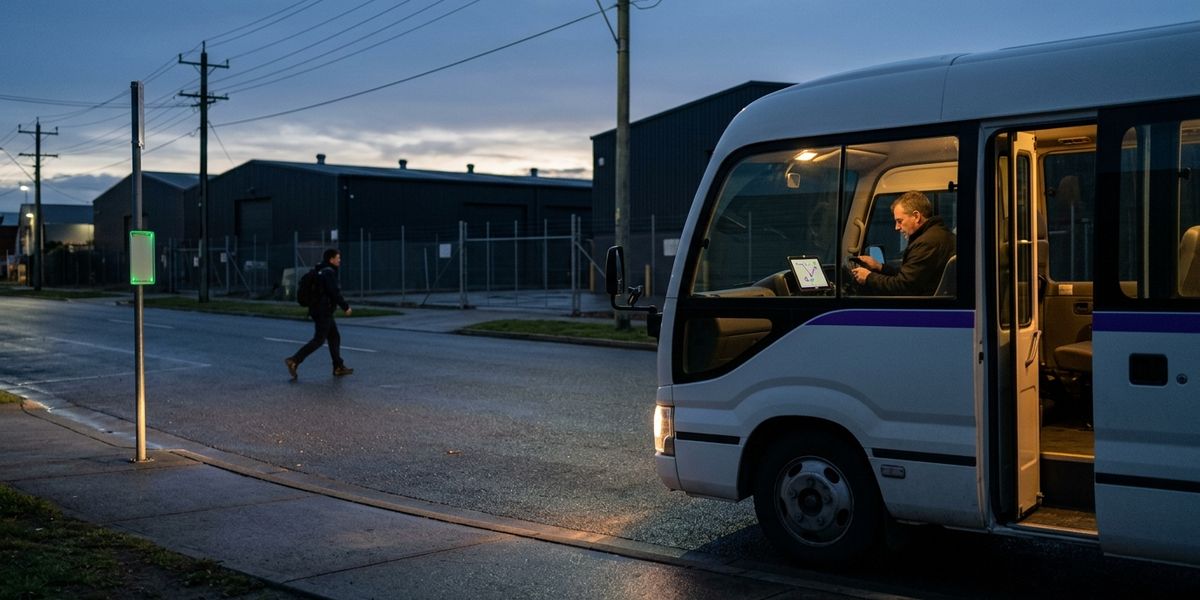
Your rider handbook tells employees to "book in advance" and "be at the stop on time." Neither sentence is a rule. A rule has a number in it: the hour booking closes, the minutes a van waits, the count of missed trips that triggers a consequence. Leave the numbers out and the dispatcher on the 5:30 a.m. run supplies them, a different number each morning, and the first rider left at the curb takes a fair complaint to HR.
If you run the shuttle or commute program at a multi-shift employer, this rulebook is yours to write, with HR co-signing eligibility and consequences. It governs a scarce benefit handed out in public. Subsidized commuting was available to 10% of US private-industry workers in 2024 (Bureau of Labor Statistics), from 4% in the Midwest up to 14% in the Northeast and the West. When a perk reaches one worker in ten, people check who got it and why.
Eight decisions make up an employee transportation policy: eligibility, booking cut-off, how long the vehicle waits, how long the rider waits, walking distance, the no-show definition and its consequences, passenger mixing, and the emergency ride home. Each one needs a number, an owner and a system that enforces it. Business-travel reimbursement and company-car rules are separate documents, and nothing below applies to them.
An employee transport policy is a list of numbers someone has to pick
Employers rarely publish their shuttle rulebooks, which live in intranets, rider apps and vendor contracts instead. So the public comparators come from organizations that had to write theirs down: county paratransit programs, university shuttles, airline union contracts, one corporate air shuttle and federal transit regulation. None of them binds a private employer. They are useful because each is a number somebody picked and defended, and in the federal case, wrote into regulation with precise wording.
Settle ownership before any number. The City of Richmond, Virginia, replaced a parking-only regulation from 2000 with Administrative Regulation 6.1, effective July 1, 2023, and it names who does what. Human Resources folds the transportation benefit into onboarding and offboarding. The Chief Administrative Officer holds "final authority over the terms and conditions." Write your equivalent of that sentence first. When a rider disputes a no-show at 6:10 a.m., somebody has to be the last word, and it should not be whichever supervisor answers the phone.
Then fill in the table. Each row is one decision, a public rule you can compare against, and the failure you inherit by leaving the cell empty.
| Rule | Public comparator | What you decide | If you leave it blank |
|---|---|---|---|
| Eligibility | Richmond: benefits-eligible position plus a qualifying work arrangement. Boston Children's: 24-hour shift and drove or biked in | Categories, an approver per category, the data source | Ad-hoc exceptions; former employees still riding |
| Booking cut-off | ADA paratransit: the previous day. Duke: 48 hours (24 for some trips). ConocoPhillips: cancel 1 hour, reschedule 3 hours before | Hours before shift start; soft and hard close | Routes built on bookings that change afterwards |
| Vehicle waits for rider | 5 minutes (Cabarrus County, Duke), clock starting at the pickup window (FTA) | Minutes, and when the clock starts | Drivers leave early or late, inconsistently |
| Rider waits for vehicle | 15 minutes (Envoy/AFA) or 30 minutes (Southwest/TWU 556), then a reimbursed taxi or alternate transport | Minutes, plus the fallback | Stranded riders with no recourse |
| Walk to the stop | 250 to 500 meters by service level (CIHT), shorter for hospitals and poor routes | Meters, by time of day | Night-shift riders quietly drop out |
| No-show definition and threshold | Cabarrus: 3 in 90 days. VTA: 25% or 60% of booked trips | Count or rate; operator-error exclusion | Riders penalized for late vehicles |
| Consequence ladder | VTA: 5, 10, 15, 25 days. FTA: up to a week for a first offense. ConocoPhillips: email to the supervisor | Warning, visibility, seat release | Nothing happens, or a ban out of proportion |
| Emergency ride home | Metro/OCTA: 2 rides per fiscal year, listed emergencies | Count, reasons, approver | Unbudgeted taxis and disputes |
But two rows get skipped more than the others. Handbooks write the vehicle-waits-for-rider number and forget the reverse, so the policy binds one party. And no-show rules count every miss alike, including the ones the vehicle caused. Both gaps take an afternoon to close on paper.
Shuttle eligibility rules: who rides, who approves, who shares a vehicle
Eligibility is three decisions, and most policies make only the first. You define the categories of rider. You name who approves each category. And you name the system the list comes from.
ConocoPhillips' passenger rules for its corporate air shuttle set out the categories, even though the shuttle is a business-travel service the company says "is not intended for commuting between an employee's home and work location." The document is still the clearest corporate model of the structure. Employees on company business ride. Contractors ride when traveling on company business, and guests need approval from their ConocoPhillips host's supervising manager. Employees of companies holding an executed Transportation Services Agreement ride. "Employees and guests traveling for personal reasons will not be allowed." Each category that needs sign-off names who gives it.
Categories can key on how and when people work, not on job grade alone. Richmond's AR 6.1 makes an employee eligible in "a permanent and full-time or part-time benefits-eligible position and a qualifying work arrangement," and lets the benefit scale to that arrangement. Boston Children's Hospital uses shift length and arrival mode: a resident or clinical fellow "who drove or biked to work and worked a shift of 24 or more hours" can get a taxi voucher home, and so can one leaving late at night when walking or transit is unsafe. That rule aims at a specific risk, a tired driver after a long shift, and nothing wider.
Where the list lives decides whether the rule still holds a year later. Richmond revokes the benefit "upon separation from city employment" and makes HR responsible for offboarding. That works only if the shuttle roster reads from the HR system. A spreadsheet kept by the transport desk drifts in both directions: new hires wait weeks for access, and leavers keep their seats until someone notices. The employee transportation management guide covers the HRIS integration. For the policy, one sentence is enough. Eligibility is whatever the HR system says on the day of the trip.
Decide whether the shuttle stacks with other benefits. Richmond offers "either a dedicated parking spot or a monthly alternative transportation stipend" and states that "both cannot be provided simultaneously." An either/or rule stops a familiar pattern, where an employee keeps a reserved space as insurance and rides the shuttle on good-weather days. You pay for both, and the space never frees up.
The same categories decide who shares a vehicle. A contractor's crew fills seats employees booked; an executive expects a vehicle of their own. Add a mixing rule: which types ride together, which get an exclusive vehicle, and which travel alone (a single on-call engineer who needs a car rather than a seat). Booking platforms model these as passenger types with exclusivity flags. If yours cannot, the rule lives in a dispatcher's head and leaves with the dispatcher.
Section 242 of the UK's Income Tax (Earnings and Pensions) Act 2003 adds a tax line to eligibility. It exempts a works bus only if the service is "available generally" to employees and used only, or substantially only, by them or their children; a bus means 12 or more seats, a minibus 9, 10 or 11. HMRC's manual gives one example of failing the test, services "confined to directors or senior employees," and puts no number on "substantially." A shared bus for several employers can qualify, but a route that fills with riders it is not provided for, such as the public or staff of a company outside the arrangement, may fail the test. In the US, a vanpool-style commuter highway vehicle under §132(f) needs seats for at least 6 adults besides the driver, with at least 80% of its mileage expected to be commuting on trips at least half full. The US commuter benefits guide carries the detail, including the $340 monthly limit for 2026 that the IRS set in Rev. Proc. 2025-32. Neither paragraph is tax advice. Take the eligibility draft to your payroll adviser before it ships.
Booking cut-off times and booking windows
The booking cut-off is the moment your routes get built. Bookings that arrive before it shape the route. Bookings that arrive after it either squeeze into a route the driver already has or go unserved. So work backwards from route production when you pick it.
Under 49 CFR 37.131, paratransit providers must accept a request made the previous day and may take reservations up to 14 days ahead. Duke University's accessible transportation policy, which serves students and staff, asks for 48 hours' notice, accepts some last-minute appointments at 24 hours, and schedules pickups in 15-minute intervals. ConocoPhillips lets passengers cancel up to 1 hour before departure and reschedule up to 3 hours before. Public numbers vary that widely because each is tied to how that service builds its schedule. None of them is a benchmark.
Anchor your cut-off to shift start, not to the calendar day. The ADA rule lets a provider negotiate a pickup up to an hour either side of the requested time. That tolerance works for a medical appointment and fails for a 6:00 a.m. line start, because a shift worker cannot arrive an hour late. Write the rule as "booking closes N hours before the start of the shift the trip serves." A 6:00 a.m. start and a 2:00 p.m. start then get the same lead time, and night-shift riders are not forced to book at an hour when they are asleep.
Consider two cut-offs. Missouri S&T's shuttle policy, updated in July 2026, guarantees a seat to anyone who books at least 3 business days ahead, while every reservation still has to be in by noon the business day before departure. The first line is a soft close; the second is a hard one. For an employer shuttle that means a guaranteed seat before the soft close, and a seat if capacity allows between the two. S&T runs a paid airport service with late-booking fees that a free employee benefit will not copy. The two-line structure transfers anyway.
What about hybrid schedules, where riders decide late? Demand on the Tuesday-to-Thursday peak runs well above Monday and Friday. Give late changes their own outlet, an on-demand option with its own rules, rather than loosening the cut-off on scheduled routes. Move the cut-off every time someone complains and route quality drops for everyone who booked on time.
When a shift time changes after the cut-off, the policy has to say who moves the rider. In Ryde's platform a changed shift updates the booking, but a ride already built does not rebuild itself; a dispatcher adjusts it. Whatever system you run, find out which it does and write the dispatcher step into the policy so the gap has an owner.
Pickup wait time, in both directions
Most shuttle policies write one wait time, the minutes a driver waits for a late rider. Write two. A rule that says the van leaves after 5 minutes, and says nothing about how long the rider stands at the stop before the employer pays for another way in, binds only one party.
On the vehicle side, Cabarrus County, North Carolina, records a no-show when a rider is not ready within five minutes of the vehicle's arrival. Duke's driver "will wait five minutes before leaving." Five minutes runs through paratransit generally, and federal guidance adds the detail most employer rules miss, which is when the clock starts. Under the FTA's ADA circular, a 5-minute wait "cannot begin until the start of the pickup window." A van that turns up 12 minutes early and leaves 5 minutes later has not waited for anyone.
A shift shuttle needs the same anchor. Publish a pickup time at each stop and run the wait from the later of two moments: the scheduled time or the vehicle's arrival. One sentence covers it. Drivers know the rule, and so does the rider who checks the app at 5:47 and sees the van already at the stop.
For the rider side, the best public examples come from airline crew contracts, which have bargained over exactly this. Envoy Air's flight attendant agreement with AFA-CWA says that when a crew "has waited more than fifteen minutes (:15) at the curb" for hotel transport, the company reimburses the taxi. Southwest's 2024 agreement with TWU Local 556 draws the line at 30 minutes, after which "the use of reasonable alternate transportation is authorized and will be reimbursed by the Company." Layover transport is not commuting, and the two contracts differ by a factor of two. That spread carries the lesson: two airlines and two unions picked different numbers, and both numbers are on paper.
Pick yours with the shift start in mind. A 30-minute wait before any fallback means a rider for a 6:00 a.m. start clocks in late. Name the fallback as well: a reimbursed taxi or rideshare, a seat on the next on-demand run, or a supervisor's authority to excuse the late clock-in without a mark on the record. The rider shouldn't pay for a vehicle that failed to show.
The operator's matching commitment, the vendor's on-time window and what happens when it is missed, belongs in the vendor contract rather than the rider policy. The shuttle SLA guide covers that clause.
Walking distance to the stop, and when door-to-door applies
Walking distance is a policy number even when nobody writes it down, because the route planner uses some value and the riders feel it every morning. Set it on purpose.
A 2018 guide from the Chartered Institution of Highways & Transportation, Buses in Urban Developments, carries the longest-standing public reference from UK bus planning. It notes that "custom and practice" has used a 400-meter maximum walk since a 1973 government guide. CIHT then splits it by service level: 500 meters for corridors with two or more high-frequency services, 400 for a single route every 12 minutes or better, 300 for less frequent routes, 250 in town centers. A shorter maximum may suit hilly ground, hospitals, older residents, or places "where the walking environment is unattractive."
Two parts of that guidance transfer straight to an employer shuttle. First, frequency. A shift shuttle runs once per shift, which puts it at the far end of CIHT's least-frequent band (300 meters), so your maximum belongs at the short end rather than at the 400-meter folklore number. Second, the street network. CIHT warns that the real walking catchment around a stop "will be less than two-thirds of the area described by a circle," because people walk along streets, not radii. Measure along paths. Then walk the route at night yourself: an unlit underpass on the way to a 5:00 a.m. stop is longer than the map says.
Split the rule by time of day. Daytime riders can walk to a consolidated stop; late-shift riders need a separate number or a different service. Boston Children's Hospital shows where that line falls. Its free shuttle to off-site parking runs from 5:30 a.m. to 8:30 p.m. on weekdays, an evening shuttle continues until 11:40 p.m. to the lots and local MBTA stops, and "the Security Department provides an escort service when the shuttle services are not running." The span of the scheduled service tells you where the door-to-door or escort rule has to begin. Duke does something similar with night vans from 6 p.m. to midnight, booked 24 hours ahead.
Route design changes what a walking rule costs. A fixed route serves every station whether anyone booked it or not. A flexible route skips stations with no passengers, so it can carry more stops, and each rider walks less without lengthening everyone's ride. If your walking maximum looks impossible on fixed routes, the route type may be the thing to change, not the number. Safety at the stop itself (lighting, shelters, whether the driver waits until the rider is inside) deserves its own document.
Writing an employee shuttle no-show policy that counts the right misses
A no-show rule is fair only if it can tell the rider's miss from the vehicle's. Federal paratransit law had to write that distinction down, and its sentence is the most useful one to copy. Under 49 CFR 37.125(h)(1), trips missed "for reasons beyond his or her control (including, but not limited to, trips which are missed due to operator error)" cannot count toward a pattern. Appendix D to the same rules gives concrete cases: a vehicle that never arrives, or one sent to the wrong address, is not the passenger's miss. A pattern itself means "intentional, repeated or regular actions, not isolated, accidental, or singular incidents."
Write the definition first, and borrow its structure from Cabarrus County, which counts four things as a no-show: not being ready within 5 minutes of the vehicle's arrival, canceling less than 2 hours before pickup, never canceling a trip that goes unused, and declining to ride when the vehicle arrives. VTA's ACCESS paratransit in Santa Clara counts a no-show only when the vehicle arrives "within the agreed upon thirty-minute pickup window," and says riders "will not be penalized for missed trips that occur due to ACCESS errors." Copy the shape. List what counts, set a late-cancel line, and exclude operator-caused misses in the same paragraph.
To apply the exclusion, you need data that proves which side missed. FTA's circular recommends that dispatchers ask drivers to describe the pickup location and document it "in case a no-show is later questioned." A shuttle platform does the same thing with boarding status (boarded, no-show, cancelled) logged against the vehicle's GPS arrival time. Without that record, a rider-side penalty punishes riders for late vehicles, and the first appeal you cannot answer costs the policy its credibility.
Next, choose between a count and a rate. Cabarrus uses a count: three no-shows in 90 days cancels the rider's other scheduled trips and suspends service for 30 days. Duke counts three consecutive no-shows, and the suspension lasts until the rider meets a representative. VTA uses a rate. A rider booking more than 11 trips a month establishes a pattern by missing 25% of them; a rider booking fewer than 10 has to miss 60%. (The policy is silent on riders who book 10 or 11.) Under FTA's guidance, agencies "must consider a rider's frequency of use" before treating misses as a pattern.
Over 13 weeks, a five-day rider booking an inbound and an outbound trip each day holds 130 bookings. A two-day hybrid rider holds 52. Suppose both miss 3% of their trips. The five-day rider reaches about four misses and trips a three-in-90-days rule; the two-day rider reaches about one and a half and never does. Same behavior, opposite outcomes, and the person penalized is your most loyal rider. (That is illustrative arithmetic on the published thresholds, not data from any program.) A rate fixes it. If you keep a count, scale it to bookings.
Decide what a missed inbound trip does to the return. Missouri S&T cancels the return leg automatically when a rider no-shows outbound, and Cabarrus cancels every other scheduled trip at the third no-show. On a shift shuttle, auto-releasing the evening seat after a missed morning pickup frees capacity. It also strands the employee who drove in because the van was late and planned to ride home. A middle rule works: hold the return seat, send a confirmation prompt, and release it at the cut-off if nobody answers.
VTA's ladder starts with a warning letter after the third no-show or late cancellation, then suspensions of 5, 10, 15 and finally 25 days on repeat offenses. FTA considers "up to one week for a first offense to be reasonable" and "generally considers suspensions longer than 30 days to be excessive." ConocoPhillips shows a softer step that suits employers. It tracks late arrivals and no-shows and emails the statistics to the employee and their supervisor. Visibility to a line manager changes behavior without taking away anyone's ride to work. Its document doesn't say what the supervisor does next, and yours should.
Give the rider a hearing before any suspension. The federal rule requires written notice "citing with specificity the basis of the proposed suspension," an opportunity to be heard, a written decision, and a stay of the sanction while an appeal runs. Employers are not bound by it, but the shape costs little to copy: tell the rider which trips counted, let them dispute any with evidence, decide in writing.
But strict no-show rules can stall a new program, and FTA's preference for short suspensions points the same way. The pattern described in why shuttle pilots fail in week 6 is no-show drift around week 5, as riders learn the consequences are minor, fixed mostly by soft friction such as a confirmation message. But the alternative to a written rule is an admin deciding case by case, and riders experience that as arbitrary. Publish the ladder on day one with a grace period: warnings only for the first six weeks, sanctions after.
The guaranteed ride home rule
Every commute program eventually has to get someone home when the scheduled ride cannot. A rider's child falls ill at 11:00 a.m. A supervisor holds a shift 2 hours past the last van. Without a rule, each case becomes a one-off taxi receipt with no budget line and a different answer every time.
The Los Angeles County Metropolitan Transportation Authority and the Orange County Transportation Authority run a regional Guaranteed Ride Home program, and its handbook is the clearest public model. An enrolled employee who rideshared that day can use it up to 2 times per fiscal year. Qualifying reasons are listed: personal illness or emergency, an immediate family member's illness or emergency, an emergency affecting the carpool or vanpool driver, and unscheduled overtime the employee is required to work. Claims have to be filed within 60 days.
The excluded list deserves a slower read. Voluntary overtime does not qualify. Neither do public transportation disruptions, inclement weather, a carpool or vanpool breakdown, natural disasters, or being sent home early because of management scheduling. A regional program funds a capped pool across many employers and has to draw lines somewhere. Your own fallback can draw them elsewhere, and the last exclusion is the one to reconsider first. If a manager sends a rider home at 1:00 p.m. and the shuttle leaves at 6:00 p.m., the gap is the employer's doing.
Metro and OCTA recommend that employers keep "a written internal GRH company policy" covering eligibility, valid reasons, restrictions and step-by-step instructions. And since their pool pays for only two rides a year, they advise employers to line up backups of their own, such as a lift from a colleague or a car from the company fleet. Your rule needs four parts: how many rides per year, which reasons count, who approves in the moment, and how the cost gets paid back. Set the count high enough that an employee caring for a sick parent does not run out by March, and track uses by reason so you can tell whether the cap is the problem or the shuttle schedule is.
Enforcing the staff transport policy: settings, records and a monthly review
A rule enforced from memory decays within a quarter. Map every number in the policy to a setting in the booking system or a field in the trip record, so the 5:00 a.m. run applies it exactly as the noon run does.
Where does each number live? Eligibility maps to the HRIS feed that grants and revokes app access. The booking cut-off maps to the booking window and to the moment the route locks, after which new bookings stop changing it. Walking distance maps to the pickup radius in Ryde's Policy Engine, mixing to passenger grouping, and the no-show rule to boarding status tracking, which records each booked seat as boarded, no-show or cancelled. Most of these numbers need per-site overrides, since a hospital campus and a distribution center rarely share a walking maximum.
Keep the sanction out of the software. A system can record that a rider missed three trips. Whether that becomes a warning, an email to a supervisor or a released seat is your policy, applied by a person who can see the context, such as a sick child or a van that arrived at the wrong gate. Keep that split explicit in the document, so nobody later reads an automated flag as a decision.
Review a short set of numbers every month:
- No-show rate by stop and by shift, with operator-caused misses removed and reported on their own line
- Late cancellations before and after the cut-off
- Rider-wait fallbacks used, and their cost
- Guaranteed rides home used, by reason
- Eligibility exceptions granted, and who granted them
Watch the operator-caused misses as closely as the rider ones. If that line rises, the fix sits with the route or the vendor, and tightening the rider rule would punish the wrong party. We found no public benchmark for employer-shuttle no-show rates, so your first three months of data become the baseline. Set targets after that, not before.
Shuttle policy questions from program owners
What is an employee transportation policy?
It is the written rulebook for a company's commute program: who may ride, how and when they book, how long vehicles and riders wait, what counts as a no-show and what follows, and how employees get home in an emergency. It sits apart from business-travel and company-car policies.
How far in advance should employees book a shuttle seat?
Close bookings when your routes get built, counted back from shift start. Public rules run from the previous day for ADA paratransit to 48 hours at Duke University, so treat those as reference points and let your route production set the number.
What is a reasonable no-show policy for an employee shuttle?
A reasonable policy defines a no-show, excludes misses caused by the vehicle or operator, and measures misses as a share of bookings rather than a flat count. VTA's paratransit program sets the line at 25% of trips for frequent riders and 60% for infrequent ones, with a warning letter before any suspension. FTA treats up to one week as a reasonable first suspension and more than 30 days as excessive. An employer can also stop short of suspension, as ConocoPhillips does for its air shuttle, by sending no-show statistics to the employee and their supervisor.
How long should a shuttle wait for an employee?
Five minutes is a common public number, used by Cabarrus County and Duke University among others. Start it at the scheduled pickup time, not when an early vehicle pulls up, which is the rule FTA applies to paratransit. The policy also needs the reverse number: how long the employee waits for a late vehicle before a paid fallback. Airline crew contracts set that at 15 minutes (Envoy Air) and 30 minutes (Southwest). For shift workers the shorter end fits better, since a 30-minute wait at 5:30 a.m. means a late clock-in. Put both numbers in the same section so riders can see the rule binds both sides.
Write the eight numbers down this week
Open your current rider handbook and mark every rule that lacks a number: "in advance," "on time," "repeated no-shows," "emergency." Each mark is an empty cell in the table at the top. Fill the eight, name an owner for each, and map each to the setting or record that enforces it.
Before you enforce any of it, check one thing. Does your no-show count exclude trips the vehicle missed, and can your data prove which ones those were? If not, fix the data first. A no-show rule that penalizes riders for late vans will cost you more riders than it saves seats, and those riders go back to the parking lot you were trying to empty.
To see how these rules become booking windows, pickup radii and boarding records on one platform, look at Ryde's Policy Engine.
Sources
- US Bureau of Labor Statistics, "All aboard! Subsidized commuting was available to 1 in 10 private industry workers in 2024" (The Economics Daily, July 2025) — https://www.bls.gov/opub/ted/2025/all-aboard-subsidized-commuting-was-available-to-1-in-10-private-industry-workers-in-2024.htm
- City of Richmond, Virginia, "Administrative Regulation 6.1: Employee Transportation Benefits Policy" (2023) — https://rva.gov/sites/default/files/2023-05/Administrative Regulation 6.1 Employee Transportation Benefits Policy.pdf
- ConocoPhillips, "Air Shuttle Passenger Guidelines" (2025) — https://static.conocophillips.com/files/resources/passenger-guidelines.pdf
- Boston Children's Hospital, Graduate Medical Education, "Parking & Transportation" — https://gme.childrenshospital.org/benefits-support-services/parking-transportation
- legislation.gov.uk, "Income Tax (Earnings and Pensions) Act 2003, section 242" — https://www.legislation.gov.uk/ukpga/2003/1/section/242
- HM Revenue & Customs, "Employment Income Manual EIM21850: Works bus services" — https://www.gov.uk/hmrc-internal-manuals/employment-income-manual/eim21850
- Legal Information Institute, "26 U.S. Code § 132: Certain fringe benefits" — https://www.law.cornell.edu/uscode/text/26/132
- Internal Revenue Service, "Rev. Proc. 2025-32" — https://www.irs.gov/pub/irs-drop/rp-25-32.pdf
- Legal Information Institute, "49 CFR 37.131: Service criteria for complementary paratransit" — https://www.law.cornell.edu/cfr/text/49/37.131
- Duke University Parking & Transportation Services, "Duke Accessible Transportation Policy" (2024) — https://parking.duke.edu/sites/default/files/Duke Accessible Transportation Policy PDF.pdf
- Missouri University of Science and Technology, "Shuttle Policy (Updated July 2026)" — https://parking.mst.edu/media/campussupport/parking/documents/Shuttle Policy - Updated July 2026.pdf
- Cabarrus County, North Carolina, "No-Show Policy" — https://www.cabarruscounty.us/Services/Transportation/No-Show-Policy
- Federal Transit Administration, "Americans With Disabilities Act: Final Circular" (Federal Register, October 5, 2015) — https://www.federalregister.gov/d/2015-25188
- AFA-CWA Envoy Air, "Section 34: Hotels" — https://afaeagle.com/system/files/2025-01/section_34_-hotels.pdf
- TWU Local 556, "TA2024 Article 35: Hotels and Transportation (annotated)" — https://media.twu556.org/2024/03/22074715/TA2024-Article-35-Hotels-and-Transportation-Annotated.3-20-24.pdf
- Chartered Institution of Highways & Transportation, "Buses in Urban Developments" (2018; copy hosted by Milton Keynes City Council) — https://www.milton-keynes.gov.uk/sites/default/files/2022-04/CD13D_Buses in Urban Developments CIHT 2018.pdf
- Legal Information Institute, "49 CFR 37.125: ADA paratransit eligibility, process" — https://www.law.cornell.edu/cfr/text/49/37.125
- Legal Information Institute, "Appendix D to Part 37" — https://www.law.cornell.edu/cfr/text/49/appendix-D_to_part_37
- Santa Clara Valley Transportation Authority, "ACCESS Paratransit No Show Policy" (2022) — https://www.vta.org/media/25486
- Los Angeles County Metro and Orange County Transportation Authority, "Guaranteed Ride Home Program Handbook" (2025) — https://www.octa.net/pdf/GRH_Handbook.pdf