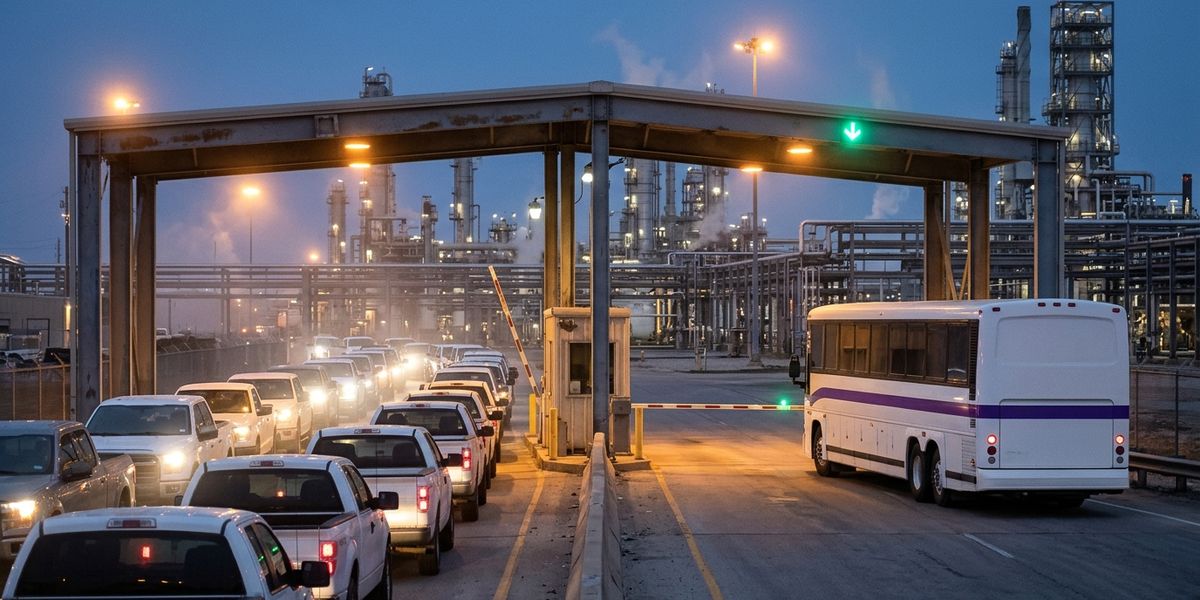
About 3,200 people a day were expected on site at the peak of the Co-op Refinery Complex's 2024 turnaround in Regina, and the owner told the city when they would move: between 5 and 7:30 a.m. and between 4 and 7:30 p.m., as shifts changed (FCL, April 2024). Most of their vehicles were to come in through one area around Fleet Street and McDonald Street, run by the refinery's security provider. That entry area is where turnaround contractor transportation gets decided. On work trips, US commuters average 1.08 people per vehicle (FHWA, 2022 National Household Travel Survey), so a workforce that drives like ordinary commuters puts close to one vehicle per person through the gate. An owner who leaves the commute to each contractor lets dozens of separate companies decide how many cars arrive in a 150-minute window. Public evidence from owners in Finland and Canada, plus the US rules that already govern contractor access, points one way. Our threshold is about 1,000 people on a single shift: past it, the owner should run one bus network from its own master roster.
A turnaround workforce is a roster that changes every day
Neste's 2024 turnaround at Porvoo shows how far a roster moves between plan and outturn. Before work began, Neste forecast some 4,500 people, about a thousand of them its own employees, from more than a hundred audited contractor companies over roughly nine weeks. When the work closed in June, the company put the total at some 7,600 people and more than 1.4 million working hours, on an investment of about €390M (Neste, June 2024).
Two calculations follow, and both are ours rather than Neste's. The headcount finished about 70% above the forecast. And 1.4 million hours across 7,600 people averages out at about 184 hours each, or some 15 twelve-hour shifts inside a nine-week event. "Took part" is a cumulative count, so most participants spent a slice of the turnaround on site and then left. A bus plan sized from the April list would have been sized for a smaller workforce than the one that came.
Where those people sleep matters as much as how many there are. For the 2026 turnaround, which Neste forecast at around 7,500 people from more than a hundred contractor companies (Neste, June 2026), the owner's arrival pages stated that Neste does not arrange accommodation. The nearest lodging was 15 to 20 minutes' drive from Kilpilahti, and the list of towns ran out to places 45 to 55 minutes away. Over 80% of the selected contractor companies were Finnish, with specialists from Germany, Poland, Spain, Sweden, the Netherlands and the UK. Riders arrive from a ring of towns up to an hour out, and the first place they can be consolidated is wherever the owner tells them to park.
Irving Oil's Saint John refinery repeats the pattern at a smaller scale. Its 2026 turnaround, Operation Osprey, needed about 2,100 additional skilled workers in 19 trades from more than 55 contracting companies, over 75 days from September, according to Irving Oil's August 2026 release. The trade association AFPM gives the reason this never settles: in the US, turnarounds cluster in spring and fall, and across the industry a limited pool of specialised turnaround workers moves from one site to the next (AFPM, October 2023). A crew coming off another owner's outage knows nothing about this site's lots, stops or gate rules.
The gate, not the road, sets turnaround parking and shuttle capacity
Co-op runs a turnaround every year, and it printed the same two shift-change windows, 5 to 7:30 a.m. and 4 to 7:30 p.m., in its 2022, 2023, 2024 and 2026 releases (FCL). In 2022 it put contractor parking on Fleet Street and had its security provider manage the area around Gate 7. In 2023 and 2024 the security provider managed the Fleet Street and McDonald Street area where most vehicles would enter. The 2026 release, for a 54-day turnaround with more than 1,500 people on site each day at peak, described the same control "to safely control traffic entering and exiting the site." Headcount changes from year to year, but the whole site still moves in about six hours a day through one managed area.
So the capacity question is how many vehicles that area must absorb, and occupancy answers it. The table runs Co-op's planned 2024 daily peak through three arrival modes. Only the first occupancy figure is measured; the other two are assumptions, and no row is a Co-op number.
| Arrival mode | People per vehicle | Vehicles for 3,200 people | Basis |
|---|---|---|---|
| Drive like US commuters | 1.08 | about 2,960 | FHWA, 2022 NHTS work-trip average |
| Crews double up in pickups | 2 | 1,600 | assumption |
| 50-seat coaches, 40 riders a trip | 40 | 80 coach trips | assumption |
Every vehicle enters once and leaves once, nearly all of it inside the shift-change windows. At commuter occupancy that comes to close to 5,900 gate movements a day; the coach row needs about 160. The 1.08 figure is a US household average, and turnaround crews may share trucks more than office commuters do, which is why the middle row is there. Even at two people per pickup, the entry area handles 20 times the vehicle movements of a coach network. A stadium meets the same arithmetic once on an event-day staff surge. A refinery turnaround meets it twice a day for 47 to 75 days, the planned lengths of Co-op's 2024 turnaround and Irving Oil's 2026 one.
Neste chose the other design. Its 2024 release announced a temporary parking area for contractors and "continuous shuttle bus transportation" from it to the turnaround site, with the buses running on Neste's own renewable diesel, and warned that traffic volumes near the refinery would "increase considerably." By 2026 the arrangement had an address: daily arrival was via the TA-terminal, which combined contractor parking, a turnaround bus terminal and social facilities (Neste, Plan your trip). Consolidation moved off the gate and onto a lot the owner controls, and what reaches the process area is buses.
Contractor-run vans versus one owner-run turnaround bus network
In 2017 a bus-service vendor supplied the labels for this choice. Writing in BIC Magazine, Randy Guillot of Onpoint split turnaround transport into decentralized, where each contractor moves its own crew, and centralized, where one provider shuttles everyone. He noted that turnaround crews once ran at fewer than 500 workers per shift and now often number in the thousands, and he claimed up to 40% fewer worker transport vehicles under the centralized model. That 40% is a vendor's figure. We found no owner that has published a measured before-and-after comparison of the two models, and none is implied here. The owner's case rests on two things anyone can check: who carries the duty, and who can see the peak.
In the US, the duty already sits with the owner. OSHA's process safety management standard names contractors doing "turnaround" work on or next to a covered process, and paragraph (h)(2)(iv) requires the host employer to "control the entrance, presence and exit of contract employers and contract employees in covered process areas" (29 CFR 1910.119). The emergency action plan rule adds "procedures to account for all employees after evacuation" (29 CFR 1910.38(c)(4)).
But neither rule mentions buses, and neither reaches the public road or the parking lot. A bus manifest is not a badge record or a muster list either. What the rules establish is that the owner already runs a control that rider data feeds. One manifest format, held by the owner, can be pulled during an incident. Dozens of van sign-in sheets, one per contractor and each in its own format, have to be assembled during one.
Visibility is the second argument, and it is arithmetic. Only the owner holds the roster across 55 or more than 100 companies, so only the owner can add every contractor's start times and see the real load inside the 150-minute morning window. A contractor sizing its own vans sees its own crew. Neste's turnaround safety rules already pull the commute inside the owner's system: its Life-Saving Rule on traffic hazards covers travel "to and from work" and tells participants that coming late is "a far better option that [sic] compromising safety while on the road."
The case for leaving transport to each contractor
Why would an owner decline all this? Transport is priced into contractor rates. Each contractor knows its own crews, its early outs and its holdovers, and can add a van on the day. An owner network adds a cost line and vehicle liability, and workers carrying tools want their own truck at the end of a 12-hour shift.
Part of that is right. Below a few hundred people per shift, which the Onpoint piece itself describes as the old norm, a gate can absorb crew vans and an owner network buys little. Co-op, planning for more than 1,500 people a day at its 2026 peak, relied on a security-managed entry area; its releases mention no owner-run buses. At that scale it is a defensible design.
Pay is the stronger objection, and it depends on where the refinery sits. Federal rules list "riding on buses between a town and an outlying mine or factory where the employee is employed" as normally preliminary or postliminary activity, outside paid time (29 CFR 790.7(f)(2)). California departs from that. In Morillion v. Royal Packing Co. (2000), the California Supreme Court held that time farmworkers spent on employer-required buses from designated assembly lots counted as hours worked under the state wage order. A compulsory park-and-ride at a California refinery can therefore carry a wage cost that a voluntary one may not, and a project labour agreement can make bus time paid in any state. Counsel should settle that before the plan is written, not after the first payroll.
None of this reverses the case above 1,000 people a shift; it bounds it. Where compulsory-travel pay rules apply, the lot-and-bus can stay the default without being the only way in, or the ride time can be priced into the turnaround budget from the start. Tools have a simpler answer: gate permits for the tool trucks and supervisors' vehicles that have to come inside, issued against the same roster.
Sizing 12-hour shift buses from the master roster
The coach fleet has to be sized to the window, not the day. If half of Co-op's 2024 peak arrived in the morning window, that is 1,600 people in 150 minutes, or 40 coach loads at 40 riders each, and arrivals bunch toward shift start rather than spreading evenly. The daily average hides that bunching completely. A fleet sized on the day total runs half-empty at the start of the window and leaves riders waiting at the end of it.
Drop points belong by unit area. A refinery's process units sit far apart, and a bus that unloads everyone at one gate moves the bottleneck from the road to the walk. Stops set from where each contractor works that week keep the walk short, and they move when the work moves.
Neste's headcount ran about 70% past forecast, so the plan has to be redrawn while the turnaround runs. That means booking by shift, recording who boarded and who did not, and re-cutting routes from those records daily. No-shows carry more information than they seem to: a crew that stops boarding can be the first sign that a contractor has demobilised before anyone told logistics.
Shift length turns the ride home into part of the schedule. API RP 755 caps outage work at 14 hours per shift and 182 hours per work-set, followed by 34 hours off, and says it is intended for "a workforce that is commuting daily to a job location" (API, RP 755 fact sheet). At 12-hour shifts, 182 hours is about 15 shifts in a row. A park-and-ride takes the gate leg off the worker; the drive from the lot to lodging up to an hour away stays with them, and that exposure is the subject of drowsy driving after the night shift. Late buses after each shift change cover the holdovers. Several bus companies under one owner contract need one service standard and one report per supplier on on-time departures and no-shows, so the owner compares them on the same terms.
Spring 2027 turnarounds are being planned now, and fall 2027 is filling up behind them. In Industrial Info Resources' outage database, seven US refineries have pushed planned work on 10 crude units out of fall 2026 and into fall 2027 (IIR, September 2026). As of 9 September, its fall-2027 planned crude outages stood 283,000 barrels a day above its 1 February view, while January to April 2027 moved by only 9,000 barrels a day. For any 2027 event where a single shift passes about 1,000 people, the evidence supports one recommendation: write transport into the turnaround execution plan, with the owner holding the roster and contractors feeding it. Below that line, a managed gate like Co-op's holds up. As far as we could find, a measured comparison of the two models is still unpublished; an owner that logs gate vehicle counts and bus manifests through a single turnaround would hold the first one, so the next plan starts from its own data instead of a vendor's 40%.
Smart Shuttles runs remote-lot shuttles with hub-and-spoke stops, seat booking with no-show tracking, and WhatsApp notifications for crews that change every week.
Sources
- Neste Corporation — Major turnaround 2024 at Neste refinery in Porvoo, Finland about to begin, 2 April 2024. https://www.neste.com/news/major-turnaround-2024-at-neste-refinery-in-porvoo-finland-about-to-begin — accessed 2026-11-06
- Neste Corporation — Major turnaround at Neste's Porvoo refinery was successfully completed, 5 June 2024. https://www.neste.com/news/major-turnaround-at-nestes-porvoo-refinery-was-successfully-completed — accessed 2026-11-06
- Neste Corporation — Neste to invest over EUR 400 million in Porvoo refinery maintenance turnaround, 30 June 2026. https://www.neste.com/news/neste-to-invest-over-eur-400-million-in-porvoo-refinery-maintenance-turnaround — accessed 2026-11-06
- Neste Corporation — Turnaround 2026: Plan your trip, Wayback Machine snapshot of 17 June 2026. https://web.archive.org/web/20260617100127/https://www.neste.com/turnaround/get-ready/plan-your-trip — accessed 2026-11-06
- Neste Corporation — Turnaround 2026: Accommodation, Wayback Machine snapshot of 17 June 2026. https://web.archive.org/web/20260617093350/https://www.neste.com/turnaround/get-ready/accommodation — accessed 2026-11-06
- Neste Corporation — Turnaround 2026: Safety (Life-Saving Rules), Wayback Machine snapshot of 17 June 2026. https://web.archive.org/web/20260617110055/https://www.neste.com/turnaround/safety — accessed 2026-11-06
- Federated Co-operatives Limited — FCL investing more than $150 million in annual Co-op Refinery Complex Turnaround, 13 April 2026, Wayback Machine snapshot. https://web.archive.org/web/20260518182625/https://www.fcl.crs/news-reports/news/article/FCL-investing-more-than-150-million-in-annual-Turnaround — accessed 2026-11-06
- Federated Co-operatives Limited — FCL investing more than $140 million in annual Turnaround, 2 April 2024, Wayback Machine snapshot. https://web.archive.org/web/20240417033915/https://www.fcl.crs/news-reports/news/article/FCL-investing-more-than-140-million-in-annual-Turnaround — accessed 2026-11-06
- Federated Co-operatives Limited — Co-op Refinery Complex to invest more than $89 million in annual Turnaround, 31 March 2023, Wayback Machine snapshot. https://web.archive.org/web/20260514160603/https://www.fcl.crs/news-reports/news/article/Co-op-Refinery-Complex-to-invest-more-than-$89-million-in-annual-Turnaround — accessed 2026-11-06
- Federated Co-operatives Limited — Co-op Refinery Complex to invest more than $100 million in annual Turnaround, 18 April 2022, Wayback Machine snapshot. https://web.archive.org/web/20220521154046/https://www.fcl.crs/news-reports/news/article/co-op-refinery-complex-to-invest-more-than-%24100-million-in-annual-turnaround — accessed 2026-11-06
- Federal Highway Administration — Summary of Travel Trends: 2022 National Household Travel Survey (FHWA-HPL-24-009), January 2024, Table 5-2. https://rosap.ntl.bts.gov/view/dot/73764 — accessed 2026-11-06
- Electronic Code of Federal Regulations — 29 CFR 1910.119, Process safety management of highly hazardous chemicals. https://www.ecfr.gov/current/title-29/subtitle-B/chapter-XVII/part-1910/subpart-H/section-1910.119 — accessed 2026-11-06
- Occupational Safety and Health Administration — 29 CFR 1910.38, Emergency action plans. https://www.osha.gov/laws-regs/regulations/standardnumber/1910/1910.38 — accessed 2026-11-06
- BIC Magazine — Randy Guillot (Onpoint), Smarter, safer options for today's large turnarounds, 18 September 2017 (vendor-authored). https://www.bicmagazine.com/departments/maintenance-reliability/september-2017-smarter-safer-options-for-todays-large-turnarounds/ — accessed 2026-11-06
- Irving Oil — Irving Oil invests $235 million in its Saint John refinery, Canada's largest, as part of its annual fall turnaround, 24 August 2026. https://www.irvingoil.com/en-CA/node/36041 — accessed 2026-11-06
- American Fuel & Petrochemical Manufacturers (AFPM) — Refinery turnarounds 101: What are turnarounds and why do we need them?, 17 October 2023. https://afpm.org/newsroom/blog/refinery-turnarounds-101-what-are-turnarounds-and-why-do-we-need-them — accessed 2026-11-06
- Electronic Code of Federal Regulations — 29 CFR 790.7, Preliminary and postliminary activities. https://www.ecfr.gov/current/title-29/subtitle-B/chapter-V/subchapter-B/part-790/section-790.7 — accessed 2026-11-06
- Supreme Court of California — Morillion v. Royal Packing Co. (2000) 22 Cal.4th 575 (via Justia). https://law.justia.com/cases/california/cal4th/22/575.html — accessed 2026-11-06
- American Petroleum Institute — RP 755 Fact Sheet: Fatigue Risk Management Systems, October 2019. https://www.api.org/-/media/Files/Oil-and-Natural-Gas/Refining/Process Safety/RP-755-Fact-Sheet.pdf — accessed 2026-11-06
- Industrial Info Resources — Jesse Broehl and Hillary Stevenson, Some U.S. Refiners Deferring Maintenance from 2026 to 2027, 17 September 2026. https://www.industrialinfo.com/iirenergy/industry-news/article/some-us-refiners-deferring-maintenance-from-2026-to-2027--362613 — accessed 2026-11-06