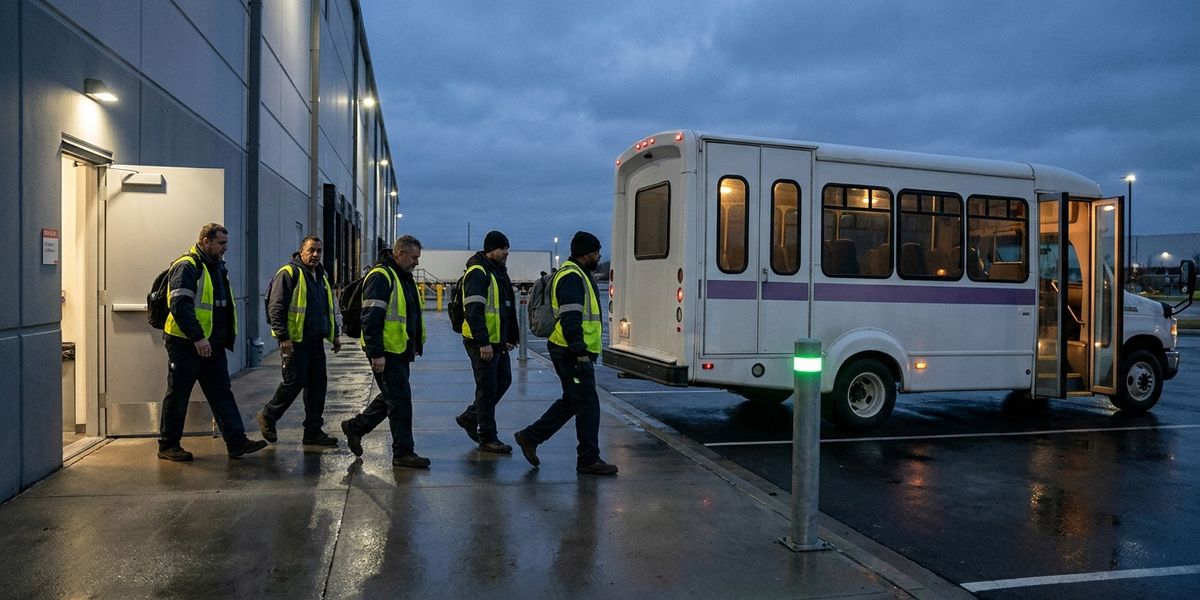
At 2:00 a.m. on Sunday, 1 November 2026, US clocks fall back to 1:00 a.m. and that hour runs twice (NIST). Anyone rostered from 11 p.m. to 7 a.m. that night works nine hours, then drives home on the first morning of the National Sleep Foundation's Drowsy Driving Prevention Week, which runs 1–7 November. The coincidence is minor. The question underneath it is not: who owns the risk of the drive home after a night shift?
US courts have mostly answered "the employee," and for a regular eight-hour schedule that answer survives. It thins wherever the employer schedules the fatigue through extended shifts, doubles and mandatory overtime, which is the direction 24/7 rosters keep moving. Meanwhile the bodies that write fatigue guidance have pulled the post-shift drive home into the employer's scope one document at a time, and in graduate medicine it is already a requirement. Employers running night and overtime-heavy rosters should expect a ride home after those shifts to become a standard control within this decade, and the evidence on the driver, the case law and the cost line all point that way.
What driving home after a night shift does to the driver
Six of 16 post-night-shift drives on a closed test track produced at least one near-crash, and 7 of 16 were stopped early for safety. After a night of sleep, the same drivers logged zero of either. Researchers from Brigham and Women's Hospital ran those two-hour daytime drives for a 2016 study in PNAS, with 16 participants and no public traffic. Small and controlled by design, it isolates the mechanism: lane excursions ran at 3.09 a minute after the night shift against 1.49 after sleep.
Field surveys report the same thing from the workforce. In a 2022 survey of 2,205 nurses at one US health system, 30% said they had dozed off while driving on their commute to work and 44.6% said drowsiness or fatigue had left them feeling unsafe or uncomfortable on the commute (Westley et al., Workplace Health & Safety). A 2017 national survey of 2,231 UK anaesthesia trainees (McClelland et al., Anaesthesia) put the share reporting an accident or near-miss on the way home from night shifts at 57%. NIOSH training material for nurses places the main window for drowsy-driving crashes and near misses between 4 and 6 a.m. Hospitals have measured this most closely, which is why so much of the data is clinical. Nothing in the physiology is specific to medicine.
Alcohol gives the most familiar yardstick. Williamson and Feyer reported in 2000 that by 17 to 19 hours awake, their subjects scored as badly on some tests as they did at 0.05% blood alcohol, or worse (Occupational and Environmental Medicine). Anyone who woke at noon and clocks out at 7 a.m. has been awake 19 hours.
For an employer, the dose-response findings carry the weight, because they tie risk to the schedule rather than to the person. Barger and colleagues followed 2,737 first-year doctors through 17,003 monthly reports and calculated that every extended shift of 24 hours or more scheduled in a month increased "the monthly risk of a crash during the commute from work by 16.2 percent" (New England Journal of Medicine, 2005). After an extended shift, the odds of reporting a crash were 2.3 times higher and the odds of a near-miss 5.9 times higher. Nurse logbooks showed a gradient at a shorter threshold: 12.5 or more consecutive hours doubled the odds of drowsy driving (Scott et al., SLEEP, 2007). Both studies are old. Both measured the one variable an employer controls outright.
How many people does this cover? BLS counted 5.1 million US wage and salary workers usually on night shifts and 2.9 million on rotating shifts in 2024–25, in schedule data released on 24 September 2026. Non-daytime work reaches 40% of workers in leisure and hospitality and 25% in transportation and utilities. Those are the same rosters that make routing for manufacturing shift changes hard, and the same ones behind night-shift nurse retention problems.
National crash counts understate all of it, and the gap is the first thing a skeptic raises. NHTSA's police-reported count was 644 drowsy-driving deaths in 2024, 1.6% of 39,254 traffic fatalities. The AAA Foundation, modelling drowsiness where a police report cannot establish it, estimated that 17.6% of fatal crashes from 2017 to 2021 involved a drowsy driver, an estimated 29,834 deaths over five years. GHSA applied that share to 2023 and arrived at 6,326 deaths, ten times that year's police count. An officer at a crash scene can test for alcohol. Nothing equivalent exists for sleep, so the count is a floor and the model is the better estimate of the total.
Where courts draw the line on employer liability for fatigued driving
Under a regular schedule, most US courts do not make the employer liable for an employee's drowsy drive home, and any honest case for change has to start there. In Feltham v. Universal Protection Service (Cal. Ct. App., 2022), an overnight security guard at a San Francisco hospital fell asleep about an hour after her 11 p.m. to 7 a.m. shift and crashed. Summary judgment for her employer was affirmed. She had worked "a regular eight-hour shift" after "16 hours off," and the court found "no evidence that 'employer-caused' fatigue was a proximate cause."
In 2012 Maryland's highest court went further in Barclay v. Briscoe. A longshoreman checked out at 6:00 a.m. after a 22-hour shift and crashed head-on at about 7:28 a.m., and the court still found neither vicarious liability (on-the-job fatigue "is not a 'special circumstance'") nor a duty to the public, leaving maximum-hours rules to the legislature. In 2023 West Virginia's Supreme Court reversed a judgment of more than $2 million against Speedway, holding that an employer's duty requires affirmative conduct that creates the risk. That case also involved prescription drugs, so it is doctrine, not a fatigue verdict.
The exceptions are narrow, and they share a fact pattern. In Faverty v. McDonald's (Or. Ct. App., 1995), an 18-year-old worked three shifts totaling more than 12 hours within 17 hours, fell asleep driving home and crossed the center line into another driver. The award against the employer, $375,000 as The Seattle Times reported it, stood; the opinion records that the restaurant knew at least two other employees had crashed after falling asleep on the way home from late shifts. In Robertson v. LeMaster (W. Va., 1983; 301 S.E.2d 563), the employee had been kept at work for 27 hours without rest. Barclay, quoting another court, called Faverty an aberration.
Read side by side, these cases turn on two questions. Did the employer create the fatigue, and did it know? The employer in Feltham won on 16 hours off; McDonald's lost on three shifts in 17 hours plus prior crashes. A roster built on mandatory overtime, back-to-back doubles or 12.5-hour nights hands a plaintiff the facts the Feltham plaintiffs lacked, and an incident log with "near-miss on the drive home" entries supplies the knowledge.
Outcomes vary by state, and none of this is legal advice. Exposure still concentrates on the scheduling choices 24/7 operators make when they run short.
The off-the-job crash bill already on the benefits line
Winning in court does not remove the cost, and risk teams underweight that part. The Network of Employers for Traffic Safety put the cost of motor vehicle crashes to US employers at $61.7 billion for 2023 in its July 2026 report, and Art Kinsman, its chief strategy officer, called the total "a largely hidden $62 billion annual cost" in the 22 July release. The report's own breakdown attributes $26.4 billion of that, 43%, to off-the-job crashes involving employees and their dependents. It arrives through health insurance, sick leave, disability and lost productivity, whoever was at fault.
Off-the-job is broader than the commute. It covers every crash outside work, a dependent's included, so the $26.4 billion is not a commute figure and should never be quoted as one. What it shows is the channel. A crash on the drive home reaches the employer through the medical plan, the leave calendar and an empty slot on next week's night roster, whether or not anyone files suit.
GHSA's February 2026 Wake Up Call update, produced with support from General Motors, states that employers "share the responsibility for preventing drowsy driving crashes and may be legally liable in the event of a crash." That is an association's position, not a holding, and the cases above show how far courts remain from it. As a signal it still counts: the state highway-safety offices that run enforcement and public campaigns now write the employer into the problem by name, and GHSA's own policy urges states and communities to collaborate with industry on rest policies for night and shift workers.
From suggestion to requirement: how the ride home entered fatigue rules
The UK Health and Safety Executive's shift-work guidance, HSG256, first published in 2006, tells employers to "consider if providing transport to and from the workplace would be beneficial," and notes that night workers are more likely than day workers to have accidents driving home. In January 2013, CDC's Morbidity and Mortality Weekly Report relayed NHTSA guidance for employers of shift workers suggesting they "consider providing alternate transportation home for employees or allowing naps at work." Both documents are advice. Neither creates a duty.
In 2017 graduate medicine turned the advice into a rule. The Accreditation Council for Graduate Medical Education requires every accredited US residency program, with its sponsoring institution, to "ensure adequate sleep facilities and safe transportation options for residents who may be too fatigued to safely return home." That text is §6.16 of the Common Program Requirements in force since 1 July 2026. Every sponsoring institution of an accredited US residency already has to ensure a safe way home for one class of fatigued employee.
What compliance costs is on record too. Yale's Department of Surgery piloted a reimbursed-rideshare program for its 72 surgical residents working 24-hour shifts. Over 60 days, 63 rides cost $3,030, about $48 a ride. Only 16.6% of residents used it, yet 92.4% of rides went to junior residents and 91% to commutes longer than 15 miles, exactly where the risk sits. Self-reported episodes of falling asleep or nearly falling asleep at the wheel dropped significantly, and 98% of residents backed making the program permanent (White et al., Journal of Surgical Research, 2021). One program, 72 people, self-reported outcomes: treat it as a cost benchmark, not proof of effect.
Low uptake is the objection finance teams raise first. The Yale data answers it from the other side, because a ride home used only by the highest-risk sixth of the group is a cheap control rather than a failed one. Opt-in rides on request suit a residency, where the risky nights are few and announced. A distribution center running six weeks of mandatory overtime needs seats scheduled to the roster, since the people most at risk are the least likely to stop and book a car at 6 a.m.
Which rosters a plaintiff or regulator reads first
Healthcare comes first, because the rule already exists for residents and the nursing data is public. A plaintiff's lawyer in a nurse's post-shift crash can be expected to put §6.16 next to a 12.5-hour night roster and ask why residents get a ride home and nurses do not.
Next come the overtime-heavy night operations: distribution centers in peak season, plants running 12-hour rotating nights, airport ground crews on split and early shifts. If you run one of those rosters, your overtime records and your incident log are where a future case gets built, and both are discoverable.
A forecast, labelled as one: by 2030 a ride home after extended or overtime night shifts will be a line item in fatigue-risk audits and in at least one accreditation or sector standard outside residency training. No regulator has announced it. The 2006-to-2026 sequence above is the basis, and each step took a few years.
The move worth making before that window closes is narrow. Pull 12 months of rosters and mark every shift that ran past 12.5 consecutive hours, every double, every overtime night and every release between 4 and 6 a.m. Cross that list against the incident log for commute near-misses. That list is the population a ride home has to cover, and at the Yale pilot's $48 a ride it is a budget line you can price this quarter. Log every ride offered and taken; a record showing the employer acted after an extended shift is the reverse of the facts Faverty turned on.
Smart Employee Commuting is where Ryde handles shift rules, pre-planned routes timed to shift ends and dynamic rides for late finishers, with every route change logged.
Sources
- U.S. Bureau of Labor Statistics — Job Flexibilities and Work Schedules – 2024–2025, Table 8, released 24 September 2026. https://www.bls.gov/news.release/flex2.t08.htm — accessed 2026-10-24
- U.S. Bureau of Labor Statistics — Job Flexibilities and Work Schedules – 2024–2025, news release summary (industry shares of non-daytime work), 24 September 2026. https://www.bls.gov/news.release/flex2.nr0.htm — accessed 2026-10-24
- Lee ML, Howard ME, Horrey WJ, et al. — High risk of near-crash driving events following night-shift work, PNAS 113(1), 2016. https://doi.org/10.1073/pnas.1510383112 — accessed 2026-10-24
- Barger LK, Cade BE, Ayas NT, et al. — Extended work shifts and the risk of motor vehicle crashes among interns, New England Journal of Medicine 352, 2005. https://doi.org/10.1056/NEJMoa041401 — accessed 2026-10-24
- Scott LD, Hwang WT, Rogers AE, et al. — The relationship between nurse work schedules, sleep duration, and drowsy driving, SLEEP 30(12), 2007. https://pmc.ncbi.nlm.nih.gov/articles/PMC2276124/ — accessed 2026-10-24
- Westley JA, Peterson J, Cook B — Drowsy Driving Among Nurses: Potential Impetus to Support Napping, Workplace Health & Safety 70(12), 2022. https://doi.org/10.1177/21650799221111300 — accessed 2026-10-24
- McClelland L, Holland J, Lomas JP, et al. — A national survey of the effects of fatigue on trainees in anaesthesia in the UK, Anaesthesia 72(9), 2017. https://doi.org/10.1111/anae.13965 — accessed 2026-10-24
- Williamson AM, Feyer AM — Moderate sleep deprivation produces impairments in cognitive and motor performance equivalent to legally prescribed levels of alcohol intoxication, Occupational and Environmental Medicine 57(10), 2000. https://doi.org/10.1136/oem.57.10.649 — accessed 2026-10-24
- NIOSH — Training for Nurses on Shift Work and Long Work Hours, Module 11. https://www.cdc.gov/niosh/work-hour-training-for-nurses/longhours/mod11/02.html — accessed 2026-10-24
- NHTSA — Overview of Motor Vehicle Traffic Crashes in 2024, DOT HS 813 791, April 2026. https://crashstats.nhtsa.dot.gov/Api/Public/ViewPublication/813791 — accessed 2026-10-24
- AAA Foundation for Traffic Safety (Tefft BC) — Drowsy Driving in Fatal Crashes, United States, 2017–2021, March 2024. https://aaafoundation.org/research/drowsy-driving-in-fatal-crashes-united-states-2017-2021/ — accessed 2026-10-24
- Governors Highway Safety Association — Wake Up Call: 2026 Update, February 2026 (supported by General Motors). https://www.ghsa.org/sites/default/files/2026-02/Wake_Up_Call_2026_Update.pdf — accessed 2026-10-24
- California Court of Appeal, First District — Feltham v. Universal Protection Service, LP, No. A161190, 30 March 2022. https://www.courts.ca.gov/opinions/archive/A161190.PDF — accessed 2026-10-24
- Court of Appeals of Maryland — Barclay v. Briscoe, 47 A.3d 560, 27 June 2012. https://www.mdcourts.gov/data/opinions/coa/2012/41a11.pdf — accessed 2026-10-24
- The Seattle Times — McDonald's liable in accident, 23 March 1995 (Faverty v. McDonald's Restaurants of Oregon). https://archive.seattletimes.com/archive/19950323/2111689/mcdonalds-liable-in-accident — accessed 2026-10-24
- Oregon Court of Appeals — Faverty v. McDonald's Restaurants of Oregon, Inc., 892 P.2d 703, 1995 (via CourtListener). https://www.courtlistener.com/opinion/1163367/faverty-v-mcdonalds-restaurants-of-oregon-inc/ — accessed 2026-10-24
- Supreme Court of Appeals of West Virginia — Robertson v. LeMaster, 301 S.E.2d 563, 1983 (via CourtListener). https://www.courtlistener.com/opinion/1330150/robertson-v-lemaster/ — accessed 2026-10-24
- Supreme Court of Appeals of West Virginia — Speedway LLC v. Jarrett, No. 21-0215, 8 June 2023 (via CourtListener). https://www.courtlistener.com/opinion/9405199/speedway-llc-v-devorah-l-jarrett-as-the-of-the-estate-of-kevin-m/ — accessed 2026-10-24
- Network of Employers for Traffic Safety — Cost of Motor Vehicle Crashes to Employers – 2026, July 2026 (Table 2). https://trafficsafety.org/wp-content/uploads/2026/07/NETS-Cost-of-Crashes-Update_Final_07_21_26.pdf — accessed 2026-10-24
- Network of Employers for Traffic Safety — NETS Releases Updated Costs of Motor Vehicle Crashes to Employers Report, 22 July 2026 (Art Kinsman quote). https://trafficsafety.org/nets-news/nets-releases-updated-costs-of-motor-vehicle-crashes-to-employers-report/ — accessed 2026-10-24
- CDC — Drowsy Driving — 19 States and the District of Columbia, 2009–2010, MMWR 61(51), January 2013. https://www.cdc.gov/mmwr/preview/mmwrhtml/mm6151a1.htm — accessed 2026-10-24
- Health and Safety Executive — Managing shift work: Health and safety guidance (HSG256). https://www.hse.gov.uk/pubns/priced/hsg256.pdf — accessed 2026-10-24
- Accreditation Council for Graduate Medical Education — ACGME Common Program Requirements (Residency), effective 1 July 2026, §6.16. https://www.acgme.org/globalassets/pfassets/programrequirements/2026-prs/cprresidency_2026.pdf — accessed 2026-10-24
- White EM, Freedman-Weiss MR, Heller DR, Huot SJ, Yoo PS — What's it Worth?: The Costs and Benefits of an Initiative to Decrease Post-Call Fatigued Driving Among Surgery Residents, Journal of Surgical Research, 2021. https://doi.org/10.1016/j.jss.2020.12.039 — accessed 2026-10-24
- National Sleep Foundation — NSF drowsy driving programs expand, 4 August 2026 (Drowsy Driving Prevention Week, 1–7 November 2026). https://www.thensf.org/nsf-drowsy-driving-programs-expand/ — accessed 2026-10-24
- National Institute of Standards and Technology — Daylight Saving Time. https://www.nist.gov/pml/time-and-frequency-division/popular-links/daylight-saving-time-dst — accessed 2026-10-24