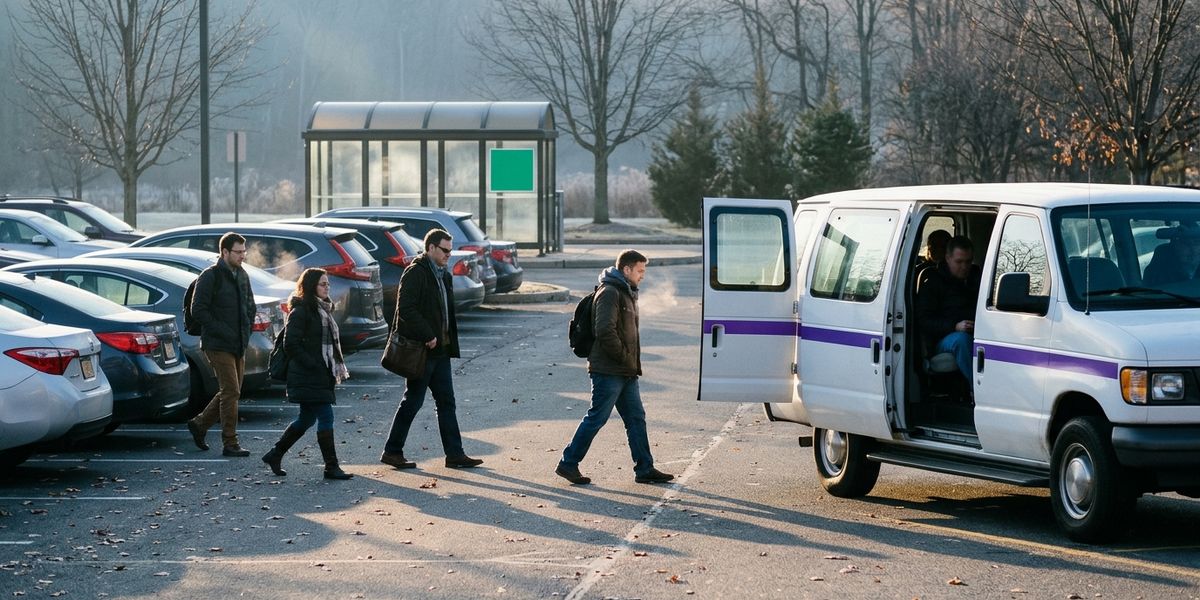
For 2027, the IRS lets employees exclude up to $350 a month for transit and vanpool and a separate $350 a month for qualified parking, up from $340 for each in 2026. Both figures come from Revenue Procedure 2026-35, which the IRS released with its tax year 2027 inflation adjustments on November 5, 2026, and both apply to taxable years beginning in 2027.
| Monthly limit under IRC §132(f) | 2026 | 2027 |
|---|---|---|
| Transit passes and vanpool, combined | $340 | $350 |
| Qualified parking | $340 | $350 |
| Most one employee can exclude (needs both kinds of cost) | $680 | $700 |
You probably file this under a two-field payroll change. Swap 340 for 350 in the transit and parking deduction codes before the first January run, update the portal, move on. The number is the easy part. What reaches a benefits inbox is how the number behaves: whether one person can get $700, whether an unused balance disappears on December 31, whether the company's own subsidy earns a second $350 on top of an employee's election, whether the bike benefit came back. Each of those questions has a confident wrong answer in circulation, and a payroll setup built on one of them either taxes money the law excludes or excludes money the law taxes, every pay period, until someone audits it.
The rules below are federal and private-sector, with Massachusetts and New Jersey as the named state exceptions. None of it is legal advice. Last year's figures, the per-jurisdiction penalties and the new-hire deadlines stay in the 2026 commuter benefits guide.
Where the 2027 figure comes from: Rev. Proc. 2026-35
If you set your 2027 caps from a benefits memo written over the summer, check its date. Anything published before November 5, 2026 was a projection.
The binding text sits in section 3.18 of Rev. Proc. 2026-35. For taxable years beginning in 2027, it puts the monthly limit under §132(f)(2)(A) on "the aggregate fringe benefit exclusion amount for transportation in a commuter highway vehicle and any transit pass" at $350, and the separate limit for qualified parking under §132(f)(2)(B) at $350 as well. The newsroom release that carried it, IR-2026-133, adjusts almost 70 provisions at once; its commuter line reads that both limits rise "to $350, up $10 from 2026."
Two words in that text decide most of what follows. "Aggregate" means transit passes and vanpool rides draw on one shared $350, never two. "Monthly" means the test runs month by month, so there is no annual pot of $4,200 to spend whenever the employee likes.
The limit has risen in each of the last five years: $300 in 2023, $315 in 2024 and $325 in 2025 (Rev. Procs. 2022-38, 2023-34 and 2024-40), then $340 in 2026 and $350 in 2027, with parking matching transit every year. That adds up to $600 a year of extra exclusion per cap since 2023. If your cap lives in three places (the payroll deduction code, the election limit in the benefits portal and the employee FAQ), change all three in the same week.
A note on names. The statute behind the cap is §132(f) as amended by P.L. 119-21, the 2025 budget law most people know as the One Big Beautiful Bill Act. IRS releases now call it the Working Families Tax Cuts. It is the same law. Publication 15-B, the IRS employer guide to fringe benefits, had no 2027 edition posted at the time of writing; the definitions and procedures in the 2026 edition carry forward, and only the dollar amounts change.
$350 or $700 a month: how the transit and parking caps combine
Exam prep phrases it as a textbook problem. An employer pays an employee's transit pass and parking every month; can it exclude $350 or $700? Your employees ask the same thing with their own numbers attached.
Both answers are correct for somebody. The $700 belongs only to an employee who has both a parking cost and a transit or vanpool cost. Transit plus vanpool, together, never exceed $350.
The statute sets two caps, and the regulation says they stack. "An employer may provide qualified parking benefits in addition to transportation in a commuter highway vehicle and transit passes," reads Q/A-7(c) of Treasury Regulation 1.132-9, and the 2026 Publication 15-B says the same in plainer words: "You may provide an employee with any one or more of these benefits at the same time." What does not stack is transit with vanpool. Massachusetts spelled out the shared cap with its own worked case in TIR 25-9: an employee with a $260 transit pass and a $100 vanpool benefit against the 2026 limit of $340 has $20 of taxable wages.
Run the 2027 figures through four fact patterns and the rule becomes mechanical:
- A $400 transit pass and $300 of parking each month. Transit runs $50 over its cap, so $50 is taxable wages; parking sits under its own cap and is fully excluded. Total excluded: $650.
- $200 of transit and $200 of vanpool each month. That is $400 against one shared $350 cap, so $50 is taxable, and the unused parking cap cannot absorb it.
- $350 of transit and $350 of parking each month. All $700 is excluded and nothing is taxable.
- $500 of parking and no transit. The parking cap excludes $350 and the other $150 is taxable, even though the transit cap went unused.
The over-limit rule from Publication 15-B (2026 edition) decides the taxable slice: "include in the employee's wages the amount over the limit minus any amount the employee paid for the benefit. You can't exclude the excess from the employee's wages as a de minimis transportation benefit." If the employee already paid part of the cost from after-tax pay, that part is not taxed a second time.
There is one more misreading worth stopping early. Skip parking in August, the thinking goes, and claim $700 of parking in September. The regulation closes that door in Q/A-9(a): "Monthly exclusion amounts are not combined to provide a qualified transportation fringe for any month exceeding the statutory limit."
Transit passes get a narrow exception. The monthly limit applies to passes the employer provides "in a month for that month or for any previous month in the calendar year" (Q/A-9(b)), and passes handed out in advance for up to 12 months can qualify if the regulation's conditions are met. So an employer that distributes passes in March covering January and February can test each pass against its own month's limit. That catch-up stays inside one calendar year and does nothing for parking or vanpool.
What counts as transit, vanpool and qualified parking
A paid trip to work qualifies only if it fits one of three definitions, and an ordinary ride-hail car fits none of them.
A transit pass is "any pass, token, farecard, voucher, or similar item" (Publication 15-B, 2026) for a ride on mass transit, or in a vehicle that "seats at least six adults (not including the driver)" if "a person in the business of transporting persons for pay or hire operates it." Mass transit "may be publicly or privately operated and includes bus, rail, or ferry." A standard four-seat ride-hail trip is neither mass transit nor a six-adult vehicle, so it falls outside the exclusion and runs through payroll as wages if you pay for it.
A commuter highway vehicle, the IRS term for a vanpool, is a highway vehicle that "seats at least six adults (not including the driver)," and "you must reasonably expect that at least 80% of the vehicle mileage will be for transporting employees between their homes and workplace with employees occupying at least one-half the vehicle's seats (not including the driver's)" (Publication 15-B, 2026). That test is what lets an employer-run vanpool or shuttle count as a qualified benefit under the $350 transit-and-vanpool cap. If you run one, who may ride and how the seats are allocated belong in your employee transportation policy, because the half-full condition depends on it.
Qualified parking is "parking you provide to your employees on or near your business premises," and it "includes parking on or near the location from which your employees commute to work using mass transit, commuter highway vehicles, or carpools. It doesn't include parking at or near your employee's home." Park-and-ride lots therefore count, and the garage at home does not. Parking counts as employer-provided when the employer owns or leases the space, pays for it directly or reimburses the employee (Treas. Reg. §1.132-9, Q/A-4(d)).
Cash is the last trap. Publication 15-B allows it only narrowly: "cash reimbursements for transit passes qualify only if a voucher or a similar item that the employee can exchange only for a transit pass isn't readily available for direct distribution by you to your employee." Where vouchers or transit cards are obtainable without restrictive fees, provide those instead of cash. And a reimbursement has to be bona fide: you can only pay back costs the employee has already incurred and documented.
One small edge sits beside the caps. A discount on transit passes stays tax-free as a de minimis fringe if it does not exceed $21 in any month, per the 2026 Publication 15-B. Check whether that figure moves when the 2027 edition appears.
Use-it-or-lose-it? Carryover, cross-use and the forfeit at termination
Every November someone asks whether they need to spend their transit balance before December 31. If your answer borrows from the health FSA, it is wrong.
Commuter balances carry over. No federal year-end forfeiture applies, and no federal carryover cap either.
The regulation answers in one word. "Yes. An employee may carry over unused compensation reduction amounts to subsequent periods under the plan of the employee's employer," says Q/A-15(a). Commuter benefits sit under §132(f), outside the §125 cafeteria-plan rules that govern an FSA, so the plan-year forfeiture logic never applies to them. A health FSA works differently: for 2027 it allows $3,500 of salary reductions, and a plan that permits carryover can roll at most $700 into the next year (IR-2026-133). That $700 matches the 2027 combined commuter maximum by coincidence, and the two numbers have nothing to do with each other. If your open-enrollment deck covers both accounts, say so on the slide.
Notice the phrase "under the plan." Federal rules permit the carryover, and your plan's terms govern how it works. The same applies to moving money between categories. In September 2020 the IRS Office of Chief Counsel answered a letter forwarded by Rep. Chellie Pingree from a constituent who had stopped riding transit during COVID-19 and started driving. Information Letter 2020-0024 replied that "an employee is not precluded from rolling over unused transit benefit amounts through the use of another qualified transportation fringe, such as qualified parking, to the extent it is offered by the employer's plan and it does not exceed the maximum monthly amount." Two limits still apply: the plan has to offer it, and each month's parking use stays under $350. Information letters are general guidance and not binding rulings, but this one is a clear statement of how the IRS reads its own regulation.
The real loss happens when someone leaves. Q/A-14(d) bars a plan from refunding an employee who stops participating, "such as in the case of termination of employment," for compensation reductions that exceeded the benefits actually provided. Information Letter 2019-0002, written in March 2019 about a fired employee who wanted an unused balance back, said no and closed both escape routes: the rule "does not distinguish between employees who are fired (or involuntarily terminated) and those that quit their employment voluntarily," and "the terminated employee cannot use the funds for continued transportation expenses." A year and a half later, New York State Senator Todd Kaminsky asked whether workers could at least receive their accumulated transit balances in cash. Information Letter 2020-0031 restated the same rule.
So the advice employees need is about departures, not December. Anyone planning to leave should shrink the election a month or two ahead so the balance is close to zero on the last day. Some plans allow a run-out period to submit claims for costs incurred while employed; that is plan design, and no federal rule sets its length, so check yours before you promise one. Add the forfeit to the offboarding checklist next to the final-paycheck items.
Employer subsidies and pre-tax elections share one $350
The cap counts what the employee receives, whatever its funding source. In Information Letter 2020-0031 the IRS put it this way: employers may provide qualified transportation fringes "up to the applicable statutory monthly limit either in addition to employees' stated compensation, or by reducing employees stated compensation." Employer money, employee salary reduction or a mix: all of it lands under one monthly limit per category. A program that subsidizes $150 a month of transit and lets employees elect another $350 pre-tax on top puts $500 against a $350 cap, and payroll owes tax on $150 of it. Publication 15-B adds that for each month "the amount of the compensation reduction can't exceed the monthly limits for transportation benefits." Set the pre-tax election ceiling at $350 minus the employer subsidy, per category, and the overage problem disappears before it starts. With a $150 transit subsidy, the 2027 transit election tops out at $200; parking keeps its own $350.
The election itself has rules that payroll calendars sometimes ignore. Q/A-12 requires it in writing or another permanent, verifiable form (electronic counts), showing "the date of the election, the amount of the compensation to be reduced, and the period for which the benefit will be provided." It must come before the cash is currently available, it can only cover a future period, and it "may not be revoked after the beginning of the period for which the qualified transportation fringe will be provided" (Q/A-14). An employee who changes the amount on January 12 changes it for the next period, never retroactively for January.
Q/A-6 adds that "Section 132(f) does not require that a qualified transportation fringe benefit plan be in writing." Write one anyway. The carryover, cross-use and run-out terms from the previous section all exist only "under the plan," and an unwritten plan leaves each of them to whoever answers the employee's email.
Self-employed individuals, partners and more-than-2% shareholders of an S corporation are not employees for this benefit, so they cannot use it. The limits also apply per employer, with all members of a controlled group under §414(b), (c), (m) or (o) treated as a single employer. Splitting a workforce across sister entities does not create a second cap.
The payroll-tax saving, and the deduction you no longer get
Your CFO hears "pre-tax benefit" and pictures two wins: a deduction and a payroll-tax saving. Only one of them exists.
Since 2018 there has been no federal deduction, and the disallowance covers salary-reduction dollars too.
The 2026 Publication 15-B quotes it in full: under §§274(a)(4) and 274(l), "no deduction is allowed for qualified transportation benefits (whether provided directly by you, through a bona fide reimbursement arrangement, or through a compensation reduction agreement) incurred or paid after 2017." The same paragraph extends the ban to "any expense incurred for providing any transportation" between an employee's home and workplace, "except as necessary for ensuring the safety of your employee." P.L. 119-21 struck the old bicycle carve-out from §274(l) and left the general rule in place.
What does survive is the payroll-tax exclusion. Amounts within the monthly limit "are not wages for purposes of the Federal Insurance Contributions Act (FICA), the Federal Unemployment Tax Act (FUTA), and federal income tax withholding," Q/A-22(a) states, and that covers salary reductions as well. FICA runs 7.65% on each side: 6.2% for Social Security up to the 2027 wage base of $192,300 (Social Security Administration), and 1.45% for Medicare with no ceiling.
Here is the 2027 arithmetic per participant, using that year's federal brackets (IR-2026-133): 22% applies to single filers' income over $52,025, 12% over $12,800. These are computed figures, not survey results.
| Annual saving per participant, 2027 | One cap maxed ($4,200 a year) | Both caps maxed ($8,400 a year) |
|---|---|---|
| Employer FICA (7.65%) | $321.30 | $642.60 |
| Employee in the 22% bracket (22% + 7.65%) | $1,245.30 | $2,490.60 |
| Employee in the 12% bracket (12% + 7.65%) | $825.30 | $1,650.60 |
The Social Security slice disappears for pay above $192,300, so high earners save the 1.45% Medicare share only. FUTA applies to the first $7,000 of each employee's wages (26 U.S.C. §3306(b)(1)), and most employees pass that line early in the year, so treat the FUTA saving as zero. And state income tax, where it applies, adds to the employee's figure. The $10 increase itself is worth $120 a year of extra exclusion per cap, or $9.18 of employer FICA per maxed participant.
Now set the deduction beside it. A C-corporation at the 21% federal rate gives up 21 cents of deduction on each salary-reduction dollar and saves 7.65 cents of employer FICA on it, so on salary-reduction money alone the federal arithmetic runs against a taxable employer. For a tax-exempt employer, many hospital systems and universities among them, the disallowance costs nothing, and the FICA saving is the entire federal effect.
The employee side holds under every employer's tax position: up to $2,490.60 a year for a 22%-bracket worker using both caps, without a raise. That is the case for running the program, and the shuttle seat versus pay raise comparison works it through against a salary increase, including the gross-up math your finance partner will ask for.
The bike benefit is gone federally, and two states use their own numbers
Section 70112 of P.L. 119-21 struck the bicycle provisions from §132(f) for taxable years beginning after December 31, 2025. The 2017 tax law had only suspended the exclusion for 2018 through 2025, which is why so many people still expect it to return. The 2026 Publication 15-B leaves no room for that: "For tax years beginning after 2025, P.L. 119-21 permanently eliminates the exclusion of qualified bicycle commuting reimbursements from your employee's income." A restoration bill exists. Senators Welch and Padilla introduced the Bicycle Commuter Act of 2025 (S. 2023) on June 11, 2025, and it was referred to the Senate Finance Committee. It has not become law.
Some local ordinances never caught up. Berkeley's commuter-benefit page still listed bicycle as a qualifying option when checked on November 10, 2026, and Philadelphia's ordinance (Bill No. 220337) names bicycle expense within its pre-tax choice. If you offer a bike benefit to satisfy a city rule, code it as federally taxable wages and tell the employee why.
Massachusetts goes further. State law follows the Internal Revenue Code as in effect on January 1, 2024 (G.L. c. 62, §1(c)), so the state did not adopt the repeal. TIR 25-9, issued December 23, 2025, set the 2026 Massachusetts caps at $335 for parking, $335 for combined transit and vanpool, and $20 a month for bicycle commuting, the last capped at $240 a year with no inflation adjustment. Massachusetts also kept 1998 as the inflation base year after P.L. 119-21 moved the federal base to 1997, which is why its figure trails the federal one. For 2026, that put $5 a month of a maxed federal transit exclusion into Massachusetts taxable wages ($340 federal against $335 state). The state's 2027 figures were not yet published at the time of writing; last year's release came in late December, so expect the 2027 TIR around then and do not guess at the number.
New Jersey takes a different route. For Gross Income Tax purposes it sets an annual limit equal to 12 times the federal monthly figure, which made the 2026 cap $4,080 (New Jersey Division of Taxation). The same formula gives $4,200 for 2027, although the division had not posted a 2027 row when this was written. Configure New Jersey state withholding against a yearly total, not the federal monthly test.
These two are the confirmed exceptions, not a complete survey of every state income tax, so for any other state with an income tax, check its conformity date before assuming the federal number carries through.
2027 state and city commuter benefit mandates: a reference table
If a vendor page lists a dozen or more commuter mandates for 2027, it is counting bills and enabling laws. Ten jurisdictions require employers to offer a commuter benefit, the same ten as in 2026. Where a mandate refers to the federal maximum, read $350 for 2027.
| Jurisdiction | Who is covered | What you must offer |
|---|---|---|
| New Jersey (statewide) | 20+ employees | Pre-tax transit and vanpool |
| New York City | 20+ full-time non-union employees in NYC | Pre-tax transit and vanpool (parking not required) |
| Washington, DC | 20+ employees in DC | Pre-tax, employer subsidy or employer-provided transport; separate parking cash-out law |
| Seattle | 20+ employees worldwide | Pre-tax transit and vanpool |
| San Francisco | 20+ employees nationwide with an SF location | Pre-tax, subsidy or employer-provided transport |
| Bay Area region (BAAQMD Reg. 14, Rule 1) | 50+ full-time employees in the nine counties | One of several options, including employer-provided transport |
| Berkeley, CA | 10+ employees | Choice of options; the pre-tax option is capped at $125 a month |
| Richmond, CA | 10+ employees | Choice of options |
| Philadelphia | 50+ covered employees (30+ hours a week in the city) | Pre-tax or employer-paid transit |
| Illinois (six-county northeastern region) | 50+ covered employees near fixed-route transit | Pre-tax transit |
Berkeley is the row that breaks the "every city equals the federal number" assumption: its pre-tax option tops out at $125, far below $350. DC's parking cash-out law (D.C. Law 23-113) adds a second obligation for employers of 20 or more that subsidize parking.
California and Hawaii appear on mandate lists without belonging there. California's AB 2548 authorized LA Metro to adopt a commuter-benefit ordinance, and no adopted ordinance has been found. Hawaii's statute (HRS §46-16.2) lets its counties adopt one, and none is confirmed in force. Treat both as enabling laws to watch. Two states' 2026 bills also did not become law: Minnesota's HF 5123 and its Senate companion SF 5278 saw no action after May 12, 2026 and never left committee, and Rhode Island's H7363 has not been enacted. The Rhode Island bill's text carries a January 1, 2027 effective date, so a stale page may list it as a 2027 requirement. It is not one.
Penalties, cure periods and new-hire offer deadlines did not change with the cap; the 2026 guide lists them by jurisdiction. The access numbers are a reason to read the table even at sites no mandate reaches. Subsidized commuting was available to 11% of US civilian workers in March 2026, BLS data show, ranging from 3% in the lowest-paid quarter of workers to 18% in the highest-paid quarter. If your frontline staff earn in that bottom quarter, a commuter benefit is a perk most of their alternative employers do not offer.
Quick answers on 2027 commuter benefits
What is the IRS commuter benefit limit for 2027?
$350 a month for transit passes and vanpool combined, plus a separate $350 a month for qualified parking, set by Rev. Proc. 2026-35 for taxable years beginning in 2027.
Can an employee use leftover transit money for parking?
Yes, if your plan allows it. IRS Information Letter 2020-0024 said unused transit amounts can be used for qualified parking to the extent the employer's plan offers it, as long as each month's parking stays within that month's $350 cap. The letter is non-binding guidance.
What happens to unused commuter benefits when an employee leaves?
They are forfeited. The regulation bars a plan from refunding unused salary reductions when someone stops participating, and the IRS has applied that equally to people who quit and people who are fired. A former employee also cannot keep spending the balance on later commutes. A plan may give a short window to claim costs incurred before the last day, but nothing in federal rules requires one. The practical fix is timing: an employee who knows a departure is coming should reduce the election ahead of it.
Which states require employers to offer commuter benefits in 2027?
Only New Jersey requires one statewide. Every other mandate is a city or regional rule: New York City, Washington DC, Seattle, San Francisco, the nine-county Bay Area, Berkeley, Richmond, Philadelphia and the six-county region around Chicago. Berkeley and Richmond set the lowest threshold, at 10 employees.
Can employers deduct commuter benefits?
No. Sections 274(a)(4) and 274(l) disallow the deduction for qualified transportation benefits paid after 2017, including amounts funded by salary reduction; the employee's exclusion under §132(f) is unaffected.
Before the first 2027 payroll run
Change the caps to $350 for transit and vanpool and $350 for parking everywhere they live, and set each pre-tax election ceiling to $350 minus whatever the company already subsidizes in that category. Then read your plan document against three questions employees will ask in the first quarter: does it carry balances over, does it let unused transit move to parking, and what does it say about claims after someone leaves? If it is silent on any of them, decide now rather than in reply to an email. Flag Massachusetts and New Jersey employees for state treatment, and recheck the Massachusetts figure when its December release appears.
The next adjustment will arrive the same way, in a Revenue Procedure next autumn, and the question that outlasts the number is which benefit you put under the cap. A pre-tax election hands the cost to the employee. An employer-run vanpool or shuttle that meets the six-adult, 80% test fills the same $350 with a seat, counts as employer-provided transportation under the choice-based city mandates, and takes cars out of a parking lot you may already be paying to expand, as the parking versus shuttle cost comparison shows. If that is the option you are weighing for 2027, see how Ryde approaches smart employee commuting.
Sources
- Internal Revenue Service, IR-2026-133: IRS releases tax inflation adjustments for tax year 2027
- Internal Revenue Service, Revenue Procedure 2026-35
- Internal Revenue Service, Publication 15-B (2026), Employer's Tax Guide to Fringe Benefits
- Electronic Code of Federal Regulations, 26 CFR 1.132-9, Qualified transportation fringes
- IRS Office of Chief Counsel, Information Letter 2019-0002
- IRS Office of Chief Counsel, Information Letter 2020-0024
- IRS Office of Chief Counsel, Information Letter 2020-0031
- US Government Publishing Office, Public Law 119-21
- US Government Publishing Office, S. 2023, Bicycle Commuter Act of 2025
- Massachusetts Department of Revenue, TIR 25-9: Massachusetts commuter exclusion amounts for 2026
- New Jersey Division of Taxation, Employer-provided commuter transportation benefits
- Social Security Administration, Contribution and Benefit Base
- US Bureau of Labor Statistics, Access to quality-of-life benefits by worker characteristic, March 2026
- Minnesota Office of the Revisor of Statutes, HF 5123 (2026)
- Minnesota Office of the Revisor of Statutes, SF 5278 (2026)
- NYC Department of Consumer and Worker Protection, Commuter Benefits Law FAQs
- New Jersey Legislature, S.1567, pre-tax transportation fringe benefits
- Bay Area Air Quality Management District, Regulation 14, Rule 1: Bay Area Commuter Benefits Program
- San Francisco Board of Supervisors, Ordinance No. 199-08 (Commuter Benefits Ordinance)
- City of Berkeley, TRACC commuter benefits
- City of Richmond, CA, Commuter Benefits Ordinance
- Council of the District of Columbia, D.C. Code § 32-152, Transportation benefit program
- Council of the District of Columbia, D.C. Law 23-113, Transportation Benefits Equity Amendment Act of 2020
- Seattle Office of Labor Standards, Commuter Benefits Ordinance
- Illinois General Assembly, Transportation Benefits Program Act (HB2068)
- Delaware Valley Regional Planning Commission, Employer Commuter Benefit (Philadelphia)
- California Legislature, AB 2548 (2018): Commute benefit policies, Los Angeles County Metropolitan Transportation Authority